

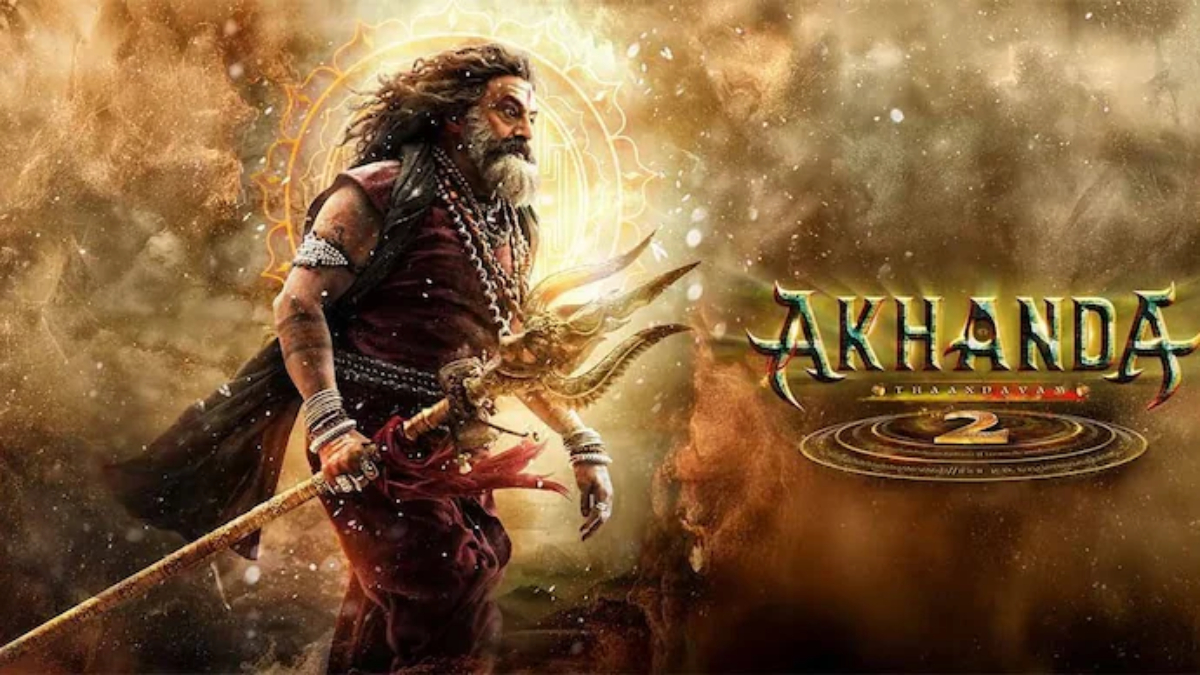
New Delhi, December 13, 2025: Nandamuri Balakrishna’s highly anticipated sequel, Akhanda 2: Thaandavam, has hit the screens, delivering the signature over-the-top action and loud mass moments expected from his collaboration with director Boyapati Sreenu. While the film is a feast for die-hard fans of the duo, critics and general audiences are finding the experience a chaotic, illogical, and overstuffed affair.
The film picks up the baton from its 2021 predecessor, this time pitting the ferocious Aghora, Akhanda, against forces attempting to destabilize India through spiritual and biological warfare. The plot centers on an international conspiracy, led by external forces, that unleashes a bio-virus at the Maha Kumbh Mela, aiming to break the nation’s faith and unity. The re-emergence of Akhanda (Balakrishna in a triple role, including his twin brother Murali Krishna) is the country’s only hope, as he takes on the enemy, single-handedly battling armies, protecting a young DRDO scientist, and delivering fiery monologues on Sanatana Dharma.
A One-Man Show by Balakrishna
Without a doubt, Nandamuri Balakrishna remains the film’s strongest pillar. His commitment to the larger-than-life character of the Aghora is absolute. Whether he is performing gravity-defying stunts—stopping a helicopter blade with a trident, or making dozens of men fly with a single punch—or powerfully delivering his dialogues, his screen presence commands attention. For fans, every one of his appearances is crafted to be a moment of “mass elevation,” successfully eliciting cheers and whistles.
The Spectacle Overwhelms the Substance
However, the general consensus is that the film struggles due to an over-ambitious and underwritten screenplay. Director Boyapati Sreenu elevates the scale significantly, setting scenes in the mystical Himalayan region, but the narrative coherence suffers. The sequel, clocking in at nearly three hours, attempts to blend elements of devotional epic, patriotic thriller, and mass action, resulting in a confusing mix that lacks emotional depth. Critics have pointed out that the sequences feel less like a cohesive story and more like elaborate setups for action blocks that defy all known laws of physics.
The supporting cast, including Samyuktha Menon and Aadhi Pinisetty, is largely underutilized, and the antagonists fail to pose a convincing threat to the invincible hero.
Technical Elements: Loud but Lacking
Another major point of contention is the music. S. Thaman, whose background score was a highlight of the first part, delivers music that is simply too loud and repetitive in the sequel, failing to truly elevate the dramatic moments. While the cinematography attempts to capture the grandeur of the setting, some critics noted that the visual effects often looked subpar.
The Box Office Story
Despite the lukewarm critical response, Akhanda 2: Thaandavam has leveraged the immense star power of the Balakrishna-Boyapati combination. The film has secured a strong opening at the box office, driven by phenomenal performance in the Telugu states and a record-breaking premiere collection in North America. This suggests that for a specific segment of the audience—those seeking pure, unadulterated “mass” entertainment where logic is secondary to heroism—the film is a fulfilling spectacle.
In summary, Akhanda 2: Thaandavam is a pure fan service film. It asks the audience to suspend disbelief entirely and surrender to the high-voltage energy of its star. It may be a noisy, chaotic, and illogical ride, but Balakrishna’s Thaandavam (fierce dance) has still managed to ignite the box office.