

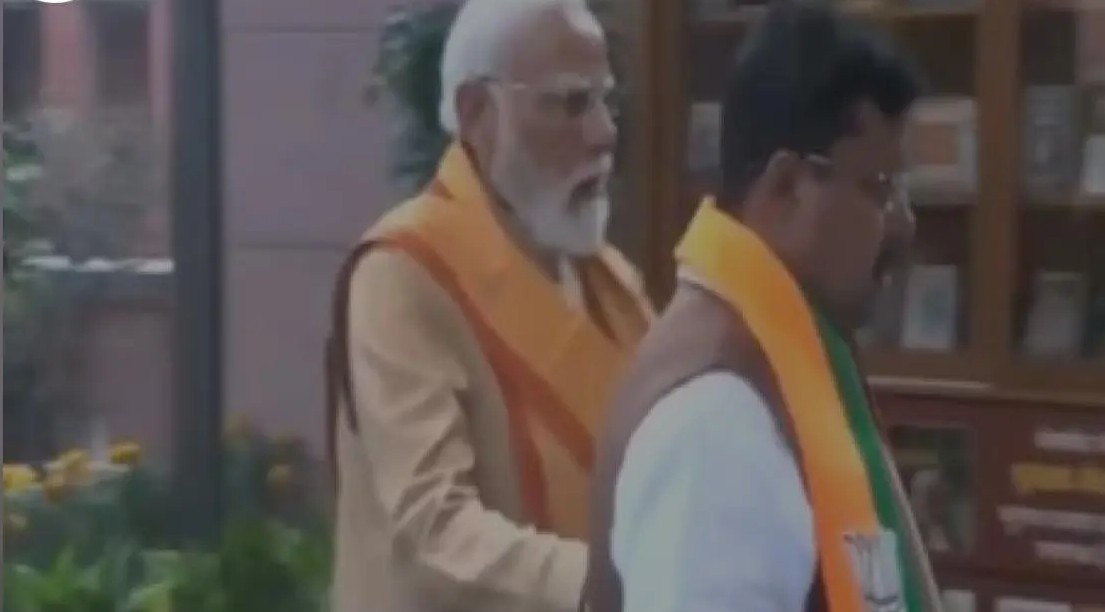
New Delhi, January 21, 2026: A significant wave of social media activity has been triggered by a viral video purportedly showing Prime Minister Narendra Modi “pushing” the newly appointed BJP leader Nitin Nabin. The footage, which began circulating in January 2026, was quickly picked up by various online communities, leading to intense debate regarding the dynamics within the party leadership. It is observed that the short clip was used to suggest a moment of friction or disrespect during a high-profile political gathering. However, as the video gained more traction, a more detailed examination of the event was sought by fact-checkers and political analysts.
The Reality Behind the Clipped Footage
A thorough analysis of the full-length broadcast has revealed that the viral segment was deliberately clipped to create a misleading narrative. It is stated by digital forensic experts that the original context shows a bustling environment where the Prime Minister was simply gesturing or moving through a crowded space. The interaction, when viewed in its entirety, is perceived as a routine moment of coordination during a busy ceremony rather than an act of aggression. The specific seconds used in the viral version were edited to remove the preceding and succeeding frames that provide the necessary context.
Also Read: PSSSB Recruitment 2026: Deadlines Extended for Group C and D Posts
Clarifying the Relationship and Context
The appointment of Nitin Nabin as a significant figure within the BJP hierarchy is viewed as a strategic move, and the relationship between him and the Prime Minister is reported to be one of professional camaraderie. It is argued by party spokespersons that the “push” narrative was manufactured by political opponents to create a sense of internal discord. The event from which the clip was taken was actually a celebratory occasion, where multiple leaders were seen interacting closely. The focus of the meeting was on future organizational goals, and the alleged incident has been described as a non-event by those who were physically present.
The Impact of Misinformation in Politics
The rapid spread of this edited video is being cited as another example of how “cheap fakes” or clipped content can be weaponized in the digital age. It is frequently noted that such videos are designed to trigger emotional responses before the truth can be verified. A call for greater media literacy has been generated among the public, as the viral nature of the clip forced several news outlets to issue formal clarifications. This incident highlights the challenges faced by public figures whose every movement is recorded, slowed down, and potentially misinterpreted by millions of viewers instantly.
Moving Beyond the Viral Rumor
As the debunked version of the video continues to be replaced by the full context online, the focus has shifted back to the political implications of Nitin Nabin’s new role. It is believed that the controversy will eventually subside as the authentic footage reaches a wider audience. The legacy of this viral moment is a reminder of the volatile nature of social media during significant political transitions in 2026. Until more stringent measures against manipulated content are implemented, the responsibility of verification remains with the consumer to prevent unverified rumors from shaping public opinion.