

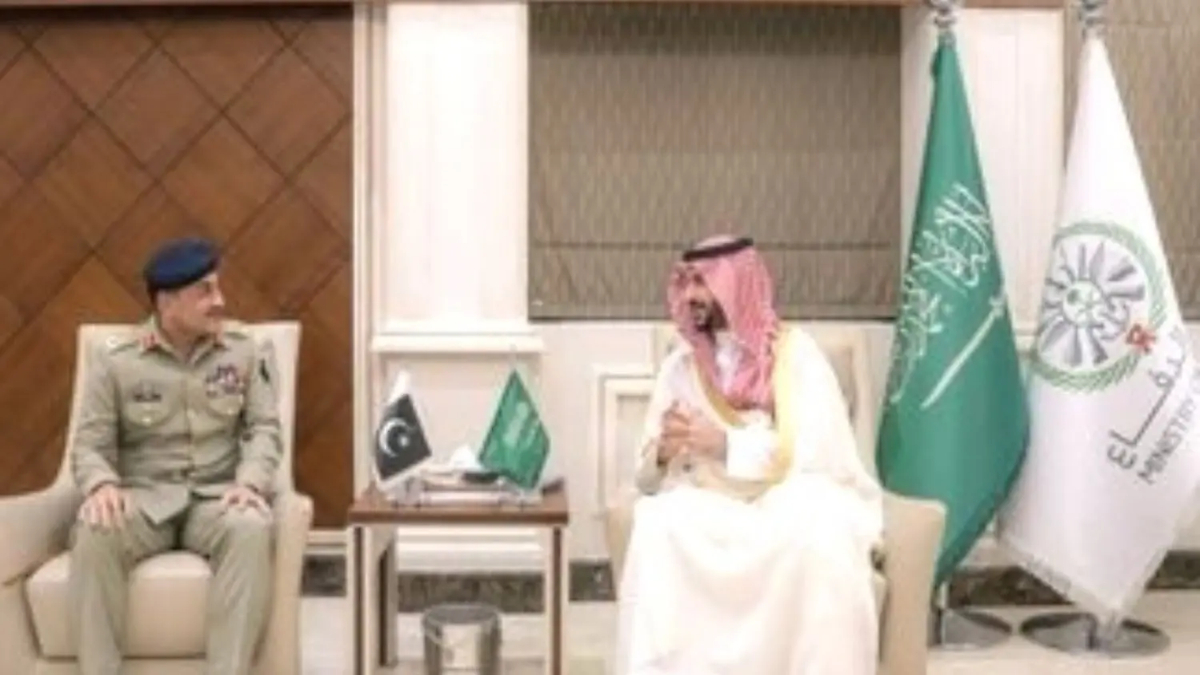
New Delhi, March 7, 2026 — In a move that underscores the rapidly shifting security landscape of the Middle East, Saudi Arabia’s Minister of Defense, Prince Khalid bin Salman, met with Pakistan’s Chief of Army Staff (COAS), Field Marshal Asim Munir, on Saturday. The high-level meeting focused on the recent surge in regional hostilities, specifically addressing Iranian drone and missile attacks that have targeted the Kingdom.
Strengthening the Strategic Mutual Defense Agreement
The discussions held in Riyadh were centered on the Strategic Mutual Defense Agreement (SMDA), a landmark pact signed between the two nations in September 2025. This treaty established a collective security framework, stipulating that any act of aggression against one signatory would be viewed as an attack on both.
During the meeting, Prince Khalid and Field Marshal Munir reviewed the recent security breaches, including successful Saudi interceptions of ballistic missiles and drones aimed at energy infrastructure and military sites, such as the Prince Sultan Air Base and the Shaybah oil field.
In a statement shared on his official X (formerly Twitter) account, Prince Khalid emphasized the need for collective measures to halt these provocations:
“We discussed Iranian attacks on the Kingdom and the measures needed to halt them within the framework of our Joint Strategic Defense Agreement. We stressed that such actions undermine regional security and stability.”
A Warning Against ‘Misguided Calculations’
The meeting served as a platform for Riyadh to issue a direct diplomatic warning to Tehran. Prince Khalid urged the Iranian leadership to prioritize “wisdom and reason” over military escalation. He cautioned that continuing on the current path of retaliatory strikes could lead to “misguided calculations” with devastating consequences for the entire West Asian region.
The warning comes at a critical time. Following recent joint strikes by the U.S. and Israel, Iran has launched hundreds of ballistic missiles and thousands of drones across the Gulf, impacting civilian sites, energy corridors, and U.S. military assets.
Pakistan’s Pivotal Role
For Pakistan, the meeting signals a potential shift from verbal solidarity to more concrete defense cooperation. While Islamabad has historically maintained a “balancing act” between its neighbor Iran and its strategic partner Saudi Arabia, the SMDA has significantly increased its formal obligations to Riyadh.
Field Marshal Asim Munir’s presence in Riyadh highlights the military-to-military depth of this relationship. As a nuclear-armed state, Pakistan’s involvement in the Saudi defense architecture—often referred to by analysts as a burgeoning “Islamic NATO”—is a major factor in the region’s deterrence calculus.
Regional Stability at a Crossroads
The ongoing conflict has already disrupted global energy markets and international travel, with thousands of flights canceled across the Gulf. As Saudi Arabia successfully neutralizes incoming threats using its advanced air defense systems, the collaboration with Pakistan aims to create a unified front to prevent the conflict from spiraling into a full-scale regional war.
Authorities in Riyadh confirmed that while multiple threats were neutralized this week—including drones targeting the U.S. Embassy and oil facilities—the hope remains for a diplomatic resolution. However, the message from the Khalid-Munir meeting is clear: the Saudi-Pakistani alliance is prepared to utilize the full scope of their defense pact to maintain the Kingdom’s sovereignty.