

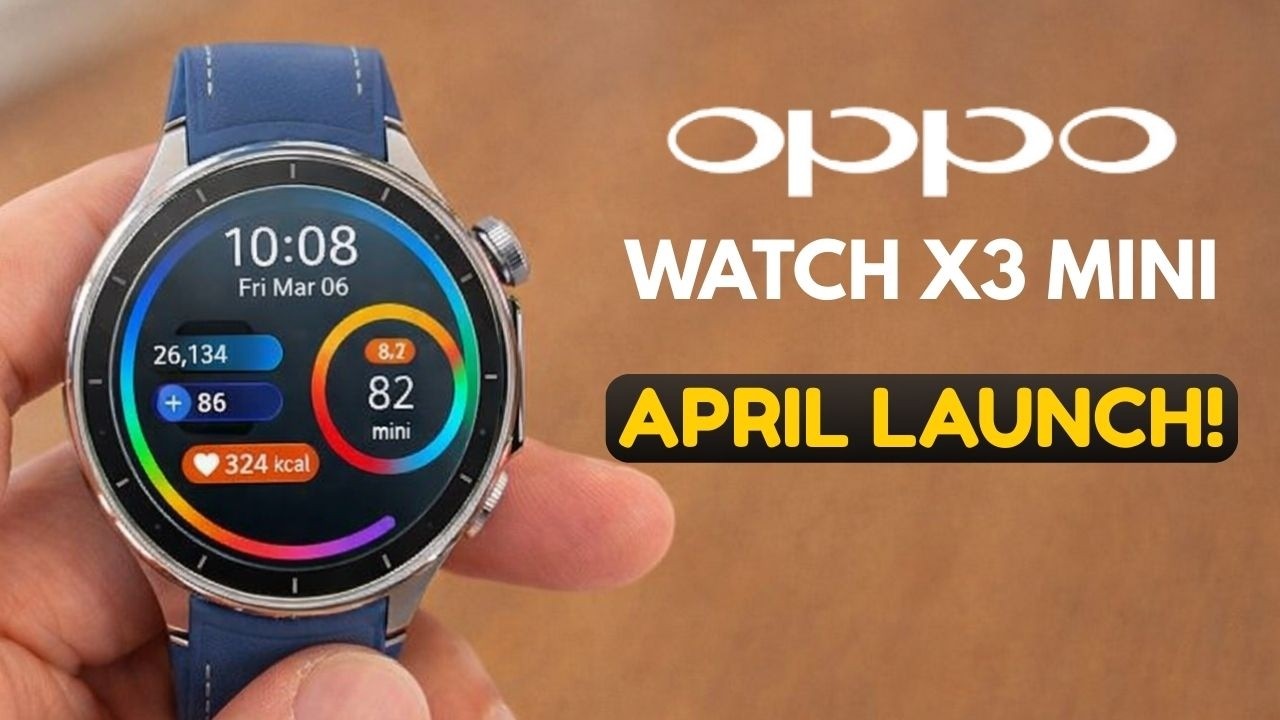
New Delhi, March 26, 2026: Following the official launch of the flagship Oppo Watch X3, the tech world is now buzzing with fresh leaks regarding its more compact sibling: the Oppo Watch X3 Mini. Designed for users who find the standard 47mm model a bit too substantial, the Mini variant aims to pack premium features into a more wrist-friendly form factor.
Here is a comprehensive breakdown of the leaks, design changes, and expected specifications for the upcoming wearable.
Redesigned Aesthetics: The “Mini” Difference
The most striking revelation from the recent leaks, shared by prominent tipsters like Evan Blass, is a subtle but significant design shift in the navigation hardware. While the standard Watch X3 features a flat-topped digital crown, the Watch X3 Mini appears to sport a rounded, tactile crown. This design tweak not only differentiates the two models but also suggests a focus on smoother ergonomics for smaller hands.
Key Design Leaks:
- Case Size: Expected to drop from the standard 47.4mm to a more versatile 43mm case.
- Build Materials: Rumors suggest a silver-finished case (likely aluminum or stainless steel) paired with white fluoroelastomer straps.
- Display: The screen is tipped to be a 1.2 or 1.3-inch AMOLED panel, maintaining the sharp resolution and high brightness levels seen in the larger model.
Expected Specifications and Performance
Despite its smaller footprint, the Watch X3 Mini is expected to share much of the high-performance DNA of the flagship series. It will likely leverage the Qualcomm Snapdragon W5 Gen 1 chipset, ensuring a lag-free experience on the latest version of ColorOS Watch.
| Feature | Expected Specifications |
| Processor | Snapdragon W5 Gen 1 + Dual-Engine Architecture |
| RAM/Storage | 2GB RAM / 32GB Internal Storage |
| Battery | Estimated 500mAh – 600mAh (Optimized for 4-5 days of smart use) |
| Connectivity | eSIM support (LTE), Bluetooth 5.2, Dual-band Wi-Fi |
| Durability | IP68/IP69 Water & Dust Resistance |
Health and Fitness Tracking
The “Mini” branding does not seem to imply a compromise on health tech. Leaked renders and industry reports suggest the device will carry over the advanced sensor suite from the Watch X3, including:
- Cuffless Blood Pressure Monitoring: A standout feature for cardiovascular health tracking.
- ECG & Heart Rate: Continuous monitoring with AFib detection.
- Sleep Analysis: Advanced tracking for sleep stages and snoring patterns.
- Sports Modes: Support for over 100 outdoor and indoor activities, backed by dual-frequency GPS.
Launch Timeline and Expected Pricing
Historically, Oppo has followed its flagship launches with “Mini” versions within a few weeks. With the standard Watch X3 having debuted in mid-March 2026, industry insiders are pointing toward an April 2026 launch for the Watch X3 Mini.
While official pricing remains under wraps, the Mini variant is expected to be positioned as a more affordable entry point into Oppo’s premium wearable ecosystem. Early estimates suggest a price tag roughly 15-20% lower than the standard titanium model, making it a strong competitor for those seeking high-end specs in a compact build.