

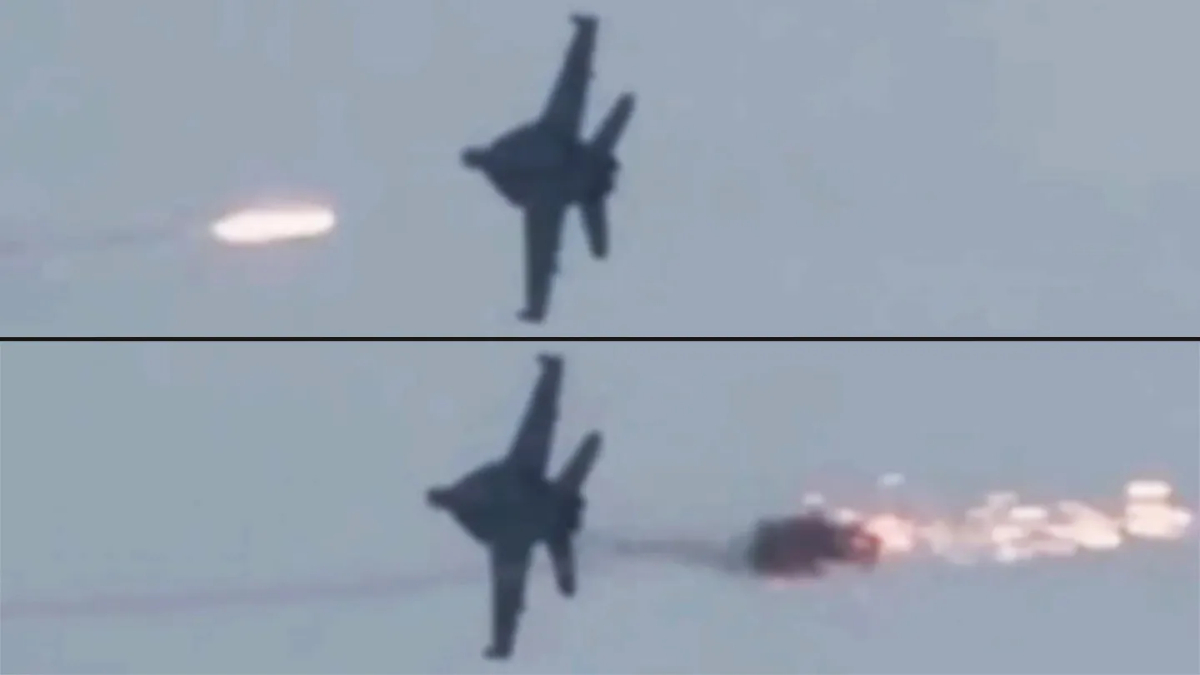
New Delhi, March 27, 2026: The skies over southeastern Iran became a theater of high-stakes brinkmanship this week as dramatic footage emerged showing a U.S. Navy F/A-18E/F Super Hornet narrowly evading a surface-to-air missile. The incident, geolocated to the strategic port city of Chabahar, has ignited a fierce war of words between the Islamic Revolutionary Guard Corps (IRGC) and U.S. Central Command (CENTCOM) amid the ongoing “Operation Epic Fury.”
The Engagement: Precision vs. Proximity
The viral video, captured by observers on the ground, depicts the American strike fighter operating at a remarkably low altitude—a tactic analysts suggest is being used for close-range strafing missions against coastal targets.
In the footage, the distinct “zip” of the jet’s M61A1 Vulcan rotary cannon can be heard just moments before a missile enters the frame. The Super Hornet is seen executing a sharp left-hand bank as a projectile, believed to be a MANPADS (Man-Portable Air-Defense System), streaks toward its tail.
- The Explosion: A massive fireball erupts directly behind the aircraft’s exhaust.
- The Aftermath: While the fireball appeared catastrophic to onlookers, the jet is seen pulling away, seemingly maintaining flight stability and showing no visible signs of structural failure or fire.
Conflicting Narratives: “Shot Down” vs. “Near Miss”
As is common in modern “gray zone” conflicts, both sides have claimed a narrative victory.
The Iranian Claim
The IRGC Public Relations Office was quick to declare the engagement a success. State-affiliated media, including Fars News, reported that the “enemy F-18” was precisely struck by an advanced indigenous air defense system and subsequently crashed into the Indian Ocean. Iranian officials framed the incident as a testament to their “integrated air defense network” and claimed it as one of several strategic U.S. aircraft downed since late February.
The U.S. Response
CENTCOM issued a blunt rebuttal via social media, labeling the Iranian claims as “Fake News.” In an official statement, U.S. authorities clarified:
“No U.S. fighter aircraft have been shot down by Iran.”
While the Pentagon has not denied that a missile was fired or that it exploded in close proximity, military analysts note that the elongated shape of the flame in the video suggests a proximity fuse detonation or a strike on a towed decoy, rather than a direct hit on the airframe.
Analysis: Why the Low Altitude?
The presence of F/A-18s at such low altitudes over Chabahar marks a significant shift in U.S. tactics. Earlier in the conflict, most strikes were conducted using stand-off munitions from high altitudes.
The move to “low and slow” operations suggests that U.S. intelligence believes Iranian long-range radar and heavy S-300/S-400 systems have been sufficiently degraded in the coastal regions. However, as this “near miss” demonstrates, the threat from shoulder-fired MANPADS remains a “persistent and lethal” danger to pilots operating in the littoral zones near the Pakistan border.
Regional Tensions at a Boiling Point
This aerial skirmish comes at a time of extreme volatility in the region. With the Strait of Hormuz effectively restricted and U.S. reinforcements—including the USS Tripoli and the 82nd Airborne—moving toward the theater, every tactical engagement carries the weight of potential escalation.
While the Super Hornet involved in the Chabahar incident appears to have returned to its carrier, the footage serves as a stark reminder of the razor-thin margins between a successful mission and a regional catastrophe.