

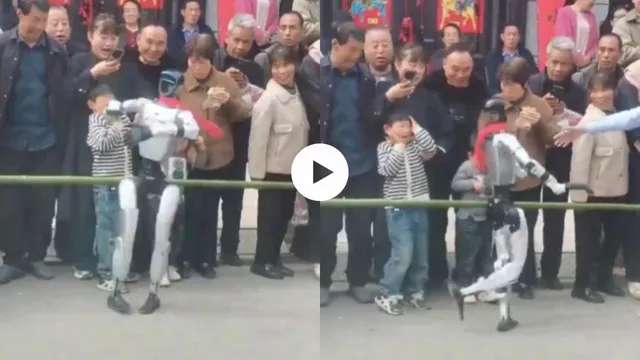
New Delhi, March 30, 2026: A startling video featuring a humanoid robot striking a young child during a public performance has ignited a massive debate over the safety of autonomous machinery in crowded spaces. The footage, which began trending on March 29, 2026, captures a promotional event at a high-tech shopping mall where a “dancing robot” was being showcased to entertain visitors. In the clip, the robot is seen performing a series of rapid arm movements when a young boy, who had wandered too close to the performance perimeter, was accidentally struck across the face by the robot’s metallic limb.
The “truth” behind the viral sensation lies in a technical glitch involving the robot’s spatial awareness sensors. It was clarified by the engineering firm responsible for the machine that the “slap” was not an intentional act of aggression but a failure of the obstacle-detection system. Because the child entered the robot’s “swing zone” faster than the internal processors could recalibrate, the pre-programmed dance routine continued uninterrupted. This mechanical oversight has been described by tech analysts as a “catastrophic failure of proximity logic.”
Panic and Immediate Response at the Public Show
The impact of the strike caused the young child to fall backward, leading to an immediate outcry from the surrounding crowd. It is observed in the video that the robot continued its upbeat dance routine for several seconds even as the boy’s parents rushed to his aid. The juxtaposition of the robot’s “cheerful” programmed movements and the child’s distress has been highlighted by netizens as a chilling reminder of the lack of empathy in artificial intelligence. Fortunately, it was reported by the mall management that the child sustained only minor bruising and was given immediate medical attention on-site.
The reaction from the digital community has been a mixture of humor and genuine concern for the future of public robotics. While some social media users created memes about the “beginning of the robot uprising,” many others raised serious questions regarding the legal liability of tech companies when autonomous units cause physical harm. The passive reception of the robot’s movements by its handlers, who were reportedly slow to hit the “emergency stop” button, has also been a major point of criticism in the viral comments.
Also Read: Yo Yo Honey Singh Mumbai Concert: Fan Clashes with Security
Strengthening Safety Protocols for Public Robotics
Following the incident, the promotional show was immediately suspended, and the robot was removed from the public floor for a comprehensive diagnostic review. It is reported that new safety guidelines are being drafted by local municipal authorities to ensure that all “public-facing” robots are equipped with physical kill-switches and a minimum safety buffer of at least five feet. This “Robot Slap” incident is being viewed by the industry as a turning point for the implementation of stricter “Human-Robot Interaction” (HRI) standards in the retail sector.
As of March 30, 2026, the video remains a top trending topic globally, serving as a cautionary tale for families attending high-tech exhibitions. While the “slap” was a result of a coding error, the psychological impact on the young witness has sparked a wider conversation about the “uncanny valley” and the dangers of treating complex machinery as harmless toys. For now, the dancing robot remains grounded, waiting for a software update that can truly distinguish between a dance floor and a human being.