

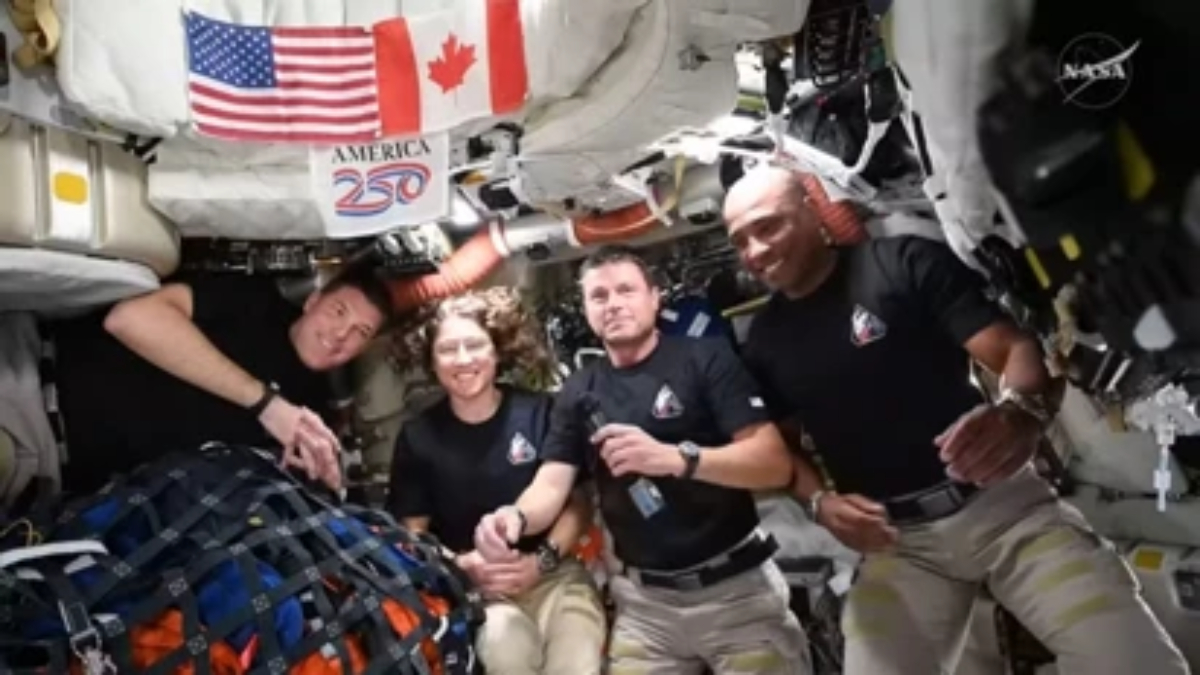
New Delhi, April 10, 2026 — For the first time in over five decades, a human-crewed spacecraft is returning from the lunar vicinity to Earth. After a spectacular 10-day journey that pushed the boundaries of modern space exploration, the Artemis II Orion capsule, aptly named Integrity, is hurtling toward a scheduled splashdown in the Pacific Ocean today, April 10, 2026.
The mission, which launched on April 1, has successfully validated the systems intended to return humanity to the Moon’s surface. Now, the four-person crew—NASA astronauts Reid Wiseman, Victor Glover, and Christina Koch, alongside Canadian Space Agency astronaut Jeremy Hansen—is preparing for the most harrowing phase of their journey: re-entry.
A Record-Breaking Voyage
The Artemis II mission was not merely a lap around the Moon; it was a record-setting odyssey. On April 6, the crew reached a distance of 252,760 miles from Earth, surpassing the previous human distance record set by the Apollo 13 crew in 1970.
Beyond the numbers, the crew shared profound moments with the world:
- The Lunar Far Side: High-resolution footage captured the cratered, rugged terrain of the Moon’s hidden face.
- A Solar Eclipse from Deep Space: The crew witnessed a rare celestial alignment as the Moon eclipsed the Sun from their unique vantage point.
- A Personal Tribute: Commander Reid Wiseman touchingly named a lunar crater after his late wife, Carroll, during the flyby.
The Final Descent: Into the Fire
Returning to Earth is a violent and precise physics-based dance. As Orion nears the atmosphere, it will be traveling at approximately 23,864 mph. At around 7:53 p.m. EDT, the spacecraft will hit the upper layers of the atmosphere, creating a superheated plasma field that will reach temperatures of 5,000°F (2,760°C).
This phase triggers a planned six-minute communications blackout. During this time, the Orion heat shield—the largest of its kind ever built—will protect the astronauts while the craft’s “lofted entry” maneuver skips it across the atmosphere like a stone on water to manage heat and G-forces.
Splashdown Milestones (All times in EDT):
| Milestone | Scheduled Time | Altitude |
| Atmospheric Entry | 7:53 p.m. | 400,000 ft |
| Drogue Parachutes | 8:03 p.m. | 22,000 ft |
| Main Parachutes | 8:04 p.m. | 6,000 ft |
| Splashdown | 8:07 p.m. | Sea Level |
Recovery and Next Steps
Waiting off the coast of San Diego is the USS John P. Murtha, a Navy transport dock ship equipped with a specialized recovery cradle. Once the capsule bobs in the Pacific, Navy divers and NASA recovery teams will secure the craft and extract the astronauts via helicopter.
The success of Artemis II is the final “green light” for Artemis III, the mission currently slated for 2028 that intends to land the first woman and the first person of color on the lunar South Pole.
“I just had an overwhelming sense of being moved by looking at the moon,” remarked Christina Koch during a final transmission. “But seeing that ‘Blue Marble’ grow larger in the window reminds us exactly why we do this—for everyone back home.”
As the world watches the Pacific horizon, the successful return of the Artemis II crew marks the end of a test flight and the beginning of a permanent human presence in deep space.