

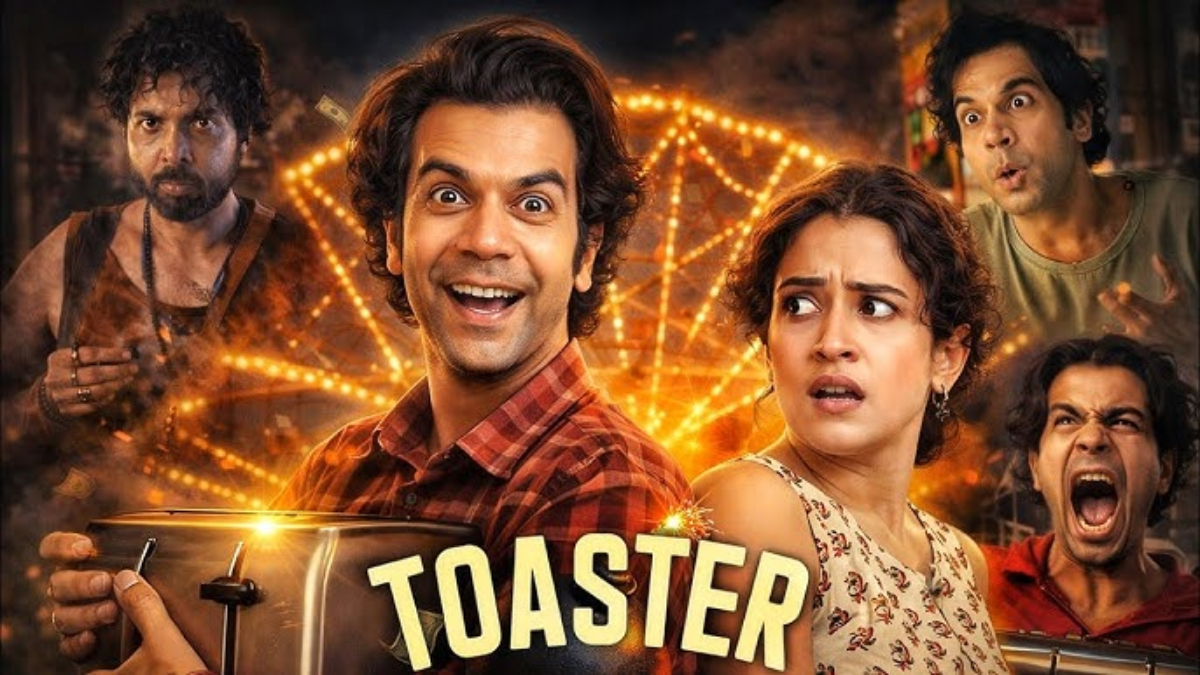
April 15, 2026 — In the landscape of modern Hindi cinema, few actors possess the “everyman” flexibility of Rajkummar Rao. He has consistently turned mundane middle-class struggles into cinematic gold, whether he was navigating election duty in Newton or battling supernatural tailors in Stree. However, his latest outing, Toaster, which premiered today on Netflix, puts that very reputation to the ultimate test. While Rao delivers a performance that is nothing short of heroic, he is tasked with carrying a narrative that feels increasingly like a “laborious” dark comedy—one that starts with a crisp, buttery premise but eventually leaves the audience with the bitter taste of something overdone.
Produced under Rao and wife Patralekhaa’s new banner, KAMPA Films, and directed by Vivek Daschaudhary, Toaster aims to be a sharp, satirical thriller. Instead, it oscillates between being a witty character study and a chaotic, logic-defying muddle that even an actor of Rao’s caliber struggles to keep afloat.
The Premise: A ₹5,000 Obsession
The story centers on Ramakant (Rajkummar Rao), a man whose frugality isn’t just a habit—it’s a religion. He keeps a ledger of every penny spent, a trait that makes him both a relatable middle-class figure and a deeply irritating neighbor. The inciting incident is as domestic as it gets: Ramakant and his wife, Shilpa (Sanya Malhotra), gift a high-end, ₹5,000 toaster to a couple at a wedding.
When the wedding is abruptly called off the very next day, Ramakant’s “kanjoos” (miserly) instincts kick into overdrive. He doesn’t just want the toaster back; he needs it back to get a refund. What follows is a “MacGuffin” style chase where the appliance becomes the center of a dizzying web involving a murder, a politician’s secret, and a series of increasingly bizarre cover-ups.
Rao’s Masterclass in a Mid-Tier Script
If there is one reason to sit through the two-hour runtime of Toaster, it is Rajkummar Rao. Playing a miser is a tightrope walk; go too far, and the character becomes a caricature. Rao, however, finds the humanity in Ramakant’s stinginess. His timing with one-liners is impeccable, and his facial expressions when he realizes he might lose his precious ₹5,000 are genuinely hilarious.
He is the anchor of the film, providing a sense of grounded realism even as the plot spirals into absurdity. It is a testament to his skill that you find yourself rooting for a man who would arguably charge his own mother for a glass of water.
A Supporting Cast Underutilized
Despite the star-studded ensemble, the supporting characters feel like wasted ingredients:
- Sanya Malhotra: As Shilpa, Malhotra is graceful and competent, but the script gives her very little to do other than look bewildered by her husband’s antics. After her stellar work in Mrs. Chatterjee vs Norway and Kathal, seeing her relegated to a “confused wife” role feels like a step backward.
- Abhishek Banerjee: Making a cameo appearance, Banerjee brings his signature energy, but his character lacks the depth required to make a lasting impact.
- Archana Puran Singh: Cast in a role she described as the “best of her career,” Singh plays a seductive, blackmailing neighbor. While she leans into the absurdity, the character’s subplots often feel disconnected from the main narrative, and the humor frequently dips into “below-the-belt” territory that feels dated.
- Seema Pahwa & Upendra Limaye: Both veterans provide moments of stability, but they are eventually drowned out by a screenplay that prioritizes chaos over character development.
The Script: When Dark Comedy Goes Dim
The primary issue with Toaster lies in its execution. Written by Akshat Ghildial (of Badhaai Ho fame) along with Parveez Shaikh and Anagh Mukherjee, the film starts strong. The first 45 minutes are a delightful exploration of middle-class quirks and the specific brand of Indian “frugality” that feels authentic.
However, the second half is where the bread begins to burn. The transition from a domestic comedy to a high-stakes murder mystery is jarring. The film attempts to juggle:
- A Murder Mystery: A body in a landlady’s house.
- Political Espionage: A secret hidden inside the toaster.
- Blackmail: Multiple characters turning on each other.
By trying to be everything at once, Toaster becomes nothing in particular. The logic begins to leak, and the “dark” elements feel forced rather than organic. One particular sequence involving Farah Khan in a cameo feels particularly out of place, serving more as a distraction than a plot device.
Production and Direction
Directing a dark comedy requires a surgical precision in tone—think Andhadhun or Rao’s own Monica, O My Darling. Vivek Daschaudhary, making his mark here, shows promise in visual storytelling, but he fails to maintain the “simmer.” The pacing drags significantly in the middle, and the climax is so chaotic that it loses the satirical edge the film was clearly aiming for.
On the production side, Rao and Patralekhaa have clearly put their hearts into their debut venture. The film looks good; the suburban Mumbai setting feels lived-in and real. But as the old saying goes, “You can’t save a bad meal with expensive plates.”
The Verdict
” Toaster is like a breakfast that looked great on the menu but arrived burnt at the edges. It’s a film that relies entirely on Rajkummar Rao’s ability to turn lead into gold, and while he glimmers, the weight of the ‘laborious’ script eventually pulls the whole project down.”
The film serves as a cautionary tale for the “quirky thriller” genre. Having a “weird” central object—like a toaster—isn’t enough if the stakes don’t feel earned. For fans of Rao, it’s a must-watch simply to see him work his magic. For everyone else, it’s a hit-or-miss affair that might leave you wishing you’d just stayed in and made some actual toast instead.