

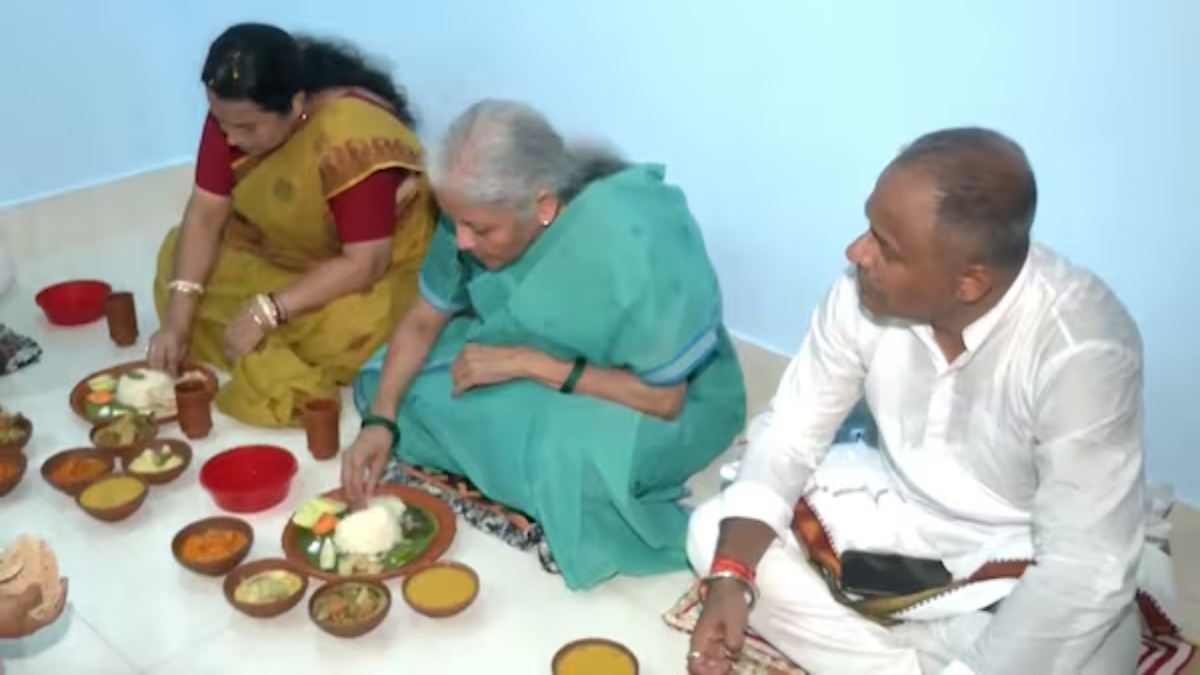
New Delhi, April 16, 2026– In a move that blended high-stakes political campaigning with grassroots personal connection, Union Finance Minister Nirmala Sitharaman shared a traditional meal at the modest home of Sukumar Haldhar, a local Tant weaver, in West Bengal’s Purba Bardhaman district on Wednesday.
The visit, occurring in the heat of the 2026 West Bengal Assembly election campaign, was more than just a photo opportunity; it served as a poignant backdrop for the Finance Minister to address the grievances of a community that has long been the cultural and economic backbone of the region.
A Meal of Simplicity and Connection
Away from the grand stages of political rallies, the scene at Sukumar Haldhar’s residence was one of quiet dignity. Sitting on the floor in the traditional Indian style, Sitharaman was served a simple, home-cooked Bengali meal. The gesture was a stark contrast to the usual security-heavy movements of a Union Minister, signaling an attempt to bridge the gap between New Delhi’s policy-making and the reality of the rural artisan.
Haldhar, whose family has been involved in the intricate art of Tant weaving for generations, shared the struggles of maintaining a craft that is currently under siege from rising raw material costs and competition from powerlooms. For the weaver’s family, the visit was a rare moment of recognition for their labor-intensive craft.
Empowering the Loom: The Distribution of Weaver Cards
The visit wasn’t merely symbolic. During her time in Purba Bardhaman and Serampore, the Finance Minister distributed “Pehchan” (Identity) Weaver Cards to several handloom workers. These cards are critical identity documents issued by the Union Ministry of Textiles, designed to act as a gateway to several central benefits, including:
- Financial Assistance: Concessional loans under the MUDRA scheme.
- Subsidies: Direct access to subsidies for purchasing yarn and raw materials.
- Social Security: Enrollment in insurance and health schemes specifically tailored for artisans.
“These cards are not just pieces of paper; they are a recognition of your skill and a guarantee of the Prime Minister’s support,” Sitharaman told a gathering of weavers at a conference in Kalna.
A Sharp Political Edge: “Syndicate Raj” vs. Development
While the meal was a moment of soft diplomacy, Sitharaman’s subsequent address at the BJP’s handloom and weaver cell conference was anything but soft. She launched a scathing attack on the Trinamool Congress (TMC) government, accusing them of “deliberate obstruction” of central welfare schemes.
The Finance Minister alleged that the people of West Bengal, particularly the artisan and labor classes, have been deprived of life-changing programs like Ayushman Bharat (healthcare) and PM Kisan (direct income support for farmers).
“The money is ready in Delhi. The Prime Minister wants to send it directly to your bank accounts, but the state government stands as a wall in between. They want you to depend on their ‘syndicate raj’ rather than becoming ‘Atmanirbhar’ (self-reliant),” she asserted.
Sitharaman highlighted that the handloom sector in Bengal has seen a 60% reduction in active looms and a 50% drop in daily earnings over the last decade. She blamed this decline on a lack of state support and the unregulated influx of cheap imports, promising that a BJP-led government would prioritize the “Pradhan Mantri Vishwakarma Yojana” to revitalize traditional trades.
The Controversy: TMC Files Complaint with Election Commission
The Finance Minister’s outreach has not gone without friction. The TMC was quick to react, with MP Kalyan Banerjee filing a formal complaint with the Election Commission (EC). The ruling state party alleged that the distribution of weaver cards during the election campaign constituted a “direct inducement” to voters and a violation of the Model Code of Conduct (MCC).
Chief Minister Mamata Banerjee also issued a sharp rebuke, questioning the timing of the benefits. “Why are these cards being distributed now, just days before the polls? It is a clear attempt to influence the free exercise of electoral rights,” she said during a rally.
In response, the BJP dismissed the allegations, stating that the Pehchan Card scheme is an ongoing national project and that the government is merely performing its duty to ensure artisans are documented and supported.
The Economic Stakes for the Weaver Community
The Purba Bardhaman region, particularly the Kalna and Shantipur belts, is world-renowned for its “Tant” sarees—lightweight cotton garments known for their transparency and comfort. However, the industry is currently facing a “triple threat”:
- Raw Material Inflation: The price of high-quality cotton yarn has fluctuated wildly, eating into the weavers’ slim margins.
- Powerloom Competition: Industrial machines can produce look-alike sarees at a fraction of the cost and time.
- Logistical Gaps: A lack of direct-to-consumer digital platforms means weavers often rely on middlemen (Mahajans) who take the lion’s share of the profit.
Sitharaman’s visit sought to reassure the 3.7 lakh people involved in Bengal’s handloom industry that their craft would be treated as an “asset to be incentivized” rather than a dying relic.
Looking Ahead to the 2026 Polls
As West Bengal prepares for its two-phase elections on April 23 and April 29, the battle for the “artisan vote” is intensifying. By sharing a meal with Sukumar Haldhar, Nirmala Sitharaman has sent a clear message: the BJP intends to fight the TMC not just on high-level economic data, but at the kitchen tables of the state’s most humble citizens.
Whether the promise of “Double Engine Growth” and direct central benefits will resonate more with the weavers than the TMC’s existing state welfare programs remains the million-dollar question. For now, the image of the Finance Minister at a weaver’s loom remains one of the most defining moments of this election cycle—a blend of culture, cuisine, and intense political competition.
Quick Highlights:
- Who: FM Nirmala Sitharaman and Weaver Sukumar Haldhar.
- Where: Purba Bardhaman, West Bengal.
- What: A traditional meal and distribution of Weaver Pehchan Cards.
- The Conflict: TMC has moved the Election Commission over alleged MCC violations.
- The Goal: To win over the 3.7 lakh-strong handloom community ahead of the April 23 polls.