

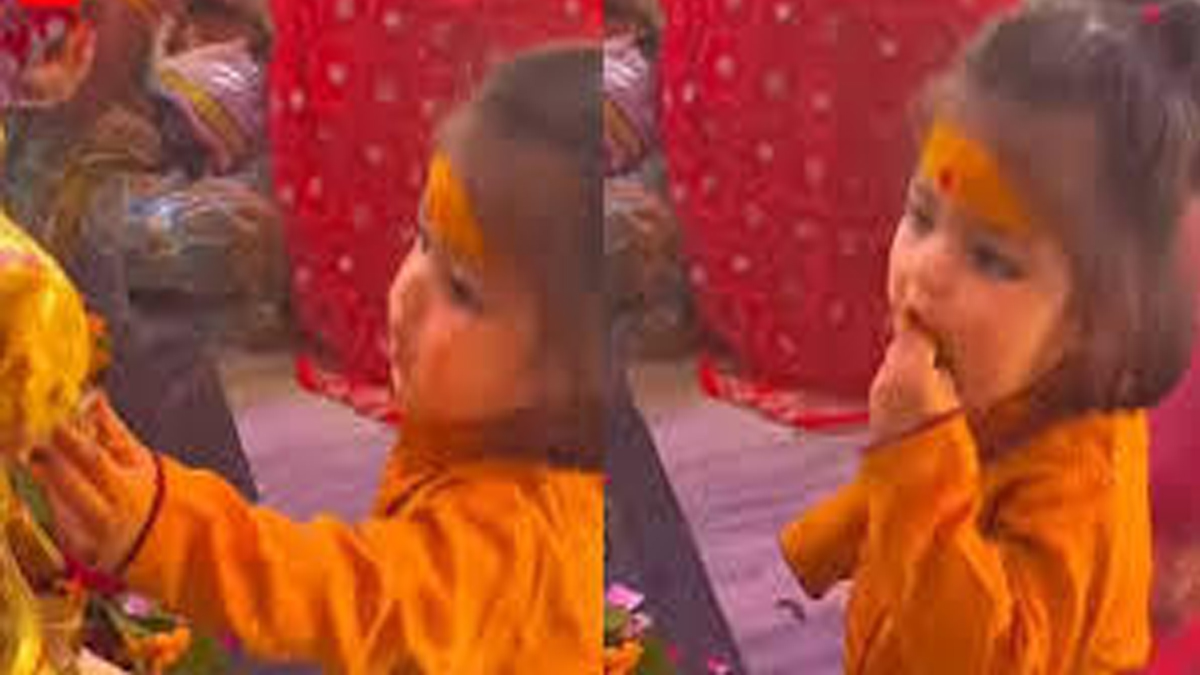
New Delhi, April 18, 2026: In a video that has gone viral across social media platforms today, April 18, 2026, a toddler’s candid interaction with a temple offering has left millions smiling, proving once again that sometimes, the most profound moments of joy require nothing more than a child’s unfiltered honesty.
The Moment That Stole the Internet
The clip, which has rapidly circulated across X (formerly Twitter), Instagram, and Facebook, takes place inside a serene temple setting. The scene begins innocuously: a mother is seen performing pooja, or traditional prayers, alongside her young son. As is customary in many Hindu traditions, she places a small offering of food—likely prasad—near the statue of Nandi, the sacred bull deity.
What happens next has melted the hearts of viewers worldwide. Oblivious to the sanctity of the ritual or the social etiquette of leaving offerings untouched, the little boy looks at the food, looks at the Nandi statue, and—driven by pure, unadulterated hunger—reaches out to take the treat for himself.
The mother, realizing what is happening, can be seen suppressing a laugh as the boy proceeds to enjoy the offering. The video was shared online with the charmingly relatable caption: “Sorry Nandi Baba, I am also hungry.”
Why This Video Resonates
In the hours since the video was uploaded, it has garnered an outpouring of affection. The comment sections are filled with users noting that this is perhaps the most “human” moment of devotion they have seen in a long time.
“Nandi Baba would surely be the first to smile at this,” one user commented, echoing the sentiment of thousands. “He understands the hunger of a child better than anyone.”
Social media analysts suggest that the immense popularity of this clip stems from a universal need for “wholesome content.” In an era where digital feeds are dominated by heavy political discourse, economic updates, and complex societal issues, videos like this offer a rare form of psychological relief. They remind viewers of a time in their own lives—or a version of the world—where things were simple, transparent, and driven by basic needs rather than complex agendas.
Also Read: The Ashok Kharat Scandal: Nashik ‘Godman’ Case Shakes Maharashtra
The Cultural Context of Innocence
The act, while technically a disruption of a ritual, is being viewed not as a transgression, but as a testament to the beautiful, uncomplicated nature of childhood. In Hindu tradition, children are often viewed as roop (forms) of the divine. The idea that a child can “share” a meal with a deity without the complex barriers of adult reverence is a concept that has resonated deeply with the Indian public and a global audience alike.
It contrasts sharply with recent debates surrounding the sanctity of religious rituals. While other viral videos this year have focused on the wastage of food during Kanya Pujan or criticized the commercialization of religious festivals, this specific incident stands out because of the child’s lack of agenda. He isn’t seeking attention or performing a role; he is simply hungry, and he sees food.
The “Feel-Good” Phenomenon
Experts often point to the “halo effect” of such videos. We see a child, we see vulnerability, and we are hardwired to protect and cherish that. When a child behaves with such stark honesty in a setting that usually demands decorum, it breaks the tension of the environment.
This incident joins a growing list of “temple-innocence” videos that circulate annually—toddlers ringing bells, mimicking their parents’ chanting, or, in this case, deciding that the deity’s offering looks too delicious to pass up. These clips serve as a gentle reminder that for many, faith is not just about rigid rules and ancient texts; it is a living, breathing part of daily life that evolves alongside us, from the smallest among us to the eldest.
A Reminder to Smile
As the video continues to make rounds, it serves as an unintended, but welcome, pause button on the frenetic pace of 2026. Whether it is a nudge to be more patient with the children in our lives, or a reminder that even our most sacred traditions are meant to be filled with love and warmth rather than fear and strictness, the message is clear.
In the end, the little boy’s “theft” of the offering wasn’t a crime—it was a lesson. It reminded us that sometimes, the most profound way to honor the divine is to simply be our authentic, hungry, and honest selves.