

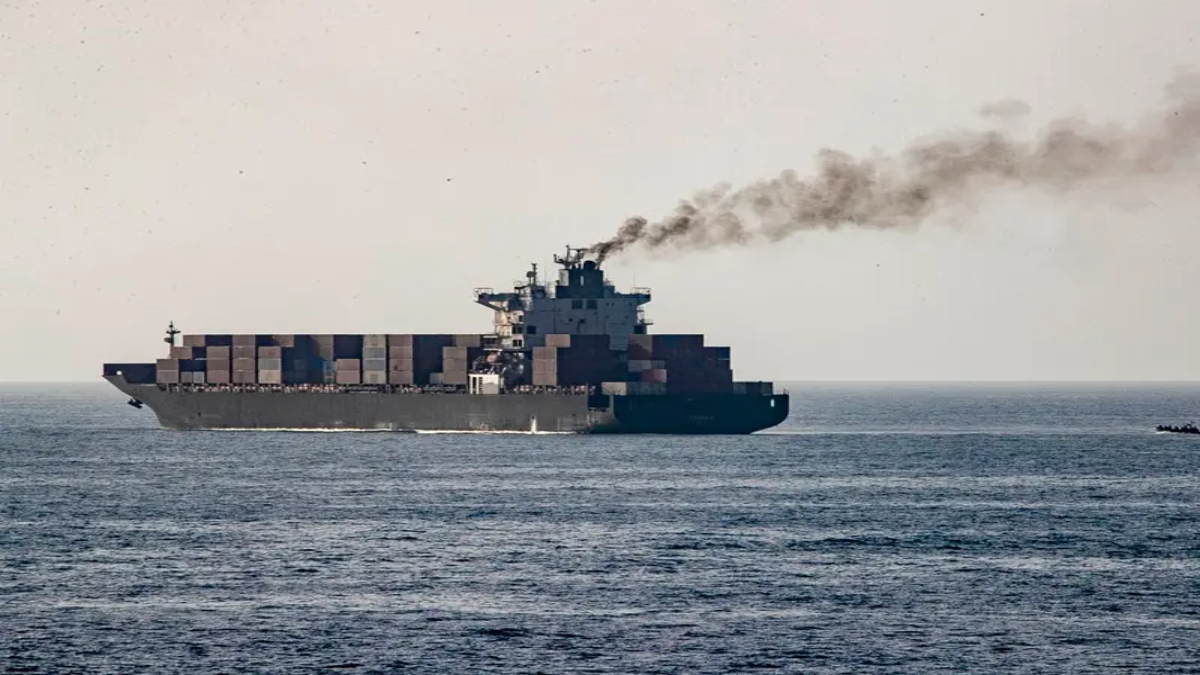
April 22, 2026: The fragile hope for a de-escalation in the West Asian conflict was shattered early Wednesday morning as reports emerged that the Islamic Revolutionary Guard Corps (IRGC) attacked a container ship in the Strait of Hormuz. The incident, which occurred just hours after U.S. President Donald Trump announced an indefinite extension of the ceasefire with Iran, underscores the deepening volatility of the region and the precarious nature of current diplomatic efforts.
According to the British military’s United Kingdom Maritime Trade Operations (UKMTO) center, the attack took place around 7:55 a.m. local time. Gunboats belonging to the IRGC targeted the vessel without prior warning as it transited the vital maritime chokepoint. While the UKMTO confirmed that the ship sustained damage, initial reports indicate no injuries among the crew and no significant environmental damage.
The attack marks a stark turn of events, occurring on the same day that the international community—and indeed, global markets—had begun to recalibrate expectations following President Trump’s surprise announcement on Tuesday.
The Ceasefire Paradox
President Trump’s declaration on April 21 to extend the ceasefire—which had been set to expire—was framed by the White House as a unilateral gesture intended to provide a window for “a unified proposal” from Tehran. The ceasefire, originally brokered earlier this month through mediation by Pakistan, had been heralded as a potential turning point in a conflict that has rattled energy markets and displaced millions.
However, the ceasefire appears to be a ceasefire in name only. Despite the diplomatic overtures, the United States has maintained its stringent blockade of Iranian ports, a move Tehran has cited as an intolerable provocation. The juxtaposition of the President’s calm rhetoric in Washington and the IRGC’s aggressive posture at sea highlights a fundamental disconnect between the diplomatic goals being pursued and the military realities on the ground.
Iranian officials have yet to issue a formal comment regarding the specific attack on the container ship. However, the move is widely seen as a direct rebuttal to the ongoing U.S. naval blockade. Hardline factions within the Iranian leadership, emboldened by recent rhetoric, appear determined to demonstrate that they will not adhere to a ceasefire that leaves their economic lifeline—their ports—severed by the U.S. military.
Also Read: Suzuki Avenis Special Edition Gets a Vibrant Refresh: New Dual-Tone Colour Launched
A Chokepoint in Crisis
The Strait of Hormuz remains the world’s most critical maritime energy chokepoint. The recent instability has turned the waterway into a theater of high-stakes brinkmanship. For global supply chains, the reopening of the strait is not merely a diplomatic preference but an economic necessity.
The brief closure of the strait earlier this month sent shockwaves through global energy markets, with Brent crude prices fluctuating wildly in response to every headline. While prices had eased slightly on Tuesday following the news of the ceasefire extension, the attack on Wednesday morning has reignited fears of a supply crunch.
The situation is further complicated by the fact that India and other major economies heavily reliant on energy imports from the region are monitoring the situation with increasing alarm. Defence Minister Rajnath Singh, speaking from Germany, noted that disruptions in the Strait are “not distant events” but “stark realities” that directly impact national security and economic stability.
The Diplomatic Deadlock
The failure of the ceasefire to produce tangible security at sea points to the limitations of the current negotiation framework. While Pakistan continues to facilitate logistical preparations for peace talks in Islamabad, the path forward remains murky.
Analysts suggest that the core issue is a lack of alignment on the fundamental terms of engagement. The United States demands a comprehensive agreement that includes nuclear constraints and regional stability guarantees, whereas Tehran continues to prioritize the lifting of the blockade and the cessation of regional hostilities.
With the Trump administration signaling that it is seeking a deal arguably more stringent than the 2015 agreement, and with factions within Iran divided over the utility of compromise, the mediation process has become a battle of attrition. The fact that the ceasefire talks in Pakistan failed to materialize on schedule this week suggests that neither side is currently willing to make the necessary concessions to move from a temporary truce to a sustainable peace.
An Uncertain Horizon
As Wednesday unfolded, the mood in the Middle East remained tense. Reports from Tehran suggested that hardliners were organizing rallies, with footage even showing ballistic missile launchers being displayed, a defiant signal to Washington and its allies.
For the shipping industry, the message from the Strait is clear: transit remains a high-risk endeavor. Shipping companies are now caught in the crossfire of a geopolitical struggle, forced to weigh the risks of transit against the astronomical costs of rerouting or waiting for safer conditions.
As the international community looks to Washington and Tehran for a resolution, the events of this morning serve as a sobering reminder of how quickly diplomatic progress can be undone by military action. Whether the ceasefire can survive this latest incident, or whether the region is sliding back into full-scale conflict, remains the pressing question of the day.
With the U.S. blockade holding firm and Iran’s revolutionary guard showing no signs of backing down from its “strict management” of the waterway, the coming days will be critical. Global leaders are expected to renew their calls for restraint, but as it stands, the diplomatic machinery is struggling to keep pace with the volatile reality at sea.