

In the age of hyper-connected social media, the distance between a heartwarming celebrity gesture and an international PR firestorm is often just a single, well-timed photograph. Recently, Rihanna—global pop icon, billionaire entrepreneur, and perennial fashion trendsetter—found herself at the center of such a whirlwind during her high-profile visit to Mumbai, India. What was intended to be a wholesome cultural moment at the residence of the Ambani family quickly spiraled into a heated digital debate about irony, luxury fashion, and the ethics of animal consumption.
The Scene in Mumbai
Rihanna’s visit to India was primarily centered around the exciting launch of her beauty brand, Fenty Beauty, in the country. As one of the world’s most influential celebrities, her presence at the Ambani residence, Antilia, was a major social event. During her stay, she participated in a variety of traditional Indian rituals. Videos and photos from the event captured the star engaging in cultural activities—performing aarti (a traditional prayer ritual), dancing, and embracing the warmth of the Ambani family’s hospitality.
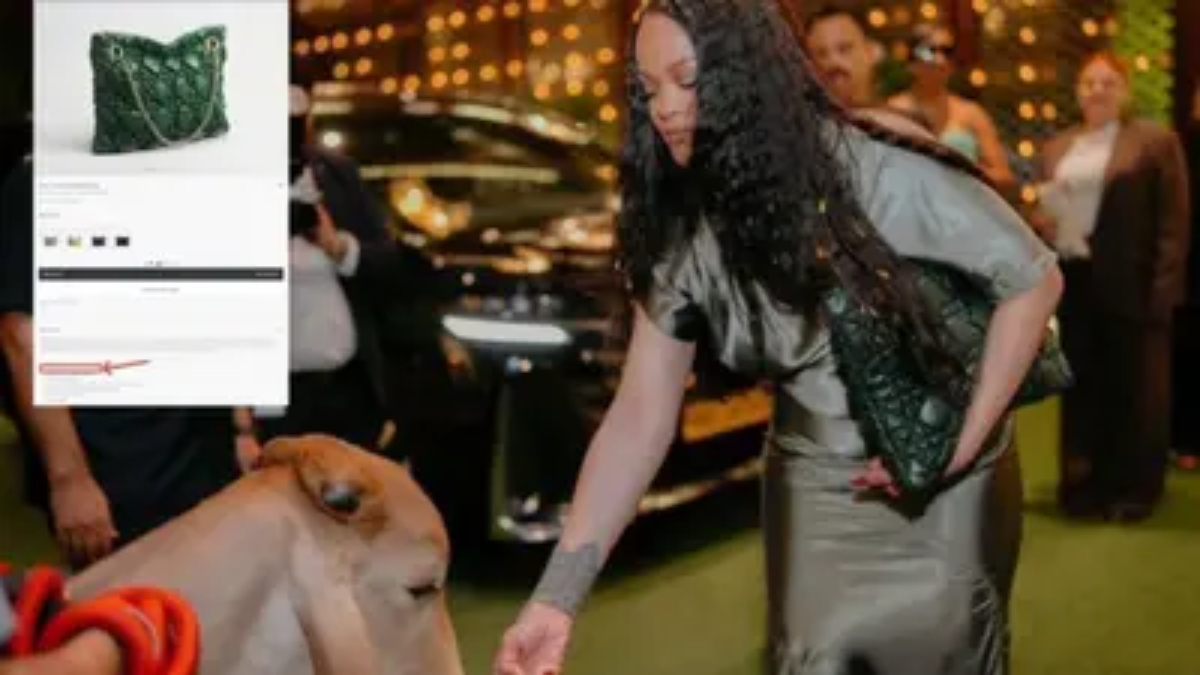
However, among these celebratory clips, one specific moment went viral for all the wrong reasons. A video showed Rihanna gently feeding a calf, a gesture that in many contexts would be seen as soft, nurturing, and respectful of local customs. But, eagle-eyed internet observers immediately shifted their focus from the act itself to the accessory Rihanna was carrying: a luxurious dark green Dior handbag.
The Spark of Controversy
The bag, a piece from the house of Dior, is an item of immense luxury, estimated to be priced at around ₹4.3 lakh (roughly $5,000 USD). The controversy erupted when social media users identified the materials of the bag, noting that it was crafted from calfskin and lined with lambskin.
The juxtaposition was stark. Here was a global superstar feeding a young cow, a symbol of life and reverence in India, while carrying an accessory made from the hide of, quite literally, a similar animal.
The backlash was swift and unforgiving. Phrases like “The height of hypocrisy” and “Irony died a thousand deaths” began to dominate the comment sections of the viral posts. Critics argued that the optics were incredibly tone-deaf. “Hope the cow does not recognize its hide,” one commenter quipped, summarizing the cynical sentiment shared by many. The incident turned into a lightning rod for broader discussions regarding the fashion industry’s reliance on exotic leathers and the disconnect between celebrities and the ethical implications of the products they endorse and wear.
The Internet Divided: Ethics vs. Excess
The incident served as a perfect microcosm of modern internet culture, where binary viewpoints collide and battle for supremacy.
On one side of the divide, the critics were firm in their stance. For them, the imagery was not just a fashion faux pas; it was an ethical contradiction. This camp argued that one cannot claim to love or respect animals—as evidenced by the act of feeding the calf—while simultaneously treating animal skin as a luxury fashion statement. To these observers, the disconnect was a glaring example of the often-unexamined privilege that accompanies extreme wealth.
On the other side of the digital fence, a passionate counter-movement emerged in defense of the singer. Supporters argued that the outrage was performative, hypocritical, and completely overblown. They pointed out that leather is a standard material in the global fashion industry, used by millions of people who also love animals. “Why are you complaining? There are plenty of people who use such products and still claim to love animals,” one defender noted.
This group felt that the criticism was an unfair “gotcha” moment. They argued that celebrities are often held to impossible, microscopic standards of behavior, where a split-second interaction can be parsed, analyzed, and condemned by millions who have never navigated the complexities of global luxury fashion firsthand.
The Cultural Lens
The controversy also highlighted a clash of cultural values. In India, the cow holds a place of profound religious and cultural significance, often treated with a level of reverence that is unique to the region. While Rihanna’s team likely viewed the act of feeding the calf as a respectful nod to her hosts’ culture, the choice of handbag inadvertently undercut that gesture for many observers.
It is a reminder that when high-profile figures travel, their actions are viewed through a localized lens. What might be considered a standard “fit” in the streets of Los Angeles or Paris—a luxury leather bag paired with a beautiful outfit—carries different weight and symbolic meaning in Mumbai. For the Ambani family, who are known for their spectacular hospitality, the event was a celebration; for the internet, it became a stage for a philosophical debate on animal welfare and capitalist excess.
The Larger Conversation
Beyond the immediate “Rihanna vs. the Internet” narrative, this incident touches on a larger, ongoing shift in the public consciousness regarding luxury fashion. In recent years, there has been a growing demand for transparency and sustainability in the fashion world. More luxury houses are moving away from fur, and there is a rising conversation about the use of exotic skins.
Celebrities, as the primary face of these luxury conglomerates, inevitably find themselves at the front lines of this movement. When they carry a bag, they are not just carrying a purse; they are carrying the branding and the values of the house that made it. In this case, the Dior bag became a proxy for the entire industry’s relationship with animal products.
Conclusion: The Cycle of Celebrity Optics
As the dust settles on this viral moment, it serves as a fascinating study in modern celebrity optics. Rihanna, as always, has navigated these waters before. She is no stranger to public discourse or the pressures of being an icon under a microscope.
Ultimately, the “cow-feeding row” will likely fade as the next celebrity headline takes its place. However, the event leaves behind a lingering question for the fashion industry and its consumers: As our societal values around animal rights and ethical consumption continue to evolve, can the traditional luxury model—which relies heavily on leather and skins—survive the scrutiny of an increasingly conscious and critical global audience?
Perhaps the most significant takeaway from this viral saga isn’t about Rihanna, or even the bag itself. It is about the power of the audience to demand accountability, however imperfectly, in a world where every celebrity gesture is now open for public debate. For now, the internet remains divided—but the conversation about what we wear, and what it says about us, is only just beginning.