

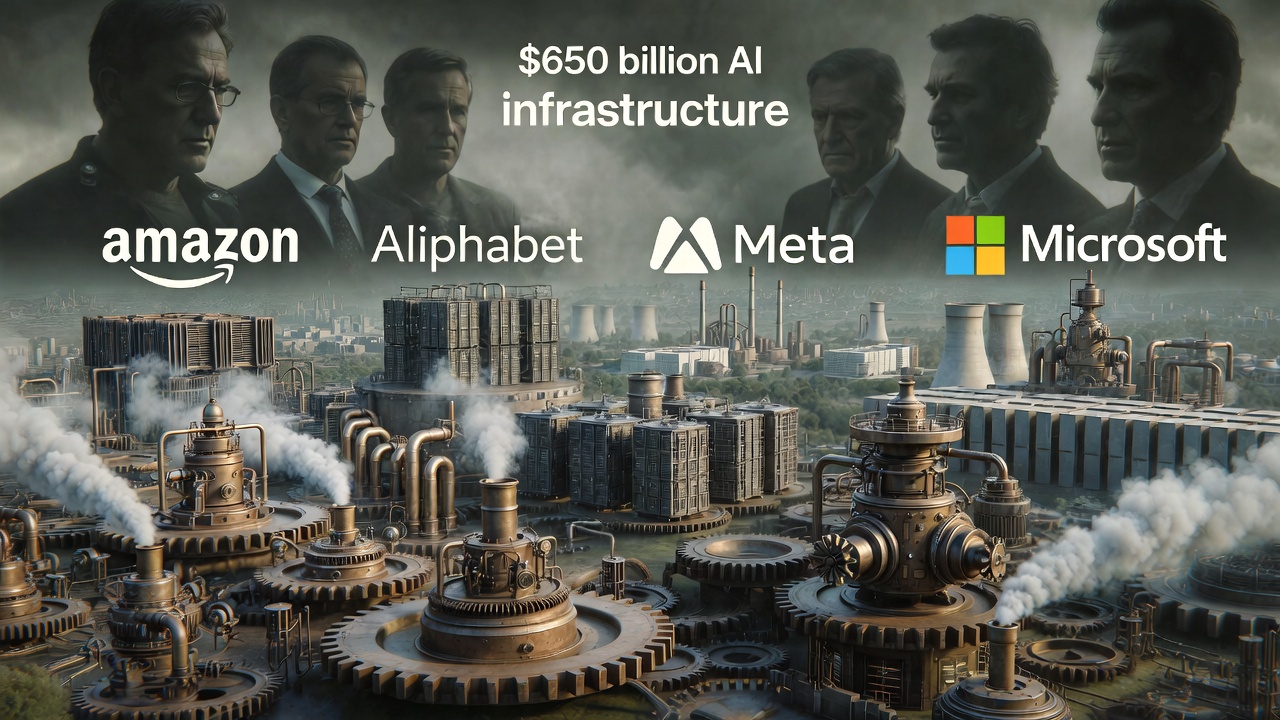
April 30, 2026 — For over a year, the “Big Four” of technology—Alphabet, Amazon, Microsoft, and Meta—have asked investors for something rare in the fast-moving world of Silicon Valley: patience. After pouring hundreds of billions into data centers, specialized chips, and power grids, the first quarter of 2026 has finally provided a definitive answer to the trillion-dollar question: Does AI spending actually pay off?
The answer, according to this week’s “frenzied” flurry of earnings reports, is a resounding—if expensive—yes.
A Tale of Two Realities: Cloud vs. Social
While all four giants beat revenue expectations, the stock market’s reaction revealed a sharp divide in how investors view different flavors of AI.
| Company | Q1 2026 Revenue | Growth (YoY) | Market Reaction |
| Alphabet | $109.9 Billion | +22% | 🚀 Up 7.2% |
| Amazon | $181.5 Billion | +17% | 📈 Up 4% |
| Microsoft | $82.9 Billion | +18% | ↔️ Flat |
| Meta | $56.3 Billion | +33% | 📉 Down 7% |
Alphabet: The AI King (For Now)
Alphabet emerged as the clear winner of the earnings race. The company’s stock surged after it reported its fastest rate of cloud growth since 2020. Google Cloud revenue crossed the $20 billion mark, proving that enterprises are moving beyond “testing” AI to actually paying for it.
CEO Sundar Pichai noted that the Gemini app and AI-integrated Search have not cannibalized the company’s core business, as many feared. Instead, AI-driven ad targeting has helped Google bypass traditional privacy hurdles, making its advertising machine more efficient than ever.
Microsoft and Amazon: The Infrastructure Giants
Microsoft and Amazon continue to be the “landlords” of the AI era.
- Microsoft Azure reported a 40% growth rate, fueled by massive demand for AI workloads. Interestingly, Microsoft revealed that paid Copilot seats have reached 20 million, signaling that workers are slowly adopting AI assistants as a daily tool.
- Amazon (AWS) saw its growth accelerate to 28%. Beyond its own tech, Amazon’s indirect bets are paying off; the company received a boost from its investments in Anthropic, which is reportedly seeking a new valuation of over $900 billion.
Meta: The Cost of “Superintelligence”
Despite posting a staggering 33% revenue growth—its fastest since 2021—Meta’s stock took a hit. Why? Because Mark Zuckerberg is raising the stakes. Meta announced it would increase its AI spending (CapEx) to as much as $145 billion this year.
Zuckerberg’s goal is to deliver “personal superintelligence” to every user on Earth. While Meta’s ad business is thriving thanks to AI recommendations on Reels, investors were spooked by the lack of a “fixed roadmap” for monetizing its latest AI models, like the newly released Muse Spark.
The Massive Cost of Admission
The numbers are difficult to wrap one’s head around. Together, these four companies are on track to spend $650 billion on AI infrastructure in 2026 alone. To put that in perspective, that is more than the annual GDP of many developed nations.
This spending is visible in two main areas:
- The “Concrete and Chips” Phase: Most of this money is flowing to NVIDIA and TSMC for the specialized hardware needed to run large language models.
- Efficiency over Headcount: A sobering throughline in these reports was the mention of “workforce restructuring.” Meta, Amazon, and Alphabet have all conducted significant layoffs in early 2026, with CEOs explicitly stating that AI allows them to do “the work of dozens with just one or two people.”
Looking Ahead: Is it a Bubble?
While the revenue numbers are healthy, critics warn of a potential “AI bubble” if these companies cannot maintain this pace of growth. The current valuations assume that AI will continue to provide double-digit boosts to productivity and sales.
For now, the “Big Four” have proven that AI is more than just a buzzword—it is a functional part of their balance sheets. But with $650 billion on the line, the pressure to turn “cool tech” into “cold cash” has never been higher.
What do you think is the biggest risk for these companies as they continue to spend record amounts on AI infrastructure?