

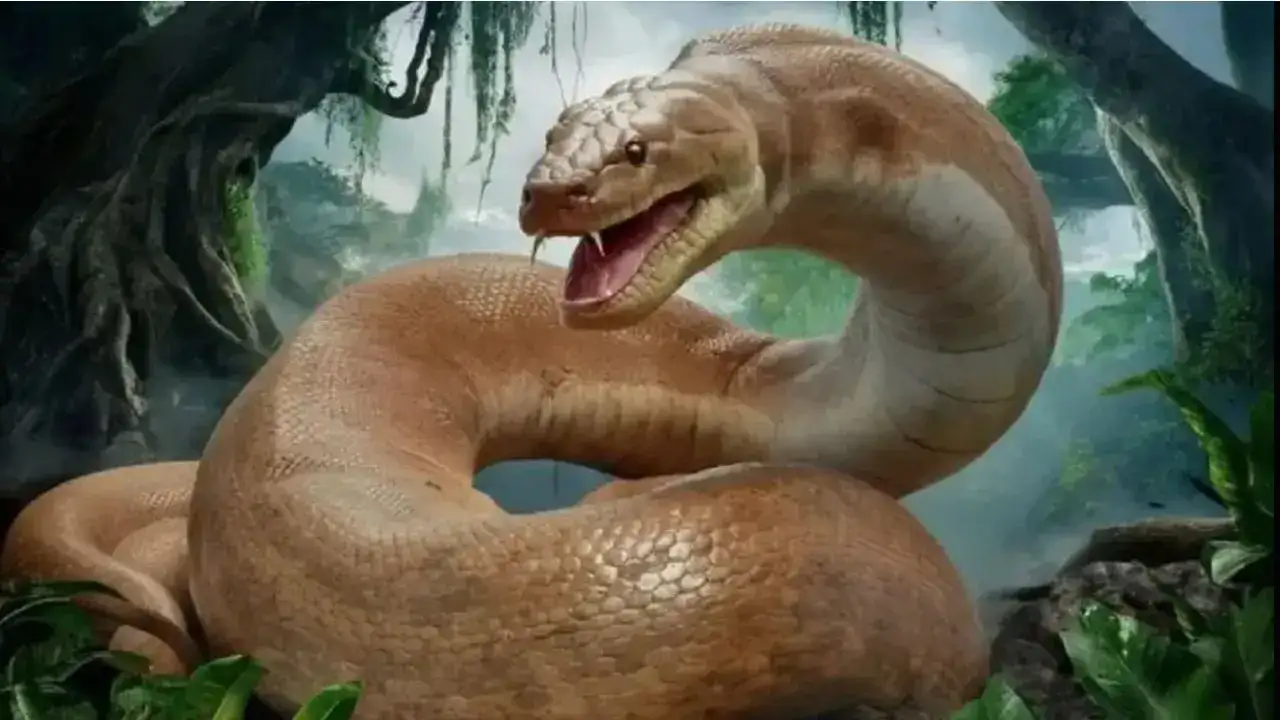
New Delhi, April 30, 2026 — In the dusty expanse of a lignite mine in western India, paleontologists have unearthed the remains of a prehistoric giant that is rewriting the record books of the natural world. Vasuki indicus, an ancient snake estimated to reach lengths of up to 50 feet (15.2 meters), has emerged as a top contender for the title of the largest snake to ever slither across the Earth.
The discovery, led by researchers from the Indian Institute of Technology (IIT) Roorkee, provides a rare glimpse into a world 47 million years ago, when the Indian subcontinent was a tropical hothouse teeming with colossal predators.
A Mythological Name for a Real-Life Monster
The serpent has been aptly named after Vasuki, the mythical king of serpents in Hindu mythology often depicted coiled around the neck of Lord Shiva. The “indicus” part of its name pays homage to the land where it was found.
While the name is rooted in legend, the physical evidence is grounded in hard science. The research team, led by Professor Sunil Bajpai and Debajit Datta, recovered 27 well-preserved vertebrae from the Panandhro Lignite Mine in Kutch, Gujarat. These fossilized bones—some still connected in the same position they were in millions of years ago—reveal a creature of staggering proportions.
Sizing Up the Giant: Vasuki vs. Titanoboa
For years, the undisputed heavyweight champion of the snake world was Titanoboa, a 42-foot monster discovered in the coal mines of Colombia in 2009. However, Vasuki indicus has now entered the ring, potentially surpassing its South American rival in length.
| Feature | Vasuki indicus | Titanoboa cerrejonensis |
|---|---|---|
| Estimated Length | 36 to 50 feet (10.9 – 15.2m) | 42 feet (12.8m) |
| Estimated Weight | ~1 Metric Ton | ~1.1 Metric Tons |
| Era | Middle Eocene (~47M years ago) | Paleocene (~60M years ago) |
| Habitat | Terrestrial/Coastal Swamps | Semi-aquatic Rivers |
| Location | Gujarat, India | La Guajira, Colombia |
While Vasuki may have been longer, scientists note that Titanoboa was likely more “robust” or thicker, meaning it might still hold the title for the heaviest snake. Regardless of who takes the crown, both were significantly larger than any snake alive today; for comparison, the modern Reticulated Python rarely exceeds 20 feet.
How Did It Live?
The anatomy of the vertebrae suggests that Vasuki was a thick-bodied, cylindrical snake. Because of its immense size, it was likely not a high-speed hunter. Instead, researchers believe it functioned much like a modern-day Anaconda or Python.
- The Ambush Strategy: Vasuki was likely a slow-moving predator that relied on stealth. It would lie in wait in the marshy swamps of ancient Gujarat, striking quickly at passing prey.
- The Power of Constriction: Like modern pythons, it was non-venomous. It would use its massive muscular body to wrap around prey—which likely included primitive whales, crocodiles, and turtles—and subdue them through sheer crushing force.
- A Warm World: The Middle Eocene was a period of high global temperatures. Scientists believe the snake’s massive size was made possible by the warm tropical climate of the time, as large cold-blooded reptiles require higher ambient temperatures to maintain their metabolic processes.
Scientific Significance: Connecting the Continents
Beyond its “cool factor,” the discovery of Vasuki indicus is a major win for biogeography. Vasuki belongs to the Madtsoiidae family, an extinct group of primitive snakes that existed for nearly 100 million years.
This find suggests that this particular lineage of giant snakes likely originated in India. As the Indian plate eventually collided with Eurasia, these giants slithered out of the subcontinent, spreading through southern Europe and into Africa during the Eocene period.
The Future of the Find
Though the 27 vertebrae provide a wealth of information, paleontologists are still hoping to find a skull. A snake’s skull is fragile and rarely fossilizes, but it would reveal exactly what Vasuki ate and how its senses operated.
For now, the Panandhro Lignite Mine remains a site of intense interest. As mining continues, more secrets of India’s prehistoric past may be unearthed, perhaps revealing even more about the giant serpent that once ruled the marshlands of Kutch.