

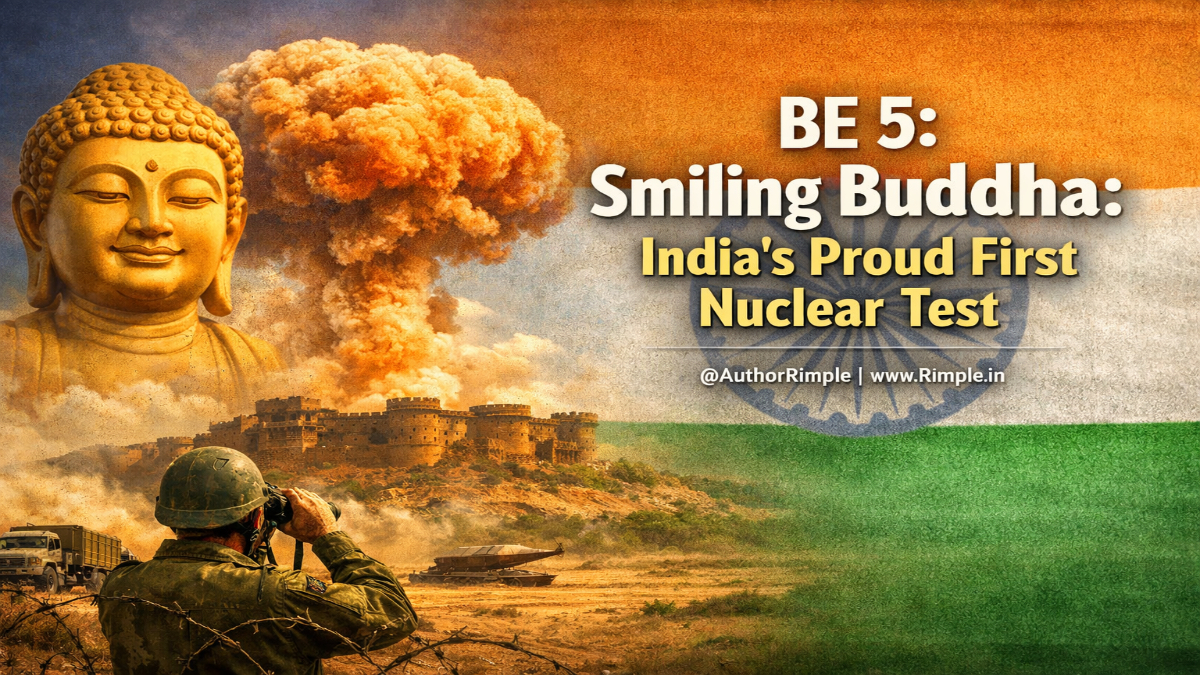
New Delhi, May 11, 2026: On a quiet morning on May 18, 1974, the Thar Desert in Rajasthan shuddered. Deep beneath the surface of Pokhran, a secret mission—code-named “Smiling Buddha” (Pokhran-I)—achieved a successful nuclear detonation. The message sent back to Prime Minister Indira Gandhi was as poetic as it was historic: “The Buddha has finally smiled.”
Fast forward to 2026, and the ripples of that explosion are still shaping the world. What was initially termed a “Peaceful Nuclear Explosion” (PNE) became the cornerstone of India’s transformation from a post-colonial state into a “responsible” nuclear power. This single event didn’t just rattle the ground; it shattered the existing global hierarchy and permanently altered India’s place in international politics.
The Audacity of Autonomy: Challenging the ‘Big Five’
Before 1974, the global nuclear order was a gated community. The five permanent members of the UN Security Council (the US, UK, USSR, France, and China) held the keys. The Non-Proliferation Treaty (NPT) of 1970 was designed to keep it that way, effectively creating a system of “nuclear haves” and “have-nots.”
India’s refusal to sign the NPT, followed by the Pokhran-I test, was an act of profound defiance. It was a statement that India would not accept a structurally unequal world order. By becoming the first nation outside the “Big Five” to conduct a nuclear test, India asserted its Strategic Autonomy.
“Smiling Buddha was as much a geopolitical statement as it was a scientific accomplishment. It reflected a shift in India’s self-perception—from a state constrained by history to one capable of shaping its own destiny.”
The Price of Defiance: Isolation and Self-Reliance
The immediate aftermath was brutal. The international community, led by the United States and Canada (who had provided the reactor used for the plutonium), responded with harsh sanctions. This led to:
- The Birth of the NSG: The Nuclear Suppliers Group was formed specifically to control the export of nuclear materials and technology to countries like India.
- Scientific Isolation: India was barred from high-tech exchanges, forcing its scientists to innovate in a vacuum.
- The “India Way”: Ironically, this isolation birthed India’s culture of Atmanirbharta (self-reliance). Indian scientists at BARC and DRDO were forced to develop indigenous technologies, leading to the successful development of the Agni and Prithvi missile systems.
From Pariah to Partner: The Long Game
Perhaps the most fascinating aspect of the Pokhran legacy is how India moved from being a “nuclear pariah” to a vital global partner. The foundation laid in 1974 allowed for the more overt tests of 1998 (Operation Shakti).
By 2008, the world finally blinked. The US-India Civil Nuclear Deal essentially recognized India as a “de facto” nuclear power without India having to sign the NPT. This was a historic reversal of the sanctions era.
India’s Nuclear Status in 2026: By the Numbers
| Category | Current Status (2026) |
| Estimated Warheads | ~190 |
| Nuclear Triad | Fully Operational (Land, Air, and Sea-based delivery) |
| Key Doctrine | No First Use (NFU) & Credible Minimum Deterrence |
| Recent Milestone | Prototype Fast Breeder Reactor (PFBR) at Kalpakkam achieved criticality in April 2026 |
The Moral Dimension: A “Responsible” Power
Unlike other nuclear-armed nations, India’s identity is built on the concept of Restraint. Its “No First Use” policy is a central pillar of its diplomacy. In 2026, as geopolitical tensions rise in the Indo-Pacific, India’s nuclear arsenal serves as a “shield of peace” rather than a “sword of war.”
India’s journey has proven that strategic capability, when coupled with political resolve, can force the international system to adapt. Today, India isn’t just sitting at the table; it is helping to write the menu for global security.
Conclusion: The Enduring Smile
Fifty-two years after the desert sands of Pokhran first shifted, the legacy of “Smiling Buddha” remains vibrant. It taught India that in the hard-edged world of global politics, respect is rarely given—it is earned through capability and the courage to stand alone.
As India enters its second stage of the three-stage nuclear program in 2026, the spirit of 1974 lives on. It is the story of a nation that refused to be a spectator in its own history, choosing instead to wake the world with a smile that changed everything.