

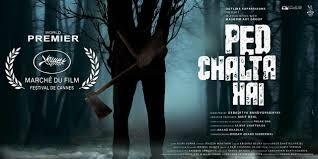
New Delhi, May 14, 2026: The prestigious red carpet of the Cannes Film Festival is a place where dreams are realized, and for the Indian film industry, it has often been a platform for mainstream Bollywood or South Indian cinema. However, the 77th edition of the festival witnessed a historic shift as the spotlight turned toward a region seldom represented on such a global scale: Jharkhand.
Director Debaditya Bandopadhyay, the visionary behind the film Ped Chalta Hai (The Walking Tree), recently shared his overwhelming emotions following the film’s premiere at the Marché du Film (Cannes Film Market). In an exclusive conversation, Bandopadhyay described the screening not just as a personal milestone, but as a “moment of pride for the entire state of Jharkhand.”
A Story Rooted in the Soil of Jharkhand
Ped Chalta Hai is more than just a cinematic project; it is a cultural ambassador. Set against the lush, rugged landscapes of Jharkhand, the film explores the intricate relationship between humanity and nature. The title itself—metaphorical and evocative—suggests a journey, a movement of life that transcends the physical rootedness of trees.
For Bandopadhyay, bringing this story to Cannes was a mission to prove that regional storytelling has a universal heart. “When we started filming in the remote corners of Jharkhand, we knew we had something special. But to see the international audience at Cannes connect with our local narrative was deeply moving,” the director shared. “This film belongs to the soil of Jharkhand, to its people, and to the silent beauty of its forests.”
The “Moment of Pride” for the State
Jharkhand, a state often highlighted in national media for its mineral wealth or socio-political challenges, has a burgeoning artistic community that has long sought a global platform. Bandopadhyay’s achievement is being hailed as a “watershed moment” for the region’s film industry.
“For years, Jharkhand was seen merely as a shooting location for outside filmmakers,” Bandopadhyay explained. “With Ped Chalta Hai, we have shown that we can produce world-class content from within. We have our own stories, our own aesthetics, and our own cinematic voice. This premiere at Cannes tells every aspiring filmmaker in Ranchi, Jamshedpur, and Dhanbad that their dreams are valid.”
The director emphasized that the support from the local community and the state’s cultural departments played a crucial role in making this dream a reality. He believes that this success will pave the way for a “Jharkhandi New Wave” in cinema, encouraging more local creators to look beyond regional boundaries.
The Cannes Experience: Red Carpets and Global Conversations
The Marché du Film at Cannes is the largest film market in the world, a bustling hub where producers, distributors, and critics gather to discover the “next big thing.” For Ped Chalta Hai, the premiere served as a gateway to international distribution.
Bandopadhyay recounted the experience of walking the Croisette and seeing his film’s name alongside global giants. “There is a certain magic in the air at Cannes. But the most rewarding part was the Q&A session after the screening. People from Europe, Latin America, and Asia were asking about the philosophy of the film and the unique geography of Jharkhand. They weren’t just watching a movie; they were discovering a part of India they had never seen before.”
The film’s cinematography, which captures the raw, ethereal beauty of Jharkhand’s woodland, received particular praise. Critics noted that the film uses nature as a central character, reflecting a “deeply spiritual and ecological consciousness.”
Breaking Stereotypes through Cinema
One of the primary goals of Ped Chalta Hai was to challenge the stereotypical portrayal of Jharkhand in Indian cinema. Frequently associated with “coal-belt” crime dramas or stories of rural struggle, the state’s softer, more poetic side is rarely explored.
“I wanted to move away from the ‘dark’ imagery often associated with our state,” Bandopadhyay said. “I wanted to show the grace, the folklore, and the profound wisdom that exists in our rural communities. Ped Chalta Hai is a lyrical film. It moves at the pace of nature. It challenges the viewer to slow down and listen.”
By choosing a narrative that blends realism with a touch of the avant-garde, Bandopadhyay has positioned himself as a filmmaker who is not afraid to experiment. This boldness is exactly what caught the eye of the Cannes selection committees.
The Road Ahead: From Cannes to the World
While the Cannes premiere is a massive achievement, it is only the beginning of the journey for Ped Chalta Hai. The film is expected to travel to several other international film festivals before making its way back to India for a theatrical and OTT release.
Bandopadhyay is already in talks with international distributors who are interested in bringing the film to audiences in Europe and North America. However, he remains grounded and focused on his roots. “The ultimate validation will come when the people of Jharkhand watch the film. I want them to see their lives and their land portrayed with dignity and beauty.”
The success of the film has also sparked discussions about the need for better film infrastructure in Jharkhand. Bandopadhyay hopes that his journey will inspire the state government to further invest in film cities, subsidies, and educational institutes to nurture local talent.
A Beacon for Independent Filmmakers
The story of Ped Chalta Hai is a testament to the power of independent filmmaking. Working with a modest budget and a dedicated crew, Bandopadhyay proved that high production value is not just about money—it’s about vision.
“We didn’t have the backing of a major studio,” he revealed. “What we had was a deep conviction in the story. Every leaf we filmed, every shadow we captured, was done with immense love. To independent filmmakers everywhere, I say: do not wait for the ‘perfect’ conditions. Start with what you have, tell the story only you can tell, and the world will eventually listen.”
Conclusion: A New Chapter for Indian Regional Cinema
As the curtains fall on the 77th Cannes Film Festival, the echoes of Ped Chalta Hai continue to resonate. Debaditya Bandopadhyay has not only brought home a “moment of pride” for Jharkhand but has also contributed to the growing prestige of Indian regional cinema on the global stage.
In an era where global audiences are craving authentic, localized stories, Ped Chalta Hai stands as a shining example of how a small story from a small state can have a massive impact. Jharkhand has officially arrived on the world cinema map, and if Bandopadhyay’s vision is any indication, this is just the first of many stories to come.
The “Walking Tree” has indeed started its journey, and it is carrying the soul of Jharkhand across borders, oceans, and cultures.