

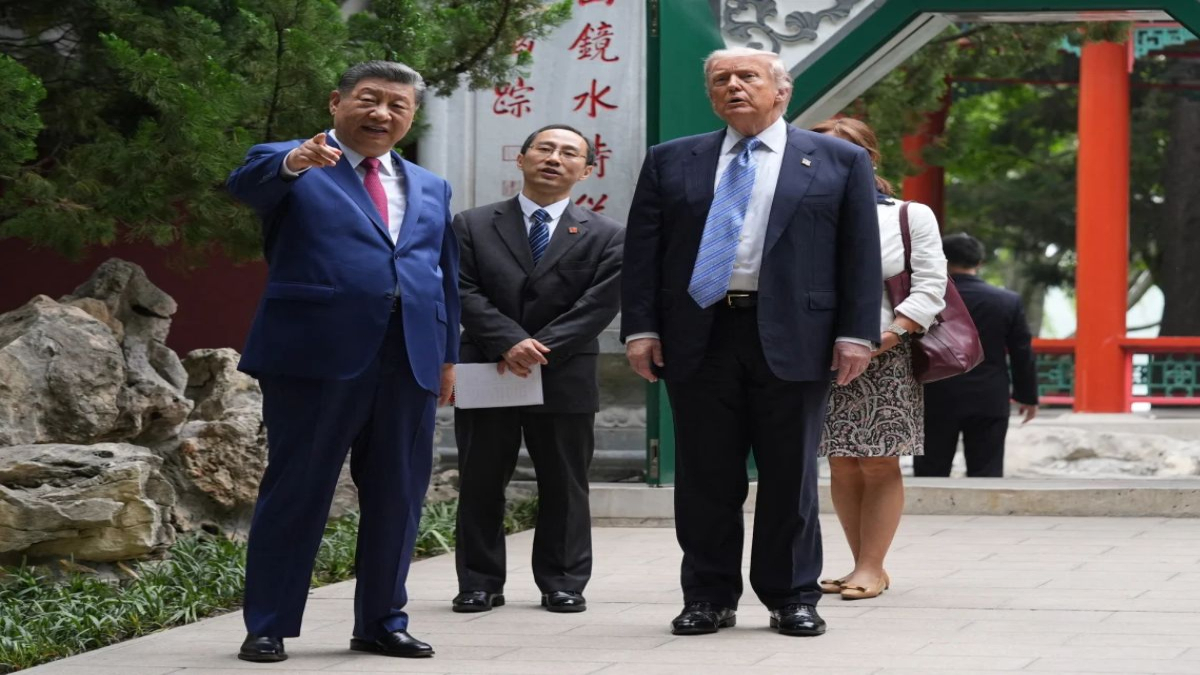
New Delhi, May 15, 2026: As the historic summit between the world’s two most powerful leaders concluded today, May 15, 2026, the global community witnessed a rare and symbolic gesture: Chinese President Xi Jinping personally guided U.S. President Donald Trump through Zhongnanhai, the highly secluded headquarters of the Communist Party of China (CPC).
This private tour of China’s “seat of power” served as the climax of Trump’s three-day state visit to Beijing—his first since returning to the White House for a second term. The visit, characterized by grand ceremonies and “fantastic” trade talk, aimed to stabilize a relationship that has been increasingly strained by conflicts in the Middle East and disputes over high-end technology.
Into the “Forbidden” Compound
While most official business takes place in the Great Hall of the People, the invitation to Zhongnanhai is a gesture reserved for only the highest level of diplomatic intimacy. Located adjacent to the Forbidden City, the compound is a lush, walled-off garden that serves as the official residence and workplace for China’s top leadership.
As the two men walked through the manicured gardens, President Xi provided a rare history lesson, explaining the compound’s significance.
“Zhongnanhai is where the CPC Central Committee and the State Council work, and it is also where I work and live,” Xi told Trump. He noted that founding leaders like Mao Zedong and Zhou Enlai once lived within these same walls, emphasizing the continuity of the Party’s “people-centered” philosophy.
President Trump, known for his appreciation of grand architecture and historical significance, appeared impressed. He remarked that the two nations are “great and wise,” suggesting that such direct communication is the only way to solve “problems that other people wouldn’t have been able to solve.”
The Agenda: Trade, Tech, and Tensions
Behind the polite smiles and scenic walks, the substance of the summit focused on two major global crises: the trade imbalance and the escalating conflict in the Middle East.
1. “Fantastic” Trade Deals
Following their final meeting, Trump struck an optimistic tone, claiming that “fantastic trade deals” had been reached. While official documents are still being finalized, early reports indicate significant breakthroughs:
- Boeing Aircraft: Trump announced that China has agreed to purchase 200 Boeing jets, a massive boost for the American aerospace industry.
- Energy and Agriculture: Beijing expressed renewed interest in buying large quantities of U.S. oil and soybeans, a move designed to reduce the trade deficit.
- Technology: Discussions reportedly included the future of AI governance and semiconductor supply chains, with Nvidia CEO Jensen Huang notably joining the U.S. delegation.
2. The Iran Crisis
A central focus of the 2026 summit was the ongoing conflict involving Iran and the closure of the Strait of Hormuz, a critical chokepoint for global oil. Trump sought Xi’s help in pressuring Tehran to accept a ceasefire.
- Xi’s Assurance: Trump told reporters that Xi had given assurances that China—the largest buyer of Iranian oil—would not provide military equipment to Iran and would like to see the Strait reopened.
- China’s Stance: Beijing officially framed the talks as a push for “strategic stability,” positioning itself as a mediator that can influence Tehran in ways Washington cannot.
The Shadow of Taiwan
Despite the outward warmth, the issue of Taiwan remains the “red line” in the relationship. During the talks, President Xi issued a stern warning, stating that any mishandling of the Taiwan question could lead to “clashes and even conflicts.”
While Trump has been vocal about his personal friendship with Xi, he has also overseen significant arms packages for the self-governed island. U.S. Secretary of State Marco Rubio, who accompanied Trump, reiterated that the U.S. policy on Taiwan remains “unchanged,” though the administration’s focus during this trip was clearly on economic wins.
A “Milestone” Moment
The summit concluded with both leaders agreeing to a “new positioning” of ties for the next three years, termed “Constructive Strategic Stability.” To underscore the personal rapport, President Xi reportedly promised to send seeds from China to be planted in the White House Rose Garden.
As Air Force One departed Beijing this afternoon, the world breathed a cautious sigh of relief. While the fundamental rivalry between the two superpowers remains, the images of the two leaders strolling through the heart of Chinese power suggest a temporary “truce” in favor of economic pragmatism.
Key Highlights of the Visit:
| Event | Significance |
| Temple of Heaven Tour | Xi used the ancient site to explain the “mandate of the people” to Trump. |
| Zhongnanhai Visit | A rare look into the CPC’s inner sanctum, signaling high-level respect. |
| Boeing Deal | A major commercial win for Trump’s “America First” economic agenda. |
| G20 & APEC 2026 | Both leaders agreed to attend upcoming summits in Miami and Shenzhen. |
Analysis:
This 2026 summit marks a pivotal shift. By inviting Trump into the “seat of power,” Xi Jinping has signaled that China is ready to deal directly with the current U.S. administration to avoid a total decoupling. For Trump, the trip provides “deal-making” ammunition for his domestic audience, showing that his personal diplomacy can still yield tangible results on the world stage.