

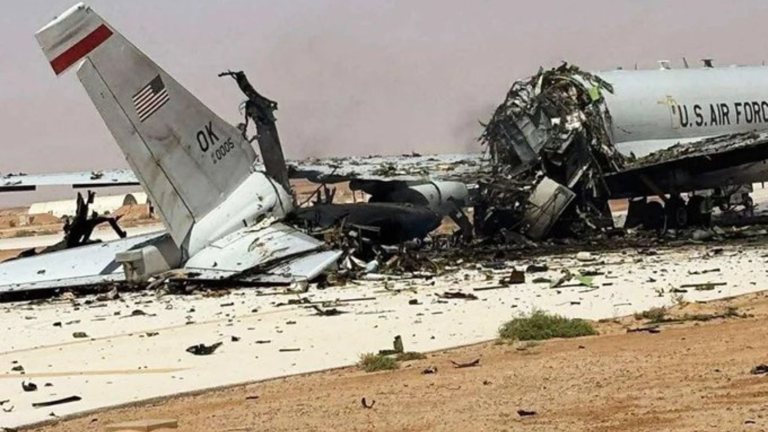
New Delhi, May 20, 2026 — Tensions in West Asia have surged to a critical breaking point as a newly released U.S. Congressional Research Service report confirmed that the American military lost or suffered severe damage to 42 aircraft during its recent 40-day air campaign against Iran.
The disclosure of these heavy combat losses has ignited a fierce diplomatic and rhetorical war of words. Iranian Foreign Minister Seyed Abbas Araghchi seized on the report to warn U.S. President Donald Trump that any fresh military action would be met with “many more surprises.” Meanwhile, President Trump has issued a blunt ultimatum, giving Tehran a window of just “two or three days” to sign a peace deal or face a renewed, devastating military assault.
The Cost of “Operation Epic Fury”
The explosive details were made public in a U.S. Congressional report analyzing the fallout of Operation Epic Fury, a joint U.S.-Israel military campaign launched against Iran on February 28, 2026. While combat operations had slowed following a fragile April ceasefire, the true extent of the aerial toll is only now coming to light.
According to the report, the 42 listed aircraft include sophisticated stealth fighter jets, heavily armored ground-attack planes, essential aerial refuelers, and an array of advanced uncrewed aerial systems (drones).
A Breakdown of U.S. Air Losses & Damages
| Aircraft Type | Status / Details |
| MQ-9 Reaper Drones | 24 Destroyed — Accounted for more than half of all recorded losses. |
| KC-135 Stratotankers | 7 Total — 2 completely destroyed, 5 severely damaged by Iranian defenses. |
| F-15E Strike Eagle Fighter Jets | 4 Destroyed — Brought down during active combat operations over Iran. |
| MC-130J Commando II | 2 Destroyed — Special operations transport aircraft lost. |
| F-35A Lightning II Stealth Fighter | 1 Damaged — Hit by Iranian ground-based air defense systems. |
| A-10 Thunderbolt II (“Warthog”) | 1 Destroyed — Ground-attack jet lost during close-air support. |
| E-3 Sentry AWACS & HH-60W Helicopter | 2 Damaged — Airborne radar jet and combat rescue chopper sustained fire. |
The Pentagon has yet to release its own independent, comprehensive assessment of combat casualties or hardware losses. However, during a recent congressional hearing, Acting Pentagon Comptroller Jules W. Hurst III testified that the estimated cost of military operations against Iran has already ballooned to a staggering $29 billion.
Iran Exploits the Report: “A Touted F-35 Shot Down”
The admission of these losses has been treated as a major strategic victory in Tehran. Taking to the social media platform X, Iranian Foreign Minister Abbas Araghchi mocked the multi-billion-dollar toll inflicted on U.S. forces.
Iranian military spokesmen have emphasized that their air defense networks performed far better than Western analysts anticipated. Beyond the physical downing of aircraft, Iranian army spokesman Mohammad Akraminia stated that the military has actively used the weeks of ceasefire to “strengthen its combat capabilities” and warned that any fresh American aggression would prompt Tehran to “open new fronts” across the region.
Trump’s Ultimatum: 72 Hours to a Deal or “Another Big Hit”
Speaking to reporters at the White House, President Donald Trump presented a starkly different view of the conflict’s power dynamics. Trump claimed that the U.S. military had pushed Iran to the brink, stating that Iranian negotiators are “begging to make a deal.”
Trump revealed that he had been just “an hour away” from ordering a major renewed bombing campaign earlier this week before postponing the strike at the explicit request of Gulf Arab allies, who fear immediate Iranian retaliation on their own infrastructure.
However, the U.S. President made it clear that his patience is running out, placing a strict timeline on the ongoing negotiations:
- The Timeline: “I’m saying two or three days, maybe Friday, Saturday, Sunday, something, maybe early next week, a limited period of time,” Trump warned regarding the window left for diplomatic talks.
- The Threat: “I hope we don’t have to do the war, but we may have to give them another big hit. I’m not sure yet.”
Despite the aggressive rhetoric, political analysts note that the war has become a heavy political liability for the Trump administration. With crucial U.S. congressional elections approaching this November, the American public is growing deeply frustrated by the economic fallout of the conflict.
Domestic and Global Economic Fallout
The war of choice has severely reverberated through global markets and the domestic U.S. economy. Iran’s strategic positioning along the Strait of Hormuz—the world’s most critical oil transit chokepoint—has allowed it to bottleneck global energy shipping.
Foreign Minister Araghchi actively highlighted these economic vulnerabilities, noting that the “real pain” for everyday Americans is just beginning.
Rising Economic Pressures in the U.S.
- Skyrocketing Energy Costs: Global oil supply anxieties have driven U.S. gasoline prices to their highest levels in years.
- Spike in Treasury Yields: Fearing prolonged war-driven inflation, investors have pushed the benchmark 10-year U.S. Treasury yield up to 4.555%, while the 30-year yield has climbed above 5%.
- Surging Borrowing Costs: These spiking yields translate directly into higher mortgage rates, more expensive auto loans, and tightened credit for American businesses. This comes at a time when U.S. auto loan delinquencies are already sitting at a 30-year high.
A Fragile Path Forward
While Vice President JD Vance has led a single round of direct peace talks with Iranian officials, the gap between Washington and Tehran remains vast.
Iran is demanding severe concessions before it agrees to a permanent ceasefire. These include the immediate lifting of all long-standing economic sanctions, the release of billions of dollars in frozen Iranian assets worldwide, and formal financial reparations for the damage caused by joint U.S.-Israeli strikes.
Furthermore, regional flashpoints continue to ignite. Direct Israeli airstrikes have continued in Lebanon, resulting in substantial civilian casualties, while a recent drone strike hitting the UAE’s Barakah nuclear power plant has drawn sharp condemnation from the International Atomic Energy Agency (IAEA) and the UN Security Council.