

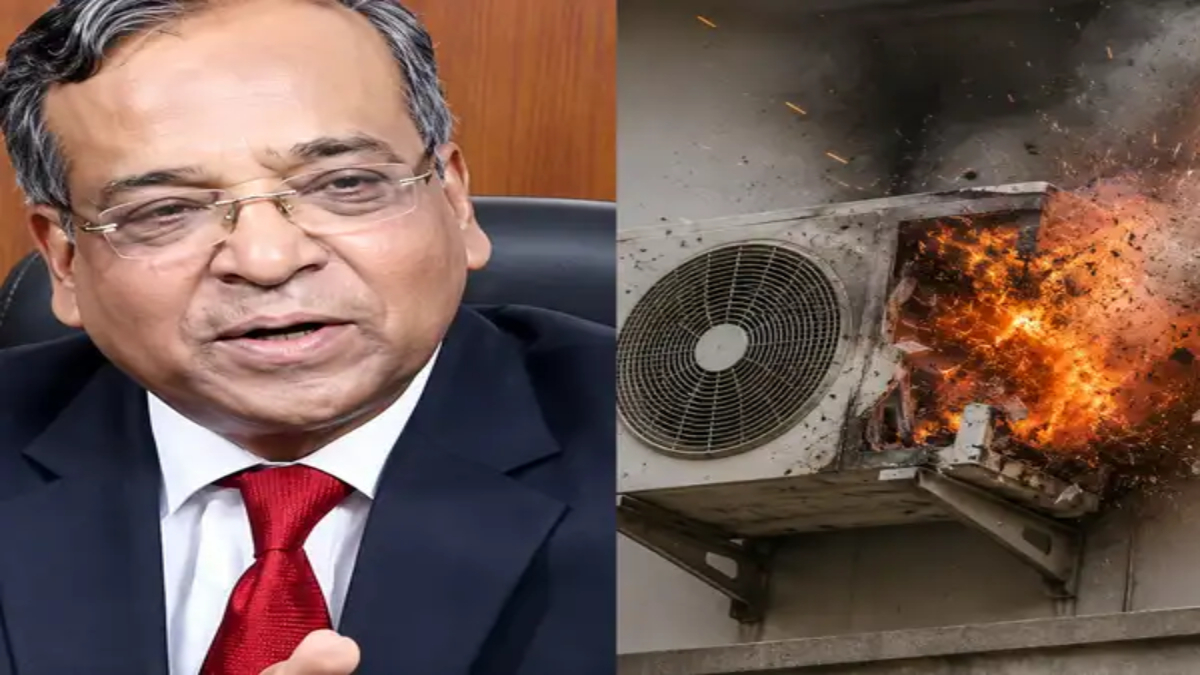
New Delhi, May 29, 2026: In a tragic incident that highlights growing concerns over household appliance safety during peak summer, Dhanendra Kumar, an 80-year-old retired Indian Administrative Service (IAS) officer and the prominent first chairman of the Competition Commission of India (CCI), lost his life after a devastating fire broke out at his south Delhi residence. The blaze, which tore through the ground floor of his three-storey home in the upscale Hauz Khas neighborhood, is heavily suspected to have been triggered by an explosion in an indoor air conditioning unit.
According to senior Delhi Police officials, the emergency call reporting the fire was received at the Hauz Khas police station at approximately 11:10 PM on Wednesday night. Fire services and local police units rushed to the scene immediately, deploying two fire tenders to battle the encroaching flames. At the time of the incident, five individuals—including Mr. Kumar, his wife, his son, and two domestic helpers—were inside the house.
High-Risk Midnight Rescue Efforts
As the fire broke out, dense smoke quickly enveloped the ground floor, cutting off easy exit routes. Domestic staff on the property immediately attempted to rescue the family members as the fire began to feed on wooden furniture, decorative elements, and structural fixtures, quickly sending toxic smoke billowing upward to the higher floors.
Firefighters and police teams pulled Mr. Kumar and his son from the burning building. Both were rushed to the nearby AIIMS Trauma Centre. While Mr. Kumar’s son sustained injuries, medical professionals confirmed he is stable and out of danger. However, despite the best efforts of the emergency medical team, the octogenarian former bureaucrat succumbed during treatment. Doctors stated that the primary cause of his death was severe smoke inhalation rather than thermal burns, a common and lethal consequence of modern residential fires where burning synthetic materials and wood release thick carbon monoxide.
Technical Investigation Focuses on Overheating
Forensic experts and electrical inspectors have been brought in to examine the remains of the ground-floor room where the fire originated. Initial inquiries strongly point to a sudden technical failure or a localized blast within the indoor unit of the air conditioner.
While a formal technical report is still awaited, investigators are closely analyzing two main possibilities: an electrical short-circuit or catastrophic overheating of the compressor system. Local authorities noted that the capital’s extreme summer heat frequently pushes power grids and household appliances beyond their intended limits.
Police officers involved in the case noted that running air-conditioning units uninterrupted for prolonged periods, especially at low temperature settings like 18°C, demands high energy consumption. This intense load can cause internal components to overheat, and if the electrical wiring or the unit’s internal circuitry is old or poorly maintained, it can rapidly spark a fire or lead to a pressurized component blowout. Statements from eyewitnesses and neighbors have been recorded, and Delhi Police have explicitly ruled out any foul play at this stage of the investigation.
A Distinguished Career in Public Service
The sudden passing of Dhanendra Kumar marks the end of a highly distinguished public service career spanning more than four decades. A member of the 1968 batch of the IAS from the Haryana cadre, Kumar was widely respected as one of India’s most capable and seasoned economic bureaucrats.
Throughout his career, he held several high-profile portfolios within both the central government and the Haryana state administration. He served with distinction as the Principal Secretary to the Chief Minister of Haryana, and later transitioned to critical roles at the national level, serving as the Union Secretary in the Ministry of Defence, the Ministry of Road Transport and Highways, and the Ministry of Culture.
Internationally, Kumar represented India on the global stage as the Executive Director at the World Bank from 2005 to 2009, representing a constituency that included India, Bangladesh, Sri Lanka, and Bhutan.
Perhaps his most enduring institutional legacy came in 2009, when he was appointed as the founding Chairman of the Competition Commission of India (CCI). As its first chief, Kumar was instrumental in breathing life into India’s modern competition law framework, shaping antitrust regulations, preventing monopolistic trade practices, and fostering a fair market environment during a period of rapid economic expansion. Following his formal retirement, he continued to actively advise on corporate governance and public policy, charting a legacy that heavily influenced India’s contemporary economic regulatory architecture.
Rising Seasonal Appliance Risks Highlighted
This tragic incident has reignited urgent conversations surrounding residential safety and appliance maintenance across urban India during the peak summer months. As temperatures routinely hit extreme highs, the reliance on air conditioners surges exponentially, causing massive spikes in power demand and stretching household electrical systems to their breaking points.
Safety experts warn that many residential properties feature outdated wiring systems that are not rated to handle the simultaneous power load of multiple modern high-tonnage appliances. Furthermore, the lack of periodic servicing for air conditioners—such as checking for proper refrigerant levels, cleaning clogged filters, and ensuring stable voltage connection lines—significantly increases the risks of mechanical malfunction.
The fire department has reiterated the necessity of giving appliances periodic operational rests, utilizing voltage stabilizers where power fluctuations are common, and ensuring that certified technicians review home wiring layouts to mitigate the threat of short-circuits. As the local community in Hauz Khas mourns the loss of a revered civil servant, the investigation remains ongoing to precisely trace the exact mechanical chain of events that turned a standard household convenience into a fatal hazard.