

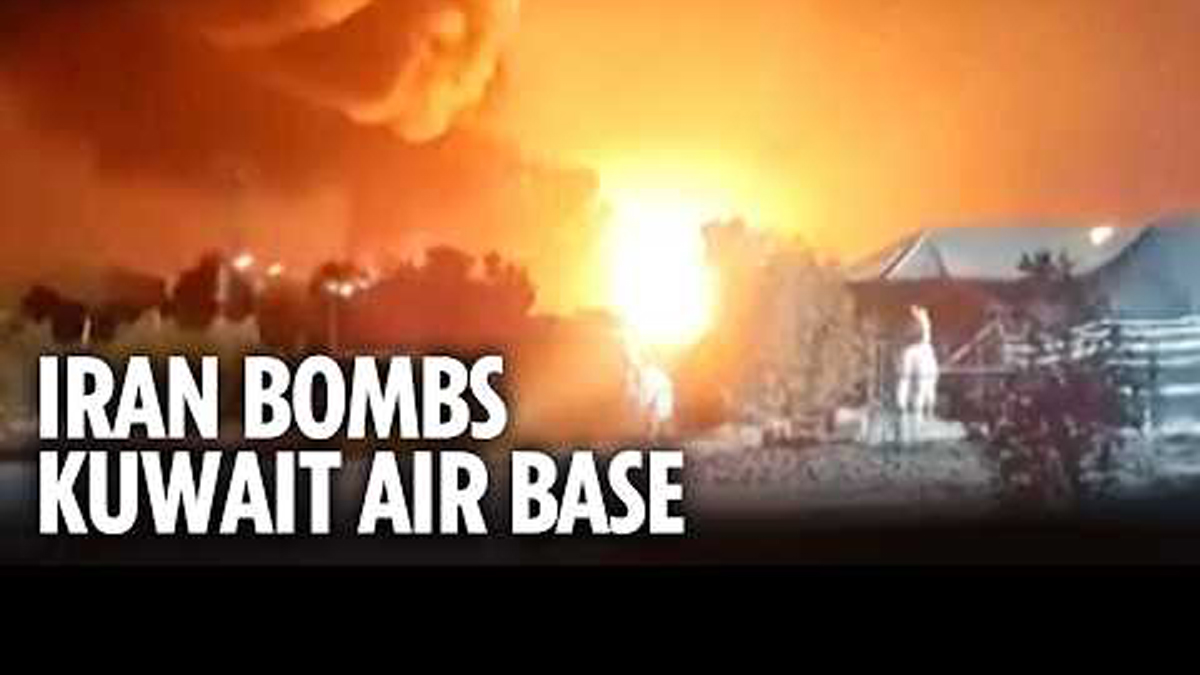
MON, JUN 1, 2026 — The conflict in West Asia has escalated sharply following intensive military actions over the weekend. The United States launched precision air strikes against strategic military positions in southern Iran, while neighboring Kuwait reported defending against an influx of hostile missile and drone attacks.
The developments mark the third time a fragile, weeks-old ceasefire between Washington and Tehran has been broken. The flare-up occurs against the complex backdrop of concurrent, backdoor diplomatic negotiations and a broadening theater of war across the region.
Precision Strikes on Qeshm and Goruk
United States Central Command (CENTCOM) confirmed late Sunday that American fighter aircraft carried out what they termed “measured and deliberate self-defense strikes” against strategic locations on Qeshm Island and in the coastal city of Goruk, Iran.
According to military officials, the operation was triggered by aggressive actions from Iran’s Islamic Revolutionary Guard Corps (IRGC), specifically the recent shootdown of a US MQ-1 drone operating over international waters.
The targets chosen by the US military were highly specific. CENTCOM reported that the strikes successfully destroyed:
- Iranian coastal radar networks used to track regional maritime traffic.
- A key drone ground control station.
- Antiaircraft missile systems.
- Two one-way attack drones prepared for launch.
Qeshm Island, positioned at the narrowest point of the Strait of Hormuz, has long been identified by intelligence agencies as a fortified stronghold equipped with underground missile networks. By striking infrastructure here and in nearby Goruk, Washington aimed to neutralize immediate threats to both military assets and commercial shipping vessels navigating the world’s most critical energy transit choke point.
Kuwait Under Fire: Interceptions and Casualties
Simultaneously, the theater of conflict spilled directly into neighboring Gulf states. On Monday morning, air defense sirens blared across Kuwait as the General Staff of the Kuwaiti Army announced that its defensive networks were actively engaging hostile missile and drone attacks breaching the country’s airspace.
While Kuwaiti air defense forces successfully intercepted incoming projectiles, falling debris caused notable damage on the ground. A ballistic missile, identified by analysts as an Iranian-engineered Fateh-110, was brought down over the Ali Al Salem Air Base—a key installation hosting American personnel.
The resulting debris field caused minor injuries to approximately five individuals, including active-duty military personnel and contractors. Furthermore, the impact resulted in serious material damage to US assets stationed at the facility, completely destroying an MQ-9 Reaper drone valued at $30 million and heavily damaging another.
The Economic War for the Strait of Hormuz
Beyond the immediate kinetic exchanges, a complex financial and logistical conflict is playing out over regional shipping lanes. The US recently imposed a fresh wave of sanctions targeting Iran’s newly instituted Persian Gulf Strait Authority. Washington has accused Tehran of weaponizing its geographic control over the Strait of Hormuz by implementing a “managed-access regime” to extract massive transit fees from international commercial shipping.
Intelligence reports from maritime outlets reveal that Iran has instituted a highly tiered access system:
- Targeted Restrictions: Chinese-linked vessels transporting Saudi crude oil are reportedly being forced to pay transit fees as high as $2 million per passage through the Strait.
- Bilateral Exceptions: Indian-flagged tankers are being permitted to navigate the waterway completely free of charge under separate, pre-arranged bilateral agreements.
US officials have fiercely condemned this system, calling it an illegal revenue-generation scheme designed to fund Iranian military operations and regional proxy activities. In response, Iranian naval forces have reportedly fired warning shots at multiple international vessels attempting to cross the Strait without coordinating directly with local authorities.
A Drastic Strain on Defense Stockpiles
The protracted nature of what the Pentagon has designated Operation Epic Fury is beginning to cause concern among military logisticians in Washington. The intensive campaign against Iranian infrastructure and the continuous interception of retaliatory barrages have significantly depleted US stockpiles of high-end munitions.
According to latest Department of Defense casualty and logistics data, the conflict has resulted in 14 American fatalities and 409 injuries to date. More critically for long-term readiness, the continuous deployment of interceptors has severely strained inventories of specific, premium defensive and offensive hardware, including:
- THAAD (Terminal High Altitude Area Defense) interceptors.
- Patriot PAC-3 air defense missiles.
- SM-3 Block IIA naval interceptors.
- Tomahawk and JASSM-ER long-range cruise missiles.
Paradoxical Diplomacy: War Amid “Good Deals”
The sudden spike in open warfare presents a jarring contrast to the political rhetoric emerging from Washington. Just as these strikes were being executed, US President Donald Trump stated that discussions regarding a comprehensive, long-term agreement with Tehran were actively moving forward, claiming the administration was close to securing a “very good deal.”
According to diplomatic sources, these backdoor negotiations focus heavily on two main pillars: the formal reopening and stabilizing of the Strait of Hormuz to international commerce, and strict new limits on Iran’s nuclear enrichment capabilities.
However, the reality on the ground appears far less optimistic. Iranian Foreign Minister Abbas Araghchi confirmed that messages are still being actively passed through neutral intermediaries in Doha, Qatar, but he flatly dismissed claims that a resolution is imminent. “Nothing is certain until a final agreement is officially signed,” Araghchi stated, warning that outside actors—including Israel, which is currently expanding its own ground operations in Lebanon—are actively trying to sabotage a bilateral US-Iran truce.
With both sides continuing to trade heavy blows while simultaneously talking through intermediaries, the region remains trapped in a highly volatile cycle of retaliation. The coming days will prove critical in determining whether the back-channel diplomatic tracks can successfully implement a durable ceasefire, or if the conflict will expand into a full-scale regional war.