

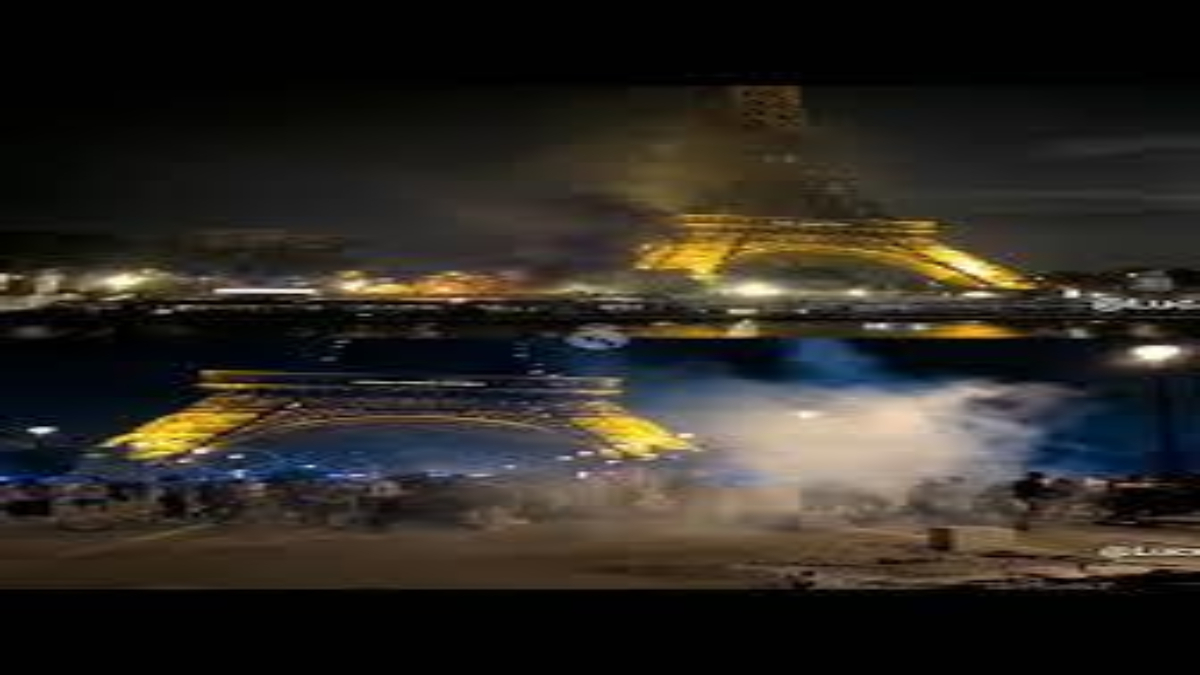
New Delhi, June 1, 2026: A terrifying video showing France’s most iconic landmark, the Eiffel Tower, engulfed in roaring flames and thick black smoke recently took social media by storm. The clip spread rapidly across platforms like TikTok, X (formerly Twitter), and Facebook, racking up millions of views and leaving viewers worldwide in a state of shock. Accompanying text posts dramatically claimed that the “centre of Paris is on fire” and that “firefighters are still unable to control the blaze.”
However, an extensive investigation reveals that the entire event is an elaborate hoax. The Eiffel Tower did not catch fire, nor has it suffered any recent structural damage. The viral video is actually a highly sophisticated piece of computer-generated imagery (CGI) and visual effects (VFX) that was taken entirely out of context to manipulate public emotions.
Digging Into the Roots of the Rumor
To understand how this panic started, fact-checkers traced the digital footprint of the viral footage. The investigation revealed that the short, hyper-realistic clip was originally created and published by a 3D visualization studio known as Augmented_One. The creator had uploaded the nine-second animation to YouTube with the explicit title “Eiffel Tower burning VFX.”
In the filmmaking and digital design world, VFX stands for visual effects—imagery created or manipulated outside of a live-action shot. The studio designed it purely as a demonstration of their technical skills. In fact, as the video began causing unintended mass confusion online, the creators pinned a public comment to clarify their work, stating, “To all the viewers, this is VFX (visual effects).”
Unfortunately, bad actors and automated bot accounts stripped the original video of its labels, captions, and context. They republished the brief snippet on TikTok and X, framing it as an active, real-time emergency. Because the physics of the fire and smoke looked incredibly realistic, millions of users fell victim to the illusion, sharing the post without verifying its authenticity.
The Total Absence of Official Records
When a major global monument faces an emergency, the real world reacts immediately. A genuine fire at the Eiffel Tower—which welcomes more than seven million visitors every year—would trigger massive, round-the-clock coverage from standard-based international news outlets. Yet, when the video went viral, not a single reputable media organization reported an incident.
Furthermore, official channels in France maintained complete silence regarding any disaster, instead operating business as usual.
- The Eiffel Tower Management: The official website and social media channels for the monument released no alerts. Instead, their updates continued to promote tourism tips, ticket sales, and even shared pictures of the tower covered beautifully in winter snow.
- Emergency Services: The Paris Fire Brigade (Brigade de sapeurs-pompiers de Paris) and local police departments recorded absolutely no fire incidents at the Champ de Mars, where the tower stands.
- Government Officials: No statements or emergency press conferences were issued by French public figures, including the Mayor of Paris or the French President.
By comparison, when the historic Notre-Dame Cathedral caught fire, the entire world witnessed real-time, multi-angle journalism from hundreds of verified reporters on the ground. The complete absence of such coverage is the strongest proof that a breaking news claim is entirely fake.
The Anatomy of Modern Misinformation
The viral Eiffel Tower hoax highlights an alarming trend in online misinformation: the dangerous intersection of advanced digital generation tools and poor media literacy. It has become incredibly easy for creators to construct hyper-realistic images using Artificial Intelligence (AI) generators like Midjourney or traditional VFX software. While these tools are fantastic for art and cinema, they present a massive challenge to public truth when weaponized out of context.
This is not the first time Paris has been targeted by digital fabrications. Fact-checkers have previously debunked widely shared videos claiming to show escaped zoo animals roaming Parisian streets, military tanks parading through the city, and artificial explosions near historical sites. Often, these hoaxes rely on a single, dramatic visual angle. Because a digital fake is usually rendered from just one pre-calculated perspective, it stands alone; you rarely see secondary videos or alternative angles from bystanders, which would naturally exist during a real public event.