
 has issued)
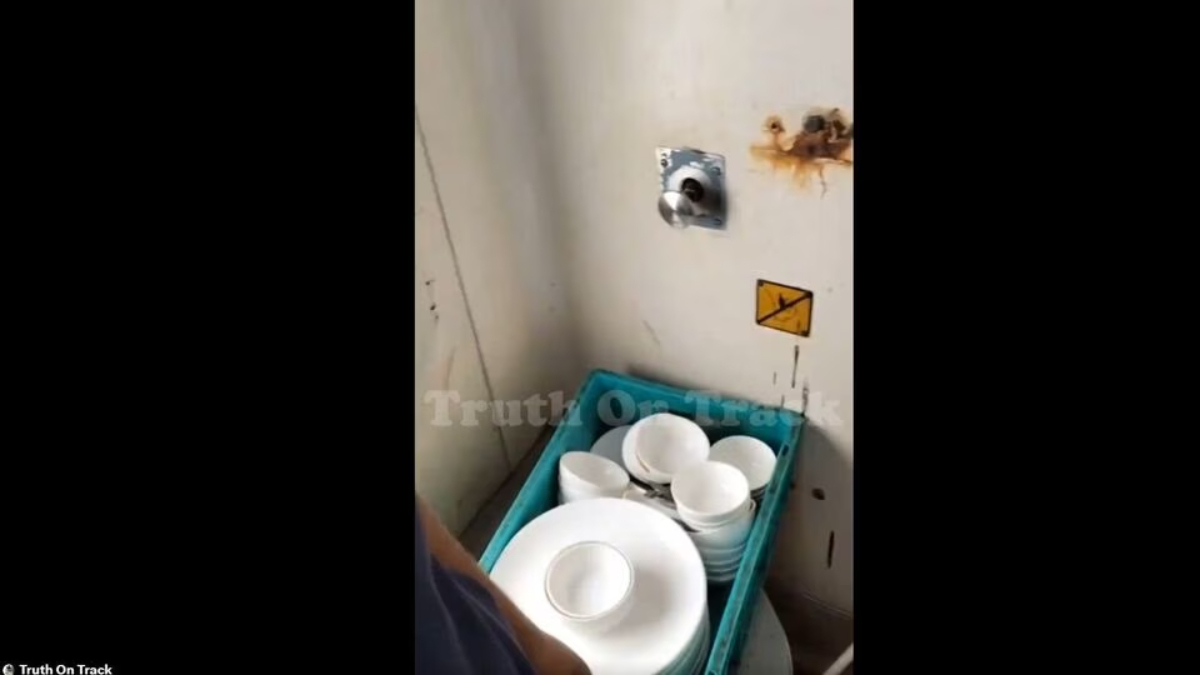
NEW DELHI — In a major embarrassment for the Indian Railways, the Food Safety and Standards Authority of India (FSSAI) has issued a strict statutory notice to the Indian Railway Catering and Tourism Corporation (IRCTC). The regulatory intervention comes on the heels of a viral social media video showing onboard catering staff washing food utensils inside a train toilet cubicle. Terming the incident “extremely unhygienic” and “highly objectionable,” the apex food safety body has demanded an immediate, detailed explanation alongside a comprehensive Action Taken Report (ATR) from the railway ticketing and catering giant.
The controversy erupted when an onboard passenger filmed the sickening breach of hygiene in the premium First AC (H1) coach of Train No. 12223, the Lokmanya Tilak Terminus (Mumbai) to Ernakulam Duronto Express. The video, widely circulated by passengers and political groups online, captures a catering worker handling food plates and cutlery in cramped toilet premises, with crates of service utensils resting dangerously close to the toilet commode during lunch service. The shocking visual evidence has reignited fierce national debates surrounding basic health compliance, passenger safety, and the oversight of third-party contracts within India’s massive railway catering network.
The Confrontation and the Regulator’s Sharp Response
The passenger who recorded the video can be heard directly confronting the worker, asking, “What are you doing? Is this an appropriate place for this?” The catering employee remains silent in the footage. When the passenger shifts his focus to a train attendant standing right outside the door, the attendant initially claims ignorance. However, upon being pressed about whether the dirty dishes were being prepared for immediate food service, the attendant responds, “The people who wash them usually do it there,” pointing away but confirming a systemic failure in routine washing protocols.
Taking suo motu cognizance—meaning acting on its own initiative without a formal written complaint—the FSSAI stepped in quickly to penalize the lapse. In its legal notice, the food regulator observed that such practices are in severe contravention of Schedule 4 of the Food Safety and Standards (Licensing and Registration of Food Businesses) Regulations, 2011. These statutes legally mandate all registered food operators to maintain sterile processing, handling, and cleaning procedures to actively prevent the contamination of food-contact surfaces.
Demanding Corporate and Operational Accountability
The food safety authority’s statutory directive leaves little room for ambiguity. The FSSAI has ordered IRCTC to clarify whether the onboard catering operations for the Duronto Express were being managed directly or outsourced to a private licensee or third-party contractor. If a contractor was running the pantry, the IRCTC must hand over full corporate details, including the contractor’s valid FSSAI license number.
Furthermore, the regulator is looking beyond just immediate firings. The FSSAI has demanded proof of training. It has asked IRCTC to submit full logs of the Food Safety Training and Certification (FoSTaC) programs completed by the food handlers and catering personnel deployed on that route. This requirement is intended to determine whether the staff intentionally flouted rules or lacked basic training regarding foodborne pathogens, contamination zones, and kitchen sanitation.
IRCTC Intervenes, Issues Heavy Penalties
As public outrage mounted across platforms like X (formerly Twitter), the IRCTC issued a public statement confirming that immediate damage-control steps had been taken. According to railway officials, the recorded incident occurred during a journey, and the department responded swiftly once the video surfaced.
In an official update, the IRCTC stated:
- Contractor Penalized: A hefty financial penalty has been slapped against the third-party catering service provider responsible for the onboard service on that specific train.
- Staff Terminated: The contract workers visible in the video and their immediate supervisors were taken off duty with immediate effect.
- Licensing Clarification: IRCTC pointed out that all its mobile catering units operate using valid FSSAI licenses issued via designated railway authorities rather than regular regional FSSAI offices, assuring passengers that standard licensing parameters remain active across the board.
Despite the corporate pushback, the public response remains highly critical. Many frequent travelers have pointed out that premium trains like the Duronto and Rajdhani Express charge substantial catering fees built directly into ticket prices. Discovering that luxury coach passengers are being served food on plates scrubbed adjacent to a train lavatory commode has caused deep resentment among regular commuters.
A Repeated Pattern of Quick-Commerce and Public Oversight
This is not the first time the FSSAI has weaponized viral social media trends to crack down on corporate food operations. Earlier, the regulator initiated suo motu action against quick-commerce delivery platforms following widespread online complaints from consumers regarding spoiled or unhygienic item drop-offs. Food safety experts note that as smartphone recording makes daily operations highly transparent, major food companies can no longer rely on internal audits alone to hide poor sanitation practices.
Moving forward, the FSSAI has commanded the Indian Railways to enforce ironclad compliance with national food standards to ensure similar events do not recur. Railway passenger associations are now calling for fixed CCTV cameras inside pantry cars and dedicated dishwashing stations at primary terminals so that staff are never forced—or tempted—to utilize passenger restrooms for commercial cleaning.
The IRCTC’s comprehensive report, outlining detailed structural reforms and future preventative actions against negligent contractors, is expected to be scrutinized heavily by central food inspectors before the case is officially closed.