

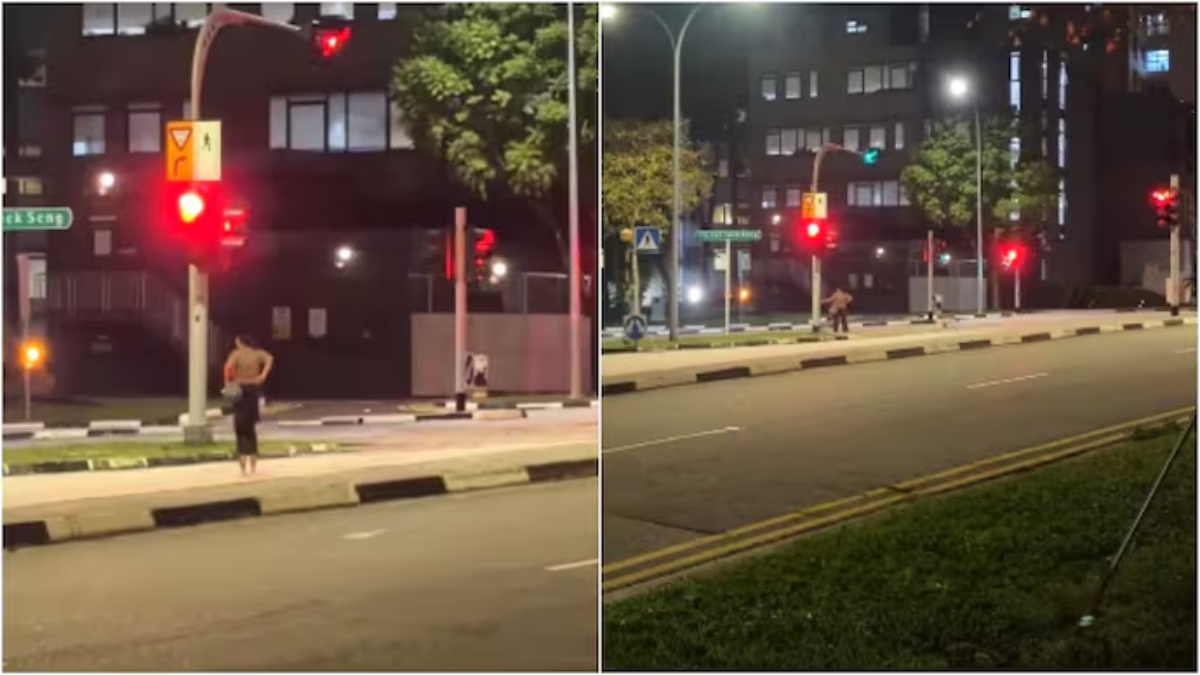
New Delhi, June 4, 2026: In the quiet, early morning hours of a humid Singapore night, an Indian content creator captured a completely mundane moment. There were no dramatic car chases, no celebrity sightings, and no shocking plot twists. Yet, the 15-second video clip she uploaded exploded across social media, clocking over 44 million views and sparking an intense international conversation about human behavior, governance, and societal values.
The video, filmed and shared by Kritika Jain, featured a deserted intersection in Singapore at exactly 1:00 AM. The streets were dead silent, devoid of oncoming cars, patrolling police officers, or flashing headlights. On the curb stood a lone pedestrian. Despite the absolute absence of traffic and any threat of danger, the individual stood completely still, patiently waiting for the pedestrian crossing light to change from red to green before taking a single step forward.
Jain overlaid the video with a simple, profound observation: “Watching a random person in Singapore at 1 am waiting for the pedestrian light to turn green demonstrates how small habits shape a country.” What followed was a massive wave of digital engagement that analyzed a fundamental question: Why do we do the right thing when we think nobody is watching?
The Anatomy of 44 Million Views
To understand why such a regular occurrence captured the fascination of tens of millions of people, one must look at the global contrast in civic behavior. In many major cities around the world—including Jain’s home country of India—an empty road at midnight is an automatic invitation to cross. Pedestrians and motorists alike routinely treat red lights as optional suggestions if there is no immediate traffic or active law enforcement nearby.
When the video hit social media feeds, it held up a mirror to public discipline. Netizens divided the phenomenon into two distinct schools of thought:
- The Fear of Consequences: Critics and skeptics quickly pointed out that Singapore is globally famous for its strict laws, widespread CCTV surveillance, and heavy fines—often colloquially dubbed a “fine city.” In this view, the pedestrian wasn’t acting out of pure moral goodness, but rather out of a conditioned fear of getting caught by a camera or facing a hefty jaywalking ticket.
- The Power of Social Norms: On the other side, millions viewed the behavior as a beautiful display of internalized civic responsibility. They argued that while strict enforcement might build a habit initially, it eventually evolves into an unconscious cultural norm. People wait for the light not because they fear a fine, but because “this is just what we do here.”
As the debate raged, comments flooded in from all corners of the globe. One viewer summed up the sentiment perfectly, writing, “Discipline at its highest level.” Another noted, “People often talk about structural development, but real development is visible in how citizens behave in public spaces.”
When Discipline Becomes the Default
Living in a high-trust society alters human psychology in subtle ways. In interviews following the viral explosion of her video, Jain reflected on her experiences living in the city-state. She noted that the viral moment wasn’t an isolated incident, but rather a reflection of a deeper consideration for shared public spaces that defines daily life in Singapore.
This internalized discipline creates a powerful domino effect. When a citizen looks around and sees that 99% of their peers respect the rules, the psychological cost of breaking those rules increases. Jaywalking across an empty street suddenly feels uncomfortable because it breaks a shared social contract. This invisible psychological force is exactly what keeps an individual standing patiently at a curb at 1:00 AM.
Interestingly, Jain mentioned that her video was inspired by a similar viral clip filmed in Japan by creator Luis Nico, where a pedestrian displayed identical discipline at 4:00 AM on a completely barren street. The cross-cultural mirroring highlights a universal truth: the world deeply admires organized, respectful societies, even if achieving that level of order requires a complete overhaul of personal habits.
The Two Sides of a Structured Paradise
While the viral video cast a glowing spotlight on Singapore’s impeccable public order, it also opened up a broader conversation about what it takes to build and maintain such a society. Total public compliance comes with its own unique ecosystem, and Jain was quick to point out the nuanced realities that tourists or casual online viewers might miss.
While Singapore offers unparalleled efficiency, world-class public infrastructure, and a stress-free environment, it operates within a highly regulated framework. The cost of living is notoriously high, and the sheer predictability of life can sometimes contrast sharply with the vibrant, chaotic energy of other cultures.
“The sense of community and spontaneity in India is something I really value,” Jain admitted when comparing her experiences. “There’s a warmth in everyday interactions, and being close to family, friends, and cultural traditions is something that’s hard to replace.”
The True Luxury of the Modern Era
Ultimately, the reason a simple traffic signal clip captured 44 million eyes is because it represents a rare commodity in the modern world: absolute peace of mind. In separate videos, Jain has documented walking home alone at 3:00 AM in Singapore, highlighting that she can do so without looking over her shoulder or feeling a flicker of fear—a reality that sounds like science fiction to women in many other parts of the world.
The 1:00 AM pedestrian video proves that a nation’s strength isn’t just measured by its GDP, its glittering skyscrapers, or its tech sectors. Instead, true civilizational progress is measured in the quietest, darkest hours of the night, when an ordinary citizen chooses to respect the law simply because they value the system they live in. It turns out that macro-level national success is built entirely on a foundation of micro-level human choices.