

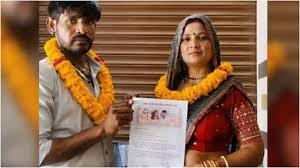
New Delhi, June 10, 2026: The boundaries of traditional family structures are frequently tested in the digital age, but a recent incident from Uttar Pradesh has pushed public discourse into unprecedented territory. In Kanpur Dehat’s Akbarpur area, a 35-year-old man reportedly dissolved his marriage with his 27-year-old wife to legally wed his 52-year-old mother-in-law. The unconventional union came to light after a video surfaced on social media showing the newlywed couple in a local court, smiling broadly, exchanging traditional garlands, and proudly displaying an official marriage certificate. The clip quickly went viral, igniting a fiery national debate regarding moral boundaries, legal loopholes, and changing societal dynamics in rural India.
The Anatomy of a Family Fracture
According to local reports and community accounts, the foundations of this unusual union began long before the court video made its way online. The man had been married to his young wife for roughly a year. What was initially expected to be a standard domestic life quickly deteriorated as a secret relationship allegedly developed between the husband and his mother-in-law during his routine visits to his in-laws’ house.
Over several months, the closeness between the two grew into a romantic involvement. Neighbors and local residents noted that the pair had been in regular, conspicuous contact, raising eyebrows within their close-knit locality. The situation reached a boiling point when the 27-year-old wife reportedly discovered the clandestine affair. Confrontations shook the household, leading to an absolute fracture of the marriage. Rather than seeking mediation or attempting to patch up the relationship, the husband and his mother-in-law took the definitive step to formalize their bond, culminating in a quiet court marriage under secular statutes.
The Viral Video and the Call for Public Acceptance
The story transformed from a private family tragedy into a massive internet sensation when the couple chose to document and share their marriage ceremony. The viral video, heavily overlayed with a romantic soundtrack specifically themed around court marriages, shows the 35-year-old son-in-law and the 52-year-old mother-in-law standing outside a court facility. They are seen smiling, ritualistically placing garlands around each other’s necks, and holding up their legal documentation for the camera.
What shocked viewers most was the couple’s direct appeal to the public. Instead of hiding their relationship from standard societal judgment, the duo looked directly into the camera to defend their union, stating that the marriage was entirely mutual, consensual, and born of personal choice. They openly asked viewers for their “blessings” and urged the public to accept their new reality. While the authenticity of the paperwork displayed is still undergoing thorough public and administrative scrutiny, the unbothered demeanor of the couple added a layer of shock value that sent the clip across major digital platforms.
Police Investigation and Legal Complexities
As the video saturated timelines and local WhatsApp groups, the intense public reaction eventually forced the authorities to step in. The Akbarpur Police Station in Kanpur Dehat launched an official inquiry into the video to verify its origins and the validity of the claims made within it. Local administrative and police officials have noted the bizarre nature of the case, but they are facing a highly distinct legal landscape.
Because the marriage appears to have been carried out by two consenting adults under a court framework, authorities have stated that no cognizable or clear criminal offense has been committed at first glance. However, legal experts are watching the development with extreme interest. Under traditional Hindu matrimonial laws, a mother-in-law falls under the category of “prohibited relationships,” which typically voids a marriage unless established customs dictate otherwise. However, because the couple claims to have opted for a secular court marriage—likely under the Special Marriage Act—the legal parameters shift completely toward individual autonomy, creating a highly complex gray area for both law enforcement and civil lawyers.
Social Media Outrage and Cultural Debate
The public reception to the viral video has been deeply polarized, serving as a mirror to India’s shifting and fractured cultural values. On one side of the digital spectrum, a massive wave of criticism, shock, and moral condemnation has flooded comment sections. Many netizens have labeled the event as a severe violation of sacred family ethics, using phrases like “the downfall of societal values” to describe how an individual could break his wife’s trust to marry her own mother. Cultural traditionalists argue that such incidents permanently damage the sanctity of domestic roles, where a mother-in-law is traditionally viewed as a maternal guardian rather than a romantic partner.
Conversely, a small but vocal minority on platforms like Reddit and X (formerly Twitter) have viewed the incident through a lens of absolute legal individualism. These commentators argue that since both participants are mature, consenting adults capable of making their own life choices, the state or public has no business intervening or moralizing over their private domestic arrangements. Others have reacted with dark humor and sheer disbelief, comparing the real-life Kanpur drama to the bizarre plotlines of prime-time television serials.
A Growing Trend of Outlandish Unions?
The incident in Kanpur Dehat is not an isolated spark; it echoes a string of increasingly unusual relationship dynamics emerging out of Uttar Pradesh that have captured national curiosity over the last few years. Local media outlets immediately drew comparisons to a highly similar case reported a few months prior in Aligarh, where a parallel son-in-law and mother-in-law romance resulted in an elopement and subsequent legal dispute.
As personal autonomy collides head-on with rigid traditional systems, and as smartphones ensure that every taboo choice is recorded and broadcasted to millions instantly, rural and semi-urban India is finding its private lives increasingly laid bare. For now, the Kanpur couple remains together, waiting for the digital storm to pass, while a baffled community and a cautious police force try to figure out how to navigate a domestic situation that has completely re-written the conventional rulebook of family life.