

New Delhi, June 29, 2026 — In a major diplomatic breakthrough aimed at preventing a full-scale regional escalation, the United States and Iran have agreed to halt active military strikes against each other. A senior U.S. official confirmed early Monday that both sides will “stand down” for now, allowing commercial vessels to move freely through the highly contested Strait of Hormuz.
The emergency de-escalation comes after several days of intense, tit-for-tat military clashes that threatened to completely tear apart a fragile, Pakistan-brokered peace agreement signed earlier this month. With global energy markets on edge and regional stability hanging by a thread, negotiators from Washington and Tehran are now rushing to Doha, Qatar, for critical face-to-face technical talks scheduled for Tuesday, June 30.
A Sudden Flare-Up Threatens the June 17 Peace Pact
The recent wave of violence shocked international observers, coming just weeks after U.S. President Donald Trump and Iranian President Masoud Pezeshkian remotely signed the Islamabad Memorandum of Understanding (MoU) on June 17, 2026. That historic framework was designed to end the devastating war that erupted in February, establishing a clear trade-off: Tehran would guarantee the safe passage of commercial vessels through the Strait of Hormuz, while Washington would lift its crippling naval blockade on Iranian ports.
However, theory quickly collided with reality over the weekend. Following a series of hardline statements and disputes over unfulfilled conditions, Iran launched a barrage of missiles and drones targeting U.S. military positions in Kuwait and Bahrain. The assault came shortly after the U.S. administration issued warnings demanding strict adherence to the peace terms.
In response to the latest flare-up, the upcoming round of diplomatic talks—initially planned to take place under a neutral framework in Switzerland—was abruptly moved to the Qatari capital of Doha. The shift highlights the urgency of addressing the immediate naval and military standoff before broader geopolitical negotiations can resume.
The Strait of Hormuz Standoff and Financial Ripple Effects
At the absolute center of the dispute is the Strait of Hormuz, a narrow waterway responsible for the transit of roughly one-fifth of the world’s petroleum. Over the weekend, Iranian diplomats strongly warned global shipping companies against trying to bypass its preferred maritime routes, stating that any unilateral changes would only heighten regional friction.
The military friction had an immediate, nervous impact on global markets on Monday morning:
- Crude Oil: Brent crude futures reacted to the weekend strikes by climbing 0.69% to $72.49 a barrel, while U.S. West Texas Intermediate (WTI) rose over 1% to near $70 a barrel.
- Safe-Haven Assets: Gold prices saw minor fluctuations, easing slightly to $4,061 per ounce as the announcement of the renewed diplomatic push in Doha tempered immediate fears of an uncontrolled war.
- Global Equities: In India, the benchmark Nifty 50 and BSE Sensex opened relatively steady, as investors breathed a sigh of relief over the U.S.-Iran pause, balancing the weekend’s bad news against the fresh promise of diplomacy. www.thehindu.com
Gaps and Disagreements Remain Wide
Despite the agreement to stop shooting, the underlying issues separating Washington and Tehran remain massive. Iranian state media indicated that Tehran intentionally pulled back from certain sub-committee meetings over the weekend, citing unfulfilled American promises regarding economic relief.
Specifically, Iranian officials are demanding immediate, verifiable verification that billions of dollars in previously frozen foreign assets have been successfully unlocked and made accessible. “If there is no access, then this condition has not been fulfilled,” noted an official close to the leadership in Tehran, emphasizing that Iran will not offer maritime concessions if it does not receive the promised financial breathing room.
Furthermore, domestic political pressure is mounting on both sides. Hardline factions within Iran have openly criticized the negotiations, while Washington faces intense pressure to ensure that any final agreement permanently curtails Iran’s advanced nuclear enrichment program.
The Complicating Lebanon-Israel Factor
Making the West Asia security landscape even more complicated is the highly volatile situation on the Israel-Lebanon border. While the U.S. and Iran are attempting to cool their direct conflict, a parallel regional tracking framework is facing severe turbulence.
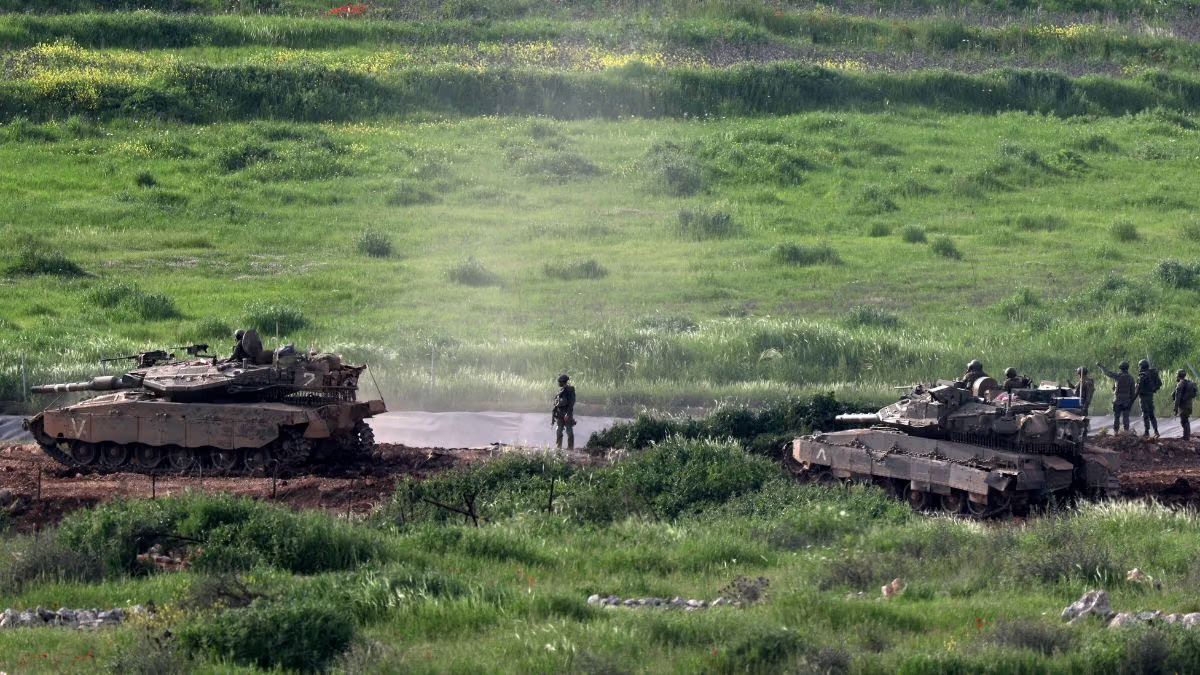
Despite a recently signed trilateral agreement aimed at ending hostilities between Israel and Lebanon, the Israeli military confirmed it conducted targeted operations over the weekend, destroying a complex network of underground Hezbollah infrastructure in southern Lebanon. Israel noted that it had briefed Washington prior to the operation. The ongoing friction resulted in the combat death of a 21-year-old Israeli platoon commander, proving how easily local clashes can boil over.
Compounding the problem, Hezbollah leadership and Lebanese Parliament Speaker Nabih Berri have aggressively pushed back against the current terms of the trilateral peace framework. Berri declared early Monday that the agreement “will not pass” or be implemented in its current form, labeling it a set of “dictates” that fails to protect Lebanese sovereignty and unfairly demands the immediate disarmament of Hezbollah. In turn, Hezbollah stated it reserves the absolute right to self-defense against what it terms “blatant violations” of the truce by Israeli forces.
What to Expect Next in Doha
As international mediators from Qatar, Saudi Arabia, and Pakistan work behind the scenes to keep the peace process alive, all eyes turn to the high-stakes meeting in Doha on Tuesday.
The immediate goal for the technical teams is to establish an ironclad, temporary maritime protocol for the Strait of Hormuz to ensure oil tankers can navigate without fear of drone strikes or naval seizures. Only if this baseline stability is secured can the two nations begin tackling the much larger, structural components of the Islamabad Memorandum—including permanent sanctions relief, nuclear oversight, and regional proxy rules.
For a world economy highly sensitive to energy supply disruptions, the next 48 hours of quiet diplomacy in Qatar will likely determine whether West Asia transitions toward a hard-fought peace or slips back into open warfare.