

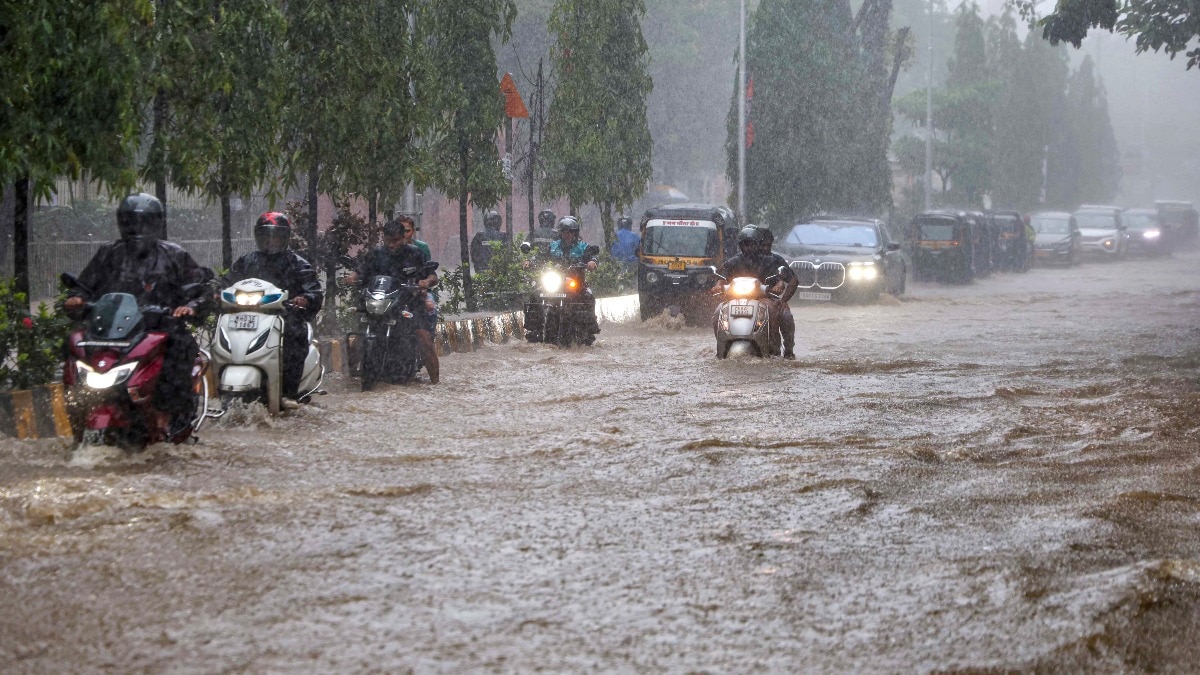
New Delhi, July 6, 2026 — A fierce and unrelenting spell of monsoon fury has brought India’s financial capital and its neighboring regions to a virtual standstill. On Monday morning, July 6, 2026, the India Meteorological Department (IMD) upgraded its weather warning from an ‘orange’ to a maximum ‘red’ alert for Mumbai, Thane, and Raigad.
Forecasting extremely heavy rainfall accompanied by fierce, gusty winds reaching speeds of 70 to 80 kmph, the weather agency has issued an urgent advisory asking citizens to strictly avoid any unnecessary travel.
The regional impact has been immediate and severe. Rivers are swelling close to danger marks, low-lying urban pockets are heavily waterlogged, and crucial arterial transit links—including the vital Mumbai-Pune Expressway—have been entirely shut down due to landslides and flooding.
Unprecedented Rainfall Numbers Battered the Coast
The sheer volume of water dumped over the Mumbai Metropolitan Region (MMR) within a 24-hour window explains the rapid inundation. Automated rain gauges monitored by the Brihanmumbai Municipal Corporation (BMC) and the IMD indicated staggering precipitation levels, with many areas crossing the 200 mm mark, and several critical hubs recording nearly 300 mm of rain.
- Vikhroli (West): Recorded the highest localized downpour at 310.6 mm.
- Colaba Pumping Station: Gauged 306.6 mm of continuous rainfall.
- Santacruz Observatory: Recorded 109.6 mm in a standard 24-hour loop, pushing the seasonal total past 40% of its annual average in just the first week of July.
The IMD warned that this intense, continuous rainfall has heavily saturated the soil, greatly elevating the sudden risk of flash floods, localized riverine overflows, and dangerous cloud-to-ground lightning strikes.
Fatalities and Severe Infrastructure Collapses
The relentless rain has unfortunately taken a tragic human toll. At least eight deaths have been reported across the region due to rain-related incidents.
In Mumbai’s Mankhurd area, a sudden structural failure caused a three-storey chawl (row tenement house) to collapse late Sunday night. Emergency response teams rushed to the site, but officials confirmed that the collapse tragically left six people dead, including five children, while others sustained severe injuries.
In Navi Mumbai’s Belapur village, residents had a narrow escape when the balcony of a severely dilapidated building crumbled under the weight of the water. Meanwhile, out in the wider Pune district, the National Disaster Response Force (NDRF) rushed a specialized 30-member team to Patan village in Mawal taluka, where a major landslide struck a residential home early Monday morning, leaving an entire family feared trapped under thick mud and debris.
Mega Transit Failure: Highways Closed, Flights and Trains Suspended
Commuters trying to move through the region faced complete gridlock as road, rail, and air traffic networks took a massive hit.
1. Road Networks & Expressways
The Maharashtra State Road Development Corporation (MSRDC) and local police took the extraordinary step of suspending all traffic on both the Pune-Mumbai Expressway and the Old Pune-Mumbai Highway. A massive landslide near the Khopoli-Kusgaon ‘Missing Link’ project partially buried the Mumbai-bound carriageway with boulders and thick mud. Extreme flooding in areas like Maval and the Tamhini Ghat has rendered alternate routes entirely impassable. Authorities have explicitly requested citizens to postpone all travel plans between Mumbai and Pune until the debris is cleared.
2. Railways
Suburban local trains—often called the lifeline of Mumbai—experienced major cascading delays. While the Western Railway managed to keep trains crawling despite receiving over 250 mm of rain on its tracks, sections of the Central Line and suburban networks extending into Raigad were temporarily halted due to water overlapping the tracks. Long-distance train services connecting Mumbai to Pune and southern India have been either cancelled, rescheduled, or short-terminated at outer stations.
3. Aviation
Flight operations at Chhatrapati Shivaji Maharaj International Airport (CSMIA) faced severe delays. Heavy crosswinds and dropping visibility forced air traffic control to completely suspend runway operations for roughly an hour on Sunday night, resulting in multiple flight diversions to nearby airports and leaving thousands of passengers stranded inside terminal buildings.
Widespread Shutdown of Educational Institutions and Exams
Recognizing the growing severity of the situation, state and civic administrations stepped in early Monday morning to protect students. Emergency holidays have been officially declared for all government, private, and civic-run schools, as well as colleges, across Mumbai, Thane, Palghar, and Pune.
Additionally, the University of Mumbai announced the immediate postponement of all higher education examinations scheduled for Monday, July 6. The university administration noted that revised dates will be issued dynamically once the weather normalizes, emphasizing that student safety remains the absolute priority.
The Weather Outlook
The immediate forecast offers very little breathing room. According to the IMD’s nowcast, the combination of a well-marked depression over the Bay of Bengal and active offshore trough conditions along the Konkan coast will continue to pump immense moisture into Maharashtra.
The red alert warning remains active, and residents are strongly encouraged to monitor local news channels, strictly follow traffic advisories, and keep emergency supplies ready as civic authorities scramble to pump out water from flooded city streets.