

July 7, 2026 — It is an annual script that Mumbaikars know all too well: the arrival of the monsoon brings the financial capital of India to a grinding halt. However, this season, a popular television actor’s biting satire has transformed a routine infrastructural failure into a national conversation, putting the Brihanmumbai Municipal Corporation (BMC)—widely recognized as Asia’s richest civic body—firmly in the crosshairs of public anger.
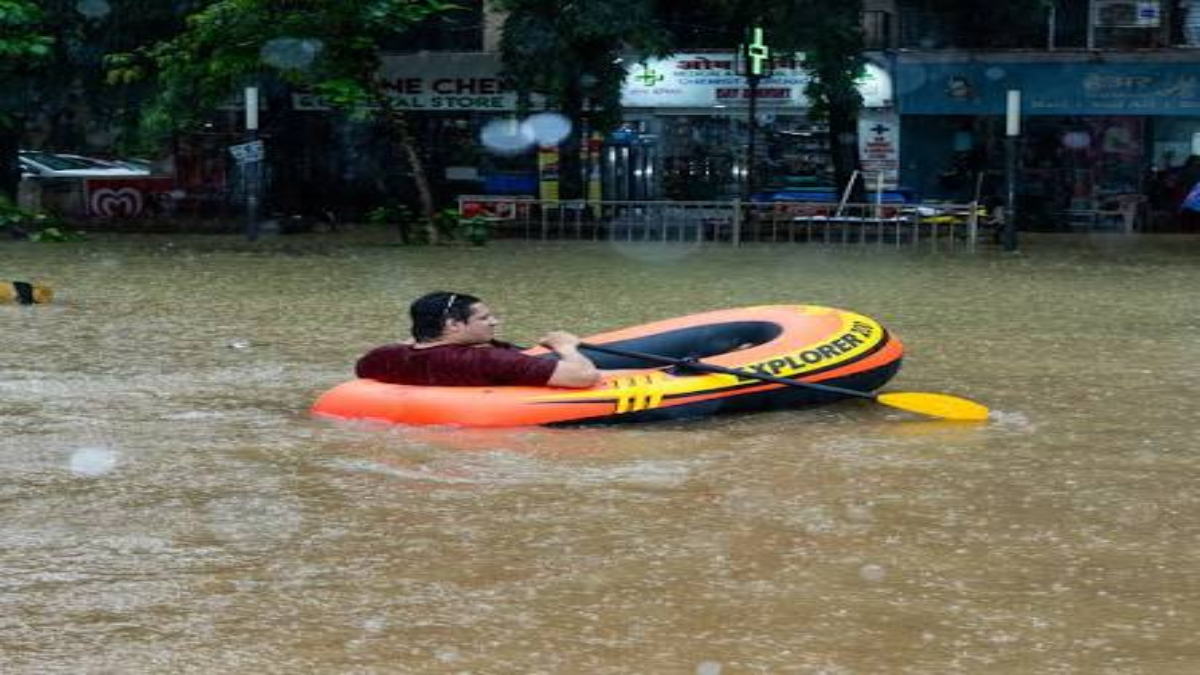
Actor Ayyaz Ahmed, a familiar face from popular television shows like Kaisi Yeh Yaariaan and Roadies, became the unlikely face of Mumbai’s citizen rebellion. In a video that quickly garnered nearly half a million views across social media platforms, Ahmed is seen navigating the flooded streets of Andheri’s Veera Desai Road not by car or local rickshaw, but inside a bright orange “Explorer 200” inflatable raft.
Dressed casually and balancing an umbrella in one hand while expertly maneuvering his plastic oars through knee-deep muddy waters, Ahmed captioned his viral clip, “Mumbaikar in Every Monsoon.”
Satire Meets Severe Reality
While the internet erupted into a mixture of laughter and applause over the actor’s creative commute, the underlying reality behind the humor remains grim. The India Meteorological Department (IMD) issued a severe red alert for Mumbai and adjoining districts, as parts of the city recorded a staggering 200 mm to 300 mm of localized rainfall in an incredibly compressed timeframe.
The sudden deluge severely fractured the city’s critical infrastructure:
- Subway Closures: The notorious Andheri Subway, a vital artery for cross-city travel, was entirely shut down after water accumulation topped three to four feet.
- Transit Delays: Lifeline local trains on the Central and Western lines crawled with consistent delays, while severe bumper-to-bumper waterlogging choked the Western Express Highway.
- Aviation Disruption: Even air travel felt the impact, with multiple Mumbai-bound flights forced to divert to airports in Gujarat and Goa due to near-zero runway visibility.
When a national Hindi news channel spotted Ahmed on his boat during a live broadcast, the reporter waded into the water to ask if he planned to travel like this permanently. Ahmed responded with an edge of sarcasm that resonated with millions: “The cars are breaking down. Electricity is getting more costly. So… this is the only option left.”
“Richest Civic Body, Poorest Performance”
The viral imagery acted as a lightning rod on social media, prompting citizens to question the financial management of the BMC. For decades, the BMC has held the title of the wealthiest municipal body in India, wielding an annual budget that rivals or exceeds those of several smaller Indian states.
Online commentators were quick to point out the stark contrast between the civic body’s vast financial resources and the visible lack of progress on the ground.
Other users jokingly dubbed Ahmed’s inflatable raft as Mumbai’s “new approved auto-rickshaw” or mockingly welcomed him to the beach. Behind the memes, however, lies a deep sense of taxpayer betrayal. Every year, civic authorities promise that extensive desilting (clearing mud from drains) and structural modifications will guarantee a flood-free monsoon. Yet, the moment a heavy downpour hits, the drainage network experiences immediate strain, leaving residents to deal with flooded basements, ruined vehicles, and major safety hazards.
The True Cost of Infrastructure Failures
While Ahmed’s video highlight the absurdity of the situation through comedy, the consequences of Mumbai’s crumbling infrastructure are frequently tragic. Beyond disrupted schedules and stalled business operations, poorly maintained drainage networks present an immediate danger to human life. Just days into the heavy rains, a resident tragically lost their life after falling into an open, flooded manhole—an incident that forced a heavily scrutinized BMC to suspend four local officials.
The corporation, for its part, released rain data noting that the city had received an average of 153 mm of rain in a 24-hour window, pointing to climate irregularities and high-tide overlaps as the primary culprits. They also highlighted their pre-monsoon tree-trimming and preventive safety drives.
However, citizens remain unpersuaded by administrative explanations. The consensus across social media platforms is clear: a city that functions as the country’s economic engine should not require its taxpayers to purchase inflatable boats to cross a main road. Until structural accountability matches the scale of the civic budget, Mumbaikars will continue to rely on dark humor—and rafts—to stay afloat.