

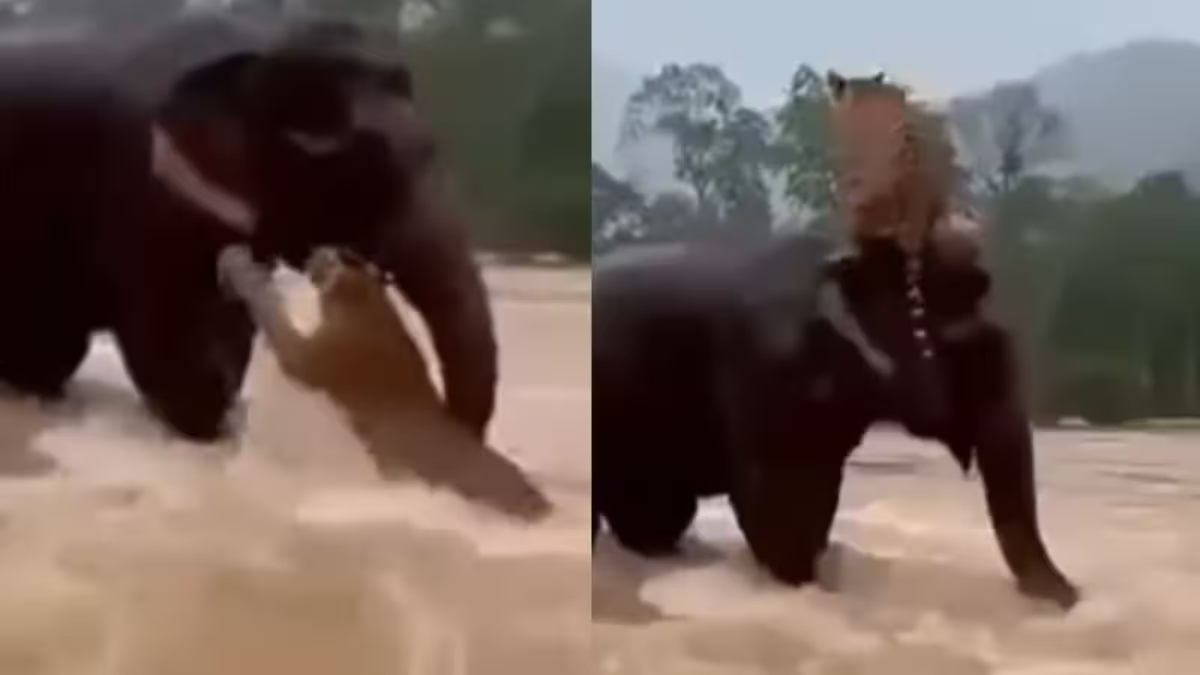
New Delhi, July 10, 2026: An extraordinary video has been circulating across social media platforms, leaving millions of viewers deeply moved. The footage depicts a dramatic, heartwarming scene: a massive Sumatran elephant carefully wading through raging, muddy floodwaters to rescue a struggling, drowning tiger. As the powerful current threatens to sweep the big cat away, the elephant uses its strength to intervene, seemingly guided by an cross-species empathy.
The clip, shared widely on platforms like X (formerly Twitter), Facebook, and Instagram, has been praised by thousands of internet users as a “rare and touching miracle of nature.” Captions accompanying the video often state that it was captured during recent flash floods. However, beneath the emotional pull of this footage lies a more complicated reality. Despite how remarkably convincing the clip appears, investigative deep-dives and digital forensics have confirmed that this dramatic animal rescue never actually happened. The video is entirely generated by artificial intelligence (AI).
How the Deception Unraveled
As the video quickly grew in popularity, especially amidst the heavy monsoon seasons affecting several regions, it caught the attention of fact-checkers and digital forensic experts. Upon initial viewing, the scene looks flawless. The weight of the elephant, the movement of the rushing water, and the panic of the tiger all feel intensely real. However, advanced AI detection systems quickly spotted the digital fingerprints left behind by machine-learning models.
According to a detailed analysis by regional fact-checking outlets like Tempo.co, specialized AI detection software run on the clip revealed a 93.7 percent probability that the visual was entirely synthetic. Multiple independent verification tools backed up these findings, identifying systemic anomalies that are highly characteristic of text-to-video AI generators.
While AI has gotten incredibly skilled at rendering realistic lighting and physics, it still struggles with fine textures and consistency over time. Experts pointed out that the water surrounding the elephant had an unnaturally smooth texture in certain frames, almost looking like fluid plastic rather than real, chaotic floodwater. Furthermore, a strange, overly glossy sheen blanketed the entire frame—a common byproduct of video generation models trying to blend complex light reflections across a moving surface.
The biggest giveaway, however, was the tiger itself. When analyzing the footage frame-by-frame, investigators noticed that the tiger’s iconic stripes blurred, shifted, and subtly rearranged themselves as the animal moved through the water. In the real world, an animal’s coat pattern remains perfectly fixed to its skin; in the world of AI, keeping track of highly intricate patterns on a moving, twisting body remains a massive technical hurdle.
An Old Digital Fabrication with a New Identity
This viral sensation is not a brand-new creation. Investigative trails reveal that the video first surfaced online around November 2025. At that time, Sumatra, Indonesia—specifically regions like Aceh and North and West Sumatra—was experiencing devastating real-world flooding caused by Cyclone Senyar.
During the height of that genuine natural crisis, an anonymous creator likely used a generative AI platform to create the fictional rescue, perhaps as a creative exercise or an attempt to bring a piece of hopeful fiction to a grim news cycle. The clip went viral on Indonesian social media before fading away.
Fast-forward eight months to July 2026. As heavy monsoon rains began battering parts of India and South Asia, triggering severe regional flooding, the video was quietly resurrected. Stripped of its original timeline, it was repackaged with fresh captions and recontextualized as a piece of breaking news. This cycle of “digital recycling” is a growing trend online, where older AI-generated content is continuously repurposed to match whatever real-world disaster is currently dominating the news cycle.
Why This Matters: The Threat to Real Conservation
While a video of an elephant saving a tiger might seem like a harmless, feel-good story, conservationists and digital experts warn that these fabrications carry real-world consequences. Both Sumatran elephants and Sumatran tigers are critically endangered species, facing severe threats from habitat loss, poaching, and human-wildlife conflict in their native Indonesian ecosystems.
When the public is flooded with hyper-realistic, fictionalized depictions of these animals harmoniously overcoming environmental disasters, it can inadvertently trivialize the very real dangers they face. Real floods do not feature miraculous cross-species rescues; they destroy fragile habitats, drown wildlife, and drive animals into dangerous closer proximity with human settlements.
Furthermore, the proliferation of AI-generated wildlife videos creates a “liar’s dividend.” As the internet becomes saturated with fake videos that look identical to real footage, the public may gradually stop believing genuine, hard-fought documentary evidence captured by actual field researchers and conservationists. If a real video of an incredibly rare animal behavior is captured, it risks being dismissed by a cynical public as “just another AI hoax.”
Spotting AI Wildlife Content in the Future
As generative video tools continue to improve, telling the difference between a real smartphone recording and an AI creation will only become more challenging. To protect yourself from being misled, digital literacy experts recommend keeping a few core rules in mind when viewing sensational animal videos:
The viral video of the Sumatran elephant and the tiger serves as a powerful reminder of the world we now inhabit. It highlights a digital landscape where our deepest emotional impulses—like our love for animals and our desire to see harmony in nature—can easily be manipulated by a few strings of code. Staying informed, questioning what we see, and relying on verified reporting remain our best defenses against the rising tide of digital misinformation.