

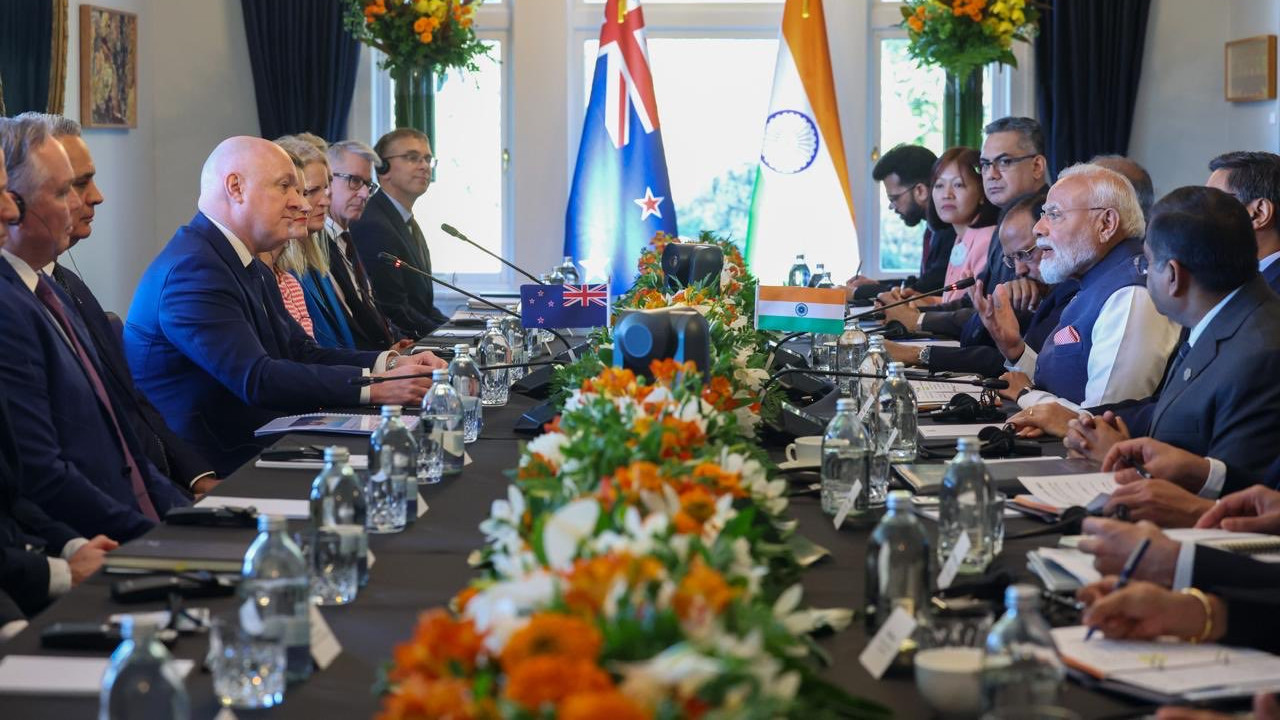
New Delhi, July 11, 2026: Auckland became the epicenter of a major diplomatic breakthrough as India and New Zealand officially elevated their bilateral relationship to a Strategic Partnership. The milestone announcement came during Prime Minister Narendra Modi’s historic official visit to New Zealand—the first by an Indian Prime Minister in 40 years—following high-level, wide-ranging talks with his Kiwi counterpart, Christopher Luxon.
The transition from a standard diplomatic relationship to a strategic partnership underscores a mutual desire to deepen geopolitical alignment, dramatically expand economic cooperation, and secure regional stability across the Indo-Pacific.
A Historic Breakthrough in Auckland
Prime Minister Modi arrived in Auckland on the final leg of a three-nation tour heavily focused on strengthening partnerships in the Indo-Pacific region. The meeting with Prime Minister Christopher Luxon was highly productive, resulting in 18 concrete outcomes and 10 formal agreements designed to drastically alter the trajectory of India-New Zealand ties over the coming decade.
The core of this upgraded relationship is anchored in the newly adopted “India-New Zealand Strategic Partnership: Roadmap to 2030.” This roadmap serves as an ambitious framework outlining specific targets and joint actions over the next four years across trade, defense, agriculture, innovation, and people-to-people connections.
The ₹35,000 Crore Trade Target
Economic diplomacy took center stage during the bilateral talks. Capitalizing on the recently signed India–New Zealand Free Trade Agreement (FTA), both leaders set a definitive five-year target to double their annual two-way trade in goods and services.
- The Target: Reaching NZD 7 billion (approximately ₹35,000 crore) by the year 2030.
- The Blueprint: Accelerating the early entry into force and effective implementation of the comprehensive FTA.
- The Impact: The agreement focuses heavily on removing trade barriers, simplifying customs procedures, and aggressively promoting New Zealand’s investment into India’s growing economy.
To ensure smoother trade pipelines, both nations agreed to operationalize the 2025 Authorised Economic Operators Mutual Recognition Arrangement (AEO-MRA), a mechanism designed to fast-track and simplify customs clearances for trusted businesses. PM Luxon noted that New Zealand is fully prepared to support India’s ambitious Viksit Bharat goal of becoming a fully developed nation by 2047 through specialized investments in innovation and clean energy.
Indo-Pacific Maritime Security and Defense Co-operation
With growing concerns over geopolitical friction and maritime safety in the Indo-Pacific, defense cooperation emerged as a critical pillar of the new strategic partnership. As two prominent maritime nations, India and New Zealand expressed a shared commitment to keeping the region free, open, inclusive, and prosperous.
Key Defense and Security Outcomes:
- Reciprocal Logistics Support: The Indian Navy and the New Zealand Defence Force signed a landmark mutual logistics agreement. This pact dramatically improves operational reach and interoperability, allowing both military forces to share refueling, repair, and supply facilities.
- Maritime Security Dialogue: A new institutional dialogue has been established to facilitate regular information exchange, coordination, and joint exercises between maritime authorities.
- Counter-Terrorism Joint Working Group: Both nations signed an arrangement to formalize intelligence sharing and combine efforts against violent extremism and transnational threats.
- Hydrography and Cartography: An implementation arrangement was reached to allow joint production of navigational charts and hydrographic data sharing, increasing maritime domain awareness.
Direct Flights, Tourism, and Cultural Ties
Beyond government-to-government pacts, the leaders placed immense value on connecting the people of both nations. A formal Memorandum of Arrangement on Tourism was signed, with both Prime Ministers actively encouraging commercial airlines to establish direct, non-stop flights between India and New Zealand in the near future to supercharge tourism and ease student travel.
Culture and community played a vibrant role during the visit. At a high-profile Business and Sports Engagement event in Auckland, PM Modi specifically lauded New Zealand’s indigenous Maori business leaders. Highlighting shared cultural values—such as a deep respect for nature, community focus, and sustainability—Modi revealed that distinct provisions have been integrated into the new FTA to ensure Maori enterprises can seamlessly engage in inclusive global trade with India.
Furthermore, cultural heritage saw an unexpected bridge build with a newly signed partnership between India’s upcoming National Maritime Heritage Complex (NMHC) in Lothal, Gujarat, and the New Zealand Maritime Museum to exchange design and architectural expertise.
Agriculture, Sports, and Global Alliances
The scope of the Roadmap to 2030 extends deep into primary industries and sustainability.
In agriculture, the two nations launched the Kiwifruit Action Plan, which establishes two distinct Centers of Excellence for Kiwifruit in the Indian states of Nagaland and Uttarakhand. This initiative allows New Zealand to transfer world-class agricultural technology and productivity action plans to Indian farmers, extending into apples, honey, forestry, and advanced dairy practices.
On the environmental front, New Zealand officially joined the India-led Global Biofuels Alliance, aligning its clean energy transition goals with international efforts to develop sustainable biofuels.
The extensive list of agreements concluded with arrangements to increase student mobility, boost research partnerships, and foster collaboration between major sporting institutions, given the deep-seated mutual love for cricket shared by both nations.
A Shared Global Vision
The bilateral meeting also touched upon urgent international matters. In a joint statement, Modi and Luxon expressed grave concern over the rising escalation of tensions in the Middle East. They collectively called for restraint, the immediate protection of civilians, and the complete restoration of freedom of navigation through the critical Strait of Hormuz.
Furthermore, aligning on global governance, both Prime Ministers strongly advocated for “bold and effective” reforms to the United Nations, explicitly endorsing the long-overdue expansion of the UN Security Council to reflect modern geopolitical realities.
As Prime Minister Modi concludes his landmark visit, the transition to a strategic partnership marks a turning point. By combining India’s massive market and economic momentum with New Zealand’s specialized innovation, agricultural mastery, and strategic position in the Pacific, the two nations have laid down a rock-solid foundation for a safer, wealthier, and deeply interconnected future.