

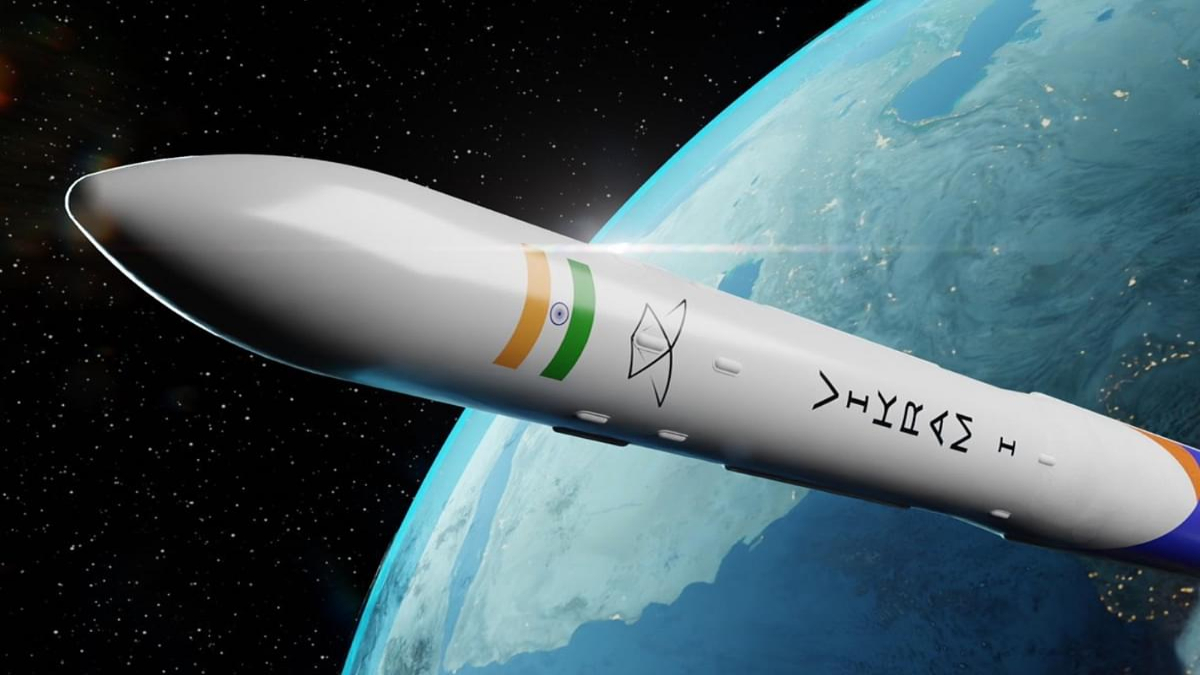
New Delhi, July 18, 2026 — In a historic leap that has permanently reshaped the landscape of global space exploration, India’s first privately developed orbital-class rocket, Vikram-1, successfully blasted into space on Saturday, July 18, 2026. Officially designated as “Mission Aagaman” (Sanskrit for “Arrival”), the textbook flight took off from the historic First Launch Pad at the Satish Dhawan Space Centre (SDSC-SHAR) at 12:05 PM IST, following a brief 35-minute hold to clear minor navigation checks. Within minutes, the seven-storey-tall vehicle achieved a flawless orbit, marking the arrival of India’s private sector into the highly elite global commercial launch marketplace.
The highly anticipated launch went off with absolute precision, proving the capability of the Hyderabad-based aerospace unicorn, Skyroot Aerospace. All four stages of the all-carbon-composite vehicle performed nominally on their very first attempt, drawing immediate praise from Prime Minister Narendra Modi. Celebrating the achievement over a personal call to the company’s founders, the Prime Minister highlighted that the young team had not only planted a new tree in the cosmos but had also strengthened India’s independent foundational roots in the global commercial space race.
Technical Feat: Engineering a “Cab Service” to Orbit
Standing roughly 22 meters tall (the height of a seven-storey building), the Vikram-1 rocket represents a massive engineering triumph. Designed specifically to address the skyrocketing global demand for small satellite launches, the vehicle can carry payloads weighing up to 350 kilograms into Low Earth Orbit (LEO). What makes this launch truly remarkable is the highly advanced, homegrown tech packed inside the architecture.
The rocket utilizes an extremely rigid and ultra-lightweight all-carbon composite frame. The three lower stages are powered by high-performance solid rocket motors, while the critical upper stage—known as the Orbit Adjustment Module (OAM)—runs on a liquid-fueled propulsion system. Crucially, this unique upper stage features engines that can be shut down and restarted multiple times mid-flight. This gives Vikram-1 the capability to execute complex drop-offs, delivering multiple customer satellites into entirely different orbits during a single journey—a capability Skyroot refers to as a literal “cab service to space”.
The Manifest: Cutting-Edge Tech and Interstellar Art
For its maiden flight, Mission Aagaman carried a carefully curated mix of critical technology demonstration satellites and symbolic payloads from both domestic and international customers:
- SOLARAS S3 (Grahaa Space): A state-of-the-art Earth observation satellite incubated at the Indian Institute of Space Science and Technology (IIST). Hindustan Times
- Embrace (Cosmoserve Space): An innovative robotic arm designed to capture and clear space debris, tackling a growing orbital environment concern. Hindustan Times
- SCOPE Payload (Skyroot Aerospace): Skyroot’s proprietary internal technology module to log flight dynamics.
- German Space Demonstration (DCUBED): A high-tech payload proving advanced deployable mechanisms in outer space. Hindustan Times
Beyond the purely industrial hardware, the rocket also transported highly unique cultural artifacts. It successfully deployed “Cosmic Bloom,” a specialized floral-shaped structural artwork crafted by lab-grown jewelry pioneer Cosmos Diamonds. Additionally, it carried a microscopic, 18-karat gold sculpture by master artist Ajay Kumar Mattewada. Smaller than a grain of rice, the micro-art piece holds the silhouettes of iconic Indian scientific pioneers: Dr. Vikram Sarabhai, Sir C.V. Raman, and Dr. A.P.J. Abdul Kalam.
Symbolic Postcards Carry the Nation’s Dreams
Perhaps the most human element of Mission Aagaman was its cargo of historic, handwritten postcards sent directly into Earth’s orbit. Tucked safely inside the vehicle’s upper module was a collection of handwritten messages from well-wishers, space policymakers, current and former ISRO chairmen, and active Indian astronauts.
Headlining this historic cache was a personal, handwritten postcard signed by Prime Minister Narendra Modi himself. Dated June 26, 2026, the card proudly bears the national phrase “Vande Mataram”, specially sent into the stars to commemorate the 150th anniversary of the iconic national song.
The Visionaries Behind the Rocket
The staggering success of Skyroot Aerospace is heavily credited to its founders, Pawan Kumar Chandana and Naga Bharath Daka—both former scientists at the Indian Space Research Organisation (ISRO) who left stable government careers to build something unprecedented. Interestingly, Chandana’s journey has inspired millions across India; as a school child, he openly struggled with mathematics, once scoring just 51 marks in the subject before finding his passion, clearing the competitive IIT entrance exam, and ultimately dedicating his life to rocket science.
The duo co-founded Skyroot in 2018 just as the country was starting to rethink its space regulations. Following their initial breakthrough in November 2022—when their suborbital rocket Vikram-S became the first private vehicle to reach space from Indian soil—the team spent nearly 3,000 days of rigorous ground testing to perfect the much larger, more complex Vikram-1 orbital engine. Today, Skyroot stands as a proud $1.1 billion tech unicorn backed by major international institutions like Google-early investor Sherpalo Ventures, Singapore’s GIC, and BlackRock.
What This Means for India’s Space Economy
The flawless orbital insertion of Vikram-1 dramatically changes the commercial landscape. Historically, global satellite operators had to rely exclusively on state-funded space agencies like ISRO, NASA, or massive corporations like SpaceX to reach orbit. Skyroot’s successful maiden run breaks open a domestic private alternative, paving the way for hyper-frequent, low-cost commercial launches on demand.
According to government economic projections, India’s rapidly evolving space economy—valued at roughly $8.4 billion in 2022—is expected to skyrocket past $40 billion over the next decade. By successfully proving that a private company can design, build, and launch an orbital rocket entirely from scratch, Skyroot has placed India into a very elite club of global nations.
As the tracking data confirms that the customer payloads are actively communicating from their precise 450-kilometer low Earth orbit, the Skyroot team is already planning its next moves. The company plans to use the vast array of data gathered during Mission Aagaman to build even larger, partially reusable launch vehicles designed to lower global launch costs to historical lows. The era of private Indian spaceflight has not just arrived—it is officially spaceborne.