

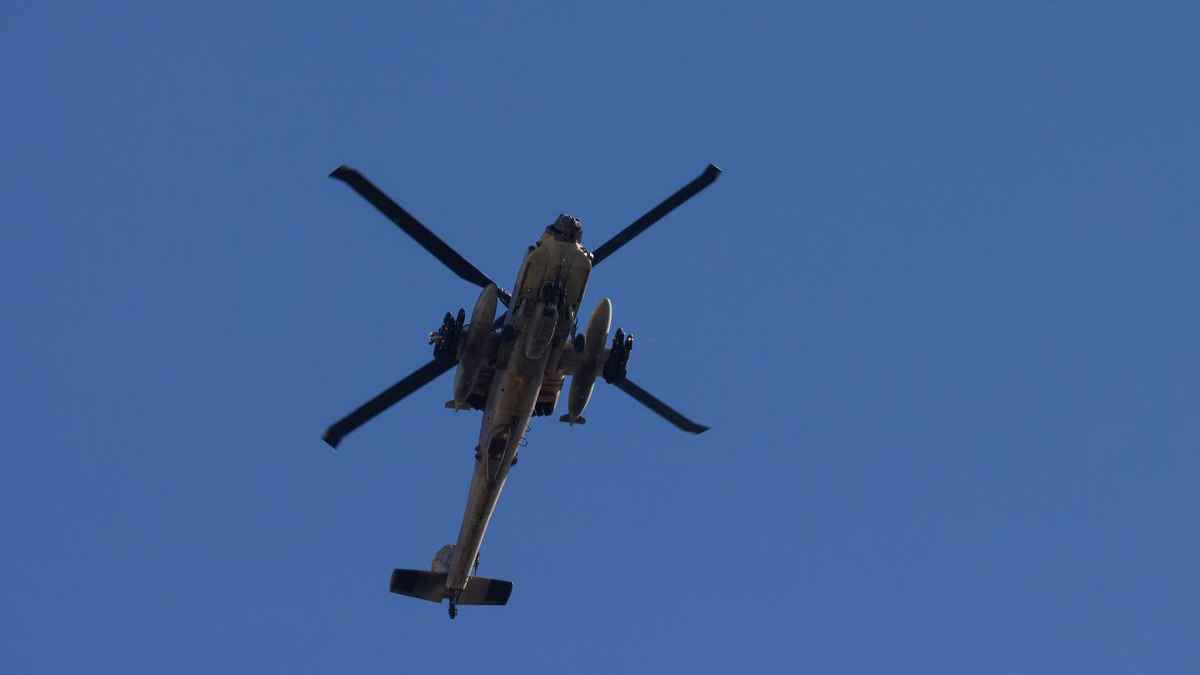
New Delhi, June 9, 2026 — A United States Army AH-64 Apache attack helicopter went down in the strategic waters near the Strait of Hormuz, triggering a rapid aviation rescue operation in one of the world’s most volatile maritime choke points. The incident occurs against a highly sensitive backdrop of regional friction, adding a fresh layer of complexity to ongoing diplomatic and military standoffs in the Middle East.
According to initially compiled reports by The New York Times, citing official sources briefed on the situation, both flight crew members on board the heavily armed gunship were successfully recovered following the crash. US President Donald Trump later confirmed the status of the aviators, stating to reporters at John F. Kennedy International Airport in New York that the pilots are “fine” and have been safely accounted for.
While the crew’s safe extraction has brought temporary relief to military planners, the exact trigger behind the crash remains heavily shrouded in uncertainty. Pentagon investigators are actively exploring multiple operational angles, weighing whether the advanced aircraft was brought down by hostile Iranian fire, suffered a catastrophic mechanical malfunction, or experienced localized technical issues during its flight path.
Geopolitical Context: The Shadow of a Fragile Ceasefire
The crash occurs at an incredibly delicate juncture for international diplomacy. Over the past several days, a localized flurry of cross-border missile barrages and military exchanges between Israel and Iran pushed the region to the absolute brink of all-out war. While both nations eventually enacted a tentative suspension of direct hostilities, the sudden downing of an American asset highlights how fragile the current security matrix remains.
Concurrently, backroom diplomatic channels have been working at an accelerated pace. US Vice President JD Vance recently indicated that Washington is in a strong position to secure a long-term diplomatic breakthrough with Tehran, noting that Iranian officials have been coming to the negotiating table with concrete proposals through Pakistani mediation. Iran’s UN Ambassador, Amir Saeid Iravani, echoed a similar sentiment, expressing hope that bilateral talks could reach a formal conclusion before the end of June.
However, the presence of heavy US military assets in the Persian Gulf highlights the duality of Washington’s current strategy: aggressive deterrence paired with active backchannel diplomacy. President Trump optimization targets a comprehensive treaty within a strict fortnight, asserting that pressure tactics will eventually yield a total diplomatic victory and stabilize global energy markets. Yet, events like this helicopter downing threaten to derail the delicate progress made by diplomats.
Escalating Patrols and Project Freedom
The downed AH-64 Apache was operating as part of an assertive, expanded maritime enforcement campaign aimed at countering severe restrictions placed on commercial shipping in the region. The Strait of Hormuz, a narrow waterway separating Iran from the Arabian Peninsula, serves as the transit point for roughly one-fifth of the world’s total petroleum liquid consumption, making its uninterrupted operation vital to global economic stability.
Under a US Navy-led effort known as Project Freedom, American forces have increasingly stepped up armed escorts for international merchant vessels. This operation has seen heavy deployments of:
- AH-64 Apache Gunships: Heavily armed with Hellfire missiles, deployed to deter fast-attack small craft and intercept low-flying hostile drones.
- MQ-9 Reaper Drones: Utilized for continuous high-altitude surveillance and electronic intelligence gathering.
- F-35 & F/A-18 Fighter Jets: Providing overarching combat air patrols to protect naval assets from sophisticated anti-ship missile batteries.
To maintain maximum visibility and deterrence, US commanders have ordered Apache units to fly closer to Iranian-controlled islands and coastal boundaries inside the Persian Gulf. While these maneuvers project immense American firepower, they inherently increase the risk of tactical miscalculations or technical mishaps in high-stress environments.
Assessing the Strategic Costs
If investigators conclude that the Apache was lost due to hostile action, it would mark the first helicopter of its specific variant destroyed in the current phase of the Gulf conflict. While the US military has previously acknowledged the loss of several high-altitude unmanned aircraft—including roughly 30 MQ-9 Reaper drones shot down by regional adversarial forces—and an F-15E Strike Eagle whose crew was rescued from hostile territory earlier this year, losing a frontline attack helicopter represents a significant escalation.
The physical and operational profile of the AH-64 makes it an invaluable asset for littoral (near-shore) defense. Its ability to hover low over water, track dozens of moving naval targets simultaneously, and deliver precise ordnance makes it the primary countermeasure against asymmetrical threats, such as swarm attacks by small, fast-moving ballistic boats.
Immediate Next Steps for Central Command
As the investigation gets underway, US Central Command (CENTCOM), led by Admiral Brad Cooper, faces the dual challenge of maintaining operational security without provoking an premature collapse of peace talks. Admiral Cooper recently briefed congressional defense subcommittees in Washington regarding the shifting priorities of American forces in the Middle East, emphasizing that protection of commercial shipping remains paramount.
For now, salvage teams will focus heavily on recovering the wreckage of the downed gunship to prevent sensitive navigational and targeting technologies from falling into adversarial hands. Simultaneously, military forensic teams will analyze the helicopter’s final telemetry data to determine whether an external strike or an internal systemic failure caused the crash.
While the safely rescued flight crew is a clear victory for search-and-rescue teams, the incident serves as a stark reminder of the razor-thin margins keeping the peace in the Strait of Hormuz. With a self-imposed two-week diplomatic deadline looming from the White House, both Washington and Tehran will have to tread carefully to ensure a localized aviation disaster does not explode into a broader geopolitical confrontation.