

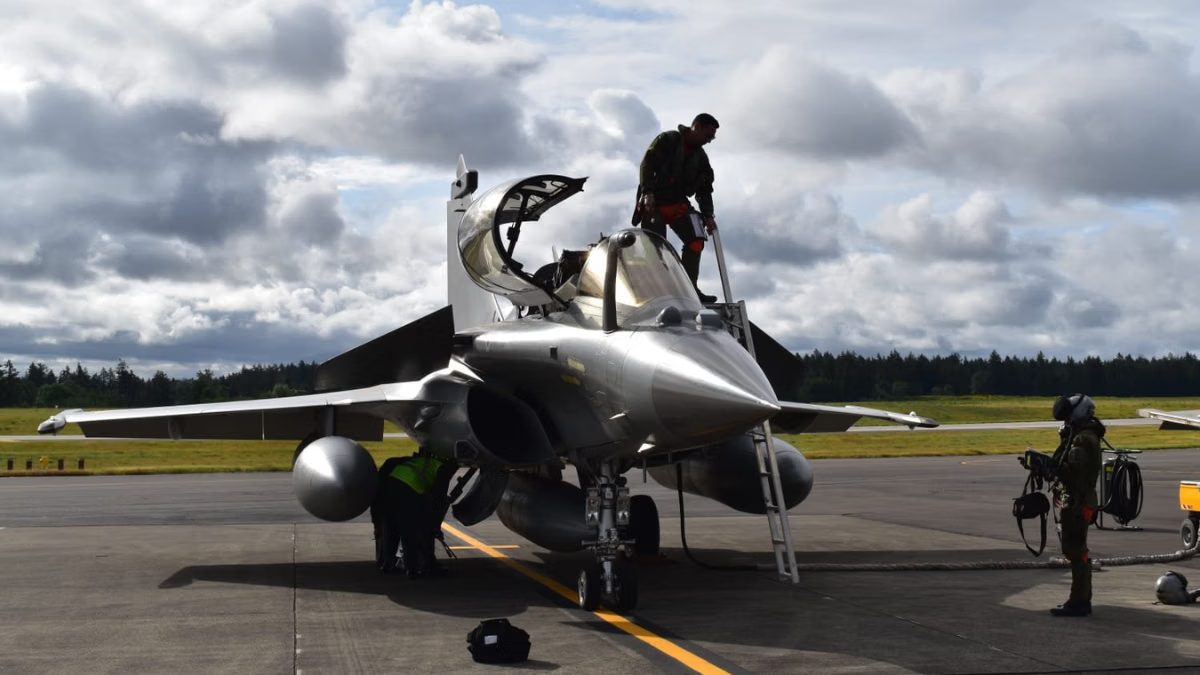
New Delhi, january 22, 2026: As of January 2026, the Dassault Rafale has cemented its status as one of the world’s most successful multi-role fighter jets. Originally a niche European platform, it has transformed into a global export powerhouse, with India and France now finalizing a historic deal that could see the aircraft manufactured on a massive scale outside of Europe.
The “Mega Deal”: 114 Jets for India
The most significant news comes from New Delhi, where the Indian government has given the green light to a $36 billion proposal to acquire 114 additional Rafale jets. This move aims to fix a critical shortage in the Indian Air Force (IAF), which currently operates far below its sanctioned strength.
Key highlights of this developing agreement include:
- “Make in India” Focus: Unlike previous off-the-shelf purchases, roughly 96 of these 114 jets are expected to be built within India through a partnership between Dassault and local firms like Tata Advanced Systems.
- India-Specific Enhancements: The jets will be integrated with indigenous Indian weapons and secure data links, ensuring they can “talk” to India’s existing radar and satellite networks.
- A “Two-Variant” Fleet: India is looking to procure a mix of the current F4 standard and the futuristic F5 standard, which is designed to work alongside AI-driven combat drones.
Global Resurgence and the F5 Standard
The Rafale is currently enjoying what analysts call a “global resurgence.” With over 500 aircraft now on order worldwide, Dassault’s production lines are working at full capacity to meet demands from the UAE, Indonesia, Egypt, Greece, and Croatia.
The future of the platform lies in the Rafale F5 (the “Super Rafale”), set to debut around 2030. This version is being developed as a “Plan B” for France while Europe works on its next-generation fighter. It will feature:
- Loyal Wingman Integration: The ability to control stealth drones (like the nEUROn) from the cockpit.
- Advanced Electronic Warfare: Upgraded “SPECTRA” systems to jam the world’s most advanced air defense networks.
- Nuclear Deterrence: Future-proofing for France’s strategic missions.
Maritime Dominance
In April 2025, India also officially signed for 26 Rafale Marine (M) jets to equip its aircraft carriers, INS Vikrant and INS Vikramaditya. The first of these naval variants are scheduled for delivery by 2029, making India the only country besides France to operate both the land-based and carrier-based versions of the jet.
Why It Matters
The Rafale’s success is largely due to its “omnirole” capability—it can perform air superiority, deep strike, and reconnaissance missions in a single flight. As tensions rise in the Indo-Pacific and Eastern Europe, the Rafale has become the go-to alternative for nations seeking high-end technology without the political or technical strings often attached to American or Russian platforms.