

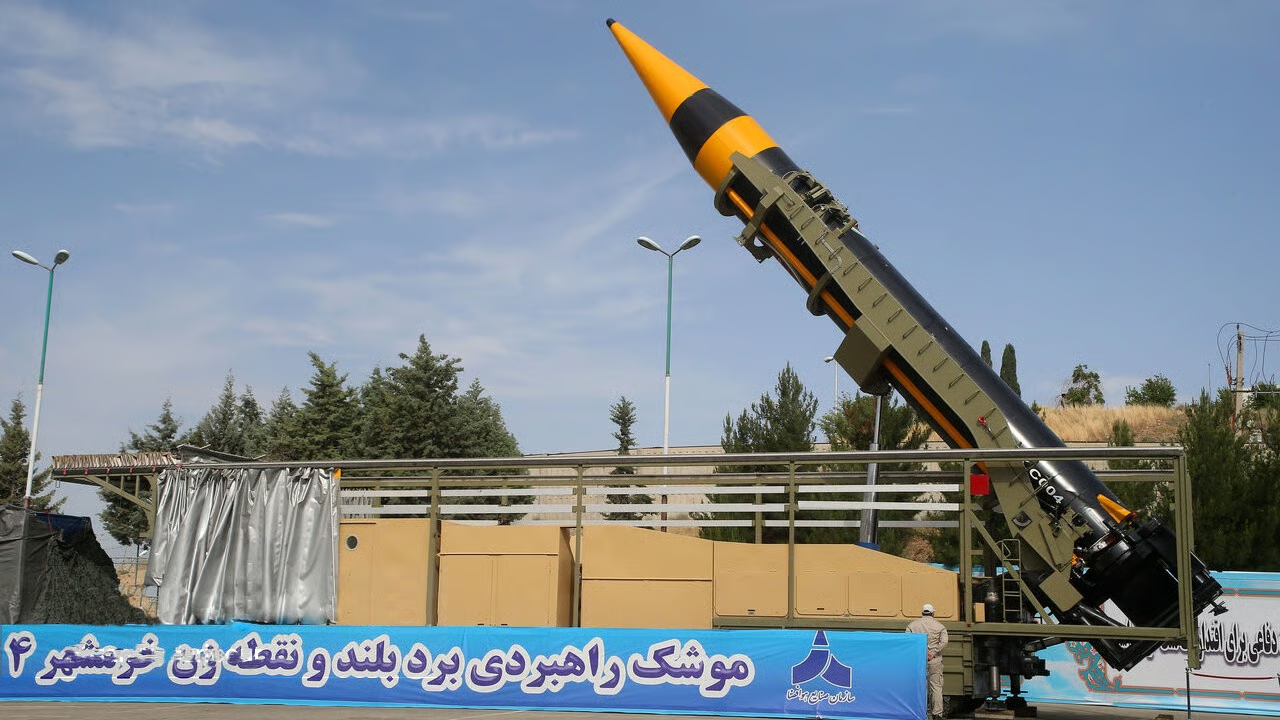
New Delhi, March 10, 2026: The landscape of Middle Eastern security has undergone a seismic shift as Iran enters a new tactical phase, characterized by the deployment of high-yield ballistic missiles capable of carrying 1,000 kg explosive warheads. This development marks a transition from “harassment” tactics to “strategic destruction,” signaling a more aggressive posture in the ongoing regional conflict.
A New Era of High-Explosive Payloads
For years, Iran’s missile doctrine focused on precision and mobility, often utilizing warheads in the 450–600 kg range. However, recent operational updates from the Islamic Revolutionary Guard Corps (IRGC) highlight a pivot toward heavier payloads.
- The Power Factor: A 1,000 kg (1-tonne) warhead significantly increases the “kill radius” of a missile. While a 500 kg warhead can damage a building, a 1,000 kg explosive payload is capable of leveling entire fortified structures, destroying deep underground bunkers, and causing catastrophic damage to critical infrastructure like oil refineries or airbases.
- Tactical Resilience: By increasing the destructive power of individual missiles, Tehran can achieve its strategic objectives with fewer successful strikes. In an environment where air defenses like the Iron Dome and Patriot systems are highly effective, Iran is betting that even a single “heavy” missile penetrating the shield can inflict the damage of five smaller ones.
The “Castle Busters” and Solid-Fuel Technology
Central to this new phase is the deployment of advanced delivery systems such as the Kheibar Shekan (meaning “Castle Buster”) and variants of the Khorramshahr family.
- Rapid Deployment: The shift toward solid-fuel technology allows these heavy-payload missiles to be fueled and ready for launch in under 15 minutes. This minimizes the window for “pre-emptive” strikes by adversary forces.
- Maneuverability: Newer models are equipped with Maneuverable Re-entry Vehicles (MaRVs). These allow the 1,000 kg warhead to change its trajectory during the terminal phase of flight, making it nearly impossible for traditional “hit-to-kill” interceptors to predict its impact point.
- Hypersonic Capabilities: With the introduction of the Fattah-2, Iran is combining high-yield explosives with hypersonic speeds, creating a weapon system designed to bypass the world’s most sophisticated radar networks.
Strategic Implications for the Region
The introduction of 1,000 kg warheads has forced a total re-evaluation of regional defense strategies.
- Infrastructure at Risk: The primary targets for these high-yield weapons are no longer just military outposts, but “hardened” targets. This includes command-and-control centers, energy hubs, and major logistics ports across the Gulf.
- The Cost of Defense: Analysts suggest a “cost-asymmetry” problem. While Iran spends thousands to produce a missile, defenders spend millions on interceptors. The threat of a 1,000 kg warhead forces defenders to fire multiple interceptors at a single incoming target to ensure a 100% kill rate, rapidly depleting expensive stockpiles.
- Regional Deterrence: This tactical phase is a clear message of deterrence. By showcasing the ability to deliver “massive” conventional destruction, Tehran aims to discourage any large-scale ground or air campaign against its territory.
Expert Insight: “We are seeing a move away from the ‘saturation’ logic of the past—where hundreds of small drones were used to swarm—and toward a ‘precision-heavy’ logic. They aren’t just looking to hit the target anymore; they are looking to erase it.”
Conclusion
The 2026 conflict has revealed that Iran’s missile program is no longer just about quantity; it is about devastating quality. The move to 1,000 kg explosives represents a matured military industrial base and a leadership willing to escalate the stakes of regional engagement. As these “heavy hitters” become the backbone of the IRGC’s arsenal, the margin for error in Middle Eastern diplomacy and defense has never been thinner.