

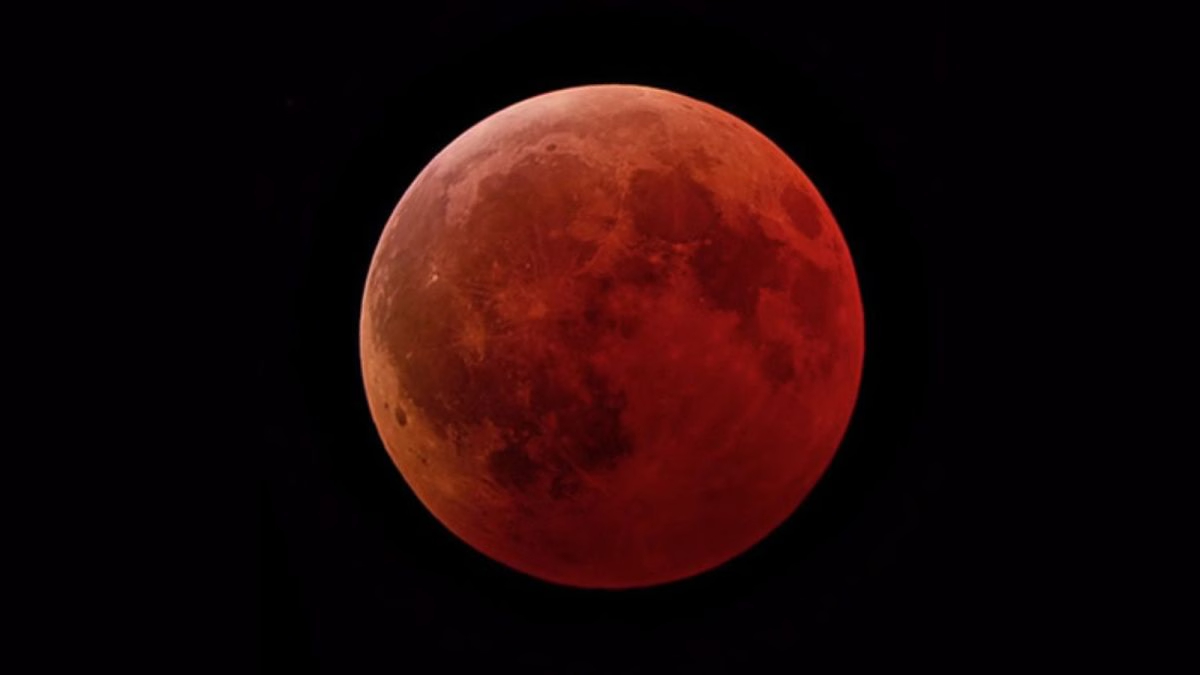
On Tuesday, March 3, 2026, the night sky will host a spectacular celestial event: a Total Lunar Eclipse, popularly known as the Blood Moon. This event is particularly rare as it coincides with the vibrant festival of Holi, a synchronization of astronomical and cultural significance that occurs only once in several decades.
While the total phase of the eclipse will be primarily visible in North America, the Pacific, and East Asia, skywatchers in India will witness the concluding phases of this phenomenon during moonrise.
Chandra Grahan 2026: Key Timings in India (IST)
According to the India Meteorological Department (IMD), the eclipse follows a specific timeline. However, because the moon rises in India after the eclipse has already begun, the visible duration for most Indian cities is relatively short.
| Phase of Eclipse | Time (Indian Standard Time) |
| Penumbral Phase Begins | 02:14 PM |
| Partial Eclipse Begins | 03:20 PM |
| Total Eclipse (Totality) Begins | 04:34 PM |
| Maximum Eclipse (Peak) | 05:03 PM |
| Total Eclipse (Totality) Ends | 05:32 PM |
| Partial Eclipse Ends | 06:47 PM |
| Penumbral Phase Ends | 07:53 PM |
City-Wise Visibility: Delhi, Mumbai, Bengaluru, Kolkata
In most parts of India, the “Blood Moon” phase (totality) will occur while the Moon is still below the horizon. Consequently, these cities will witness a Moonrise Eclipse, where the Moon emerges already partially eclipsed.
1. Kolkata
Kolkata, being in the East, has the best viewing window among the major metros.
- Moonrise Time: 05:39 PM
- Visible Duration: Approx. 1 hour 08 minutes
- What to expect: The Moon will rise just after the total phase ends, appearing deeply shadowed.
2. Delhi
The national capital will see the final stages of the partial eclipse.
- Moonrise Time: 06:22 PM
- Visible Duration: Approx. 25–30 minutes
- What to expect: A “bitten” Moon rising in the East, returning to its full form by 6:47 PM.
3. Bengaluru
In the Garden City, the window to catch the shadow is narrow.
- Moonrise Time: 06:28 PM
- Visible Duration: Approx. 19–20 minutes
- What to expect: The Moon will rise near the very end of the partial phase.
4. Mumbai
Due to its western location, Mumbai has the shortest viewing window.
- Moonrise Time: 06:45 PM
- Visible Duration: Approx. 2–3 minutes
- What to expect: The Moon will rise almost as the partial eclipse concludes, making the shadow very difficult to spot.
Why is it called a “Blood Moon”?
During a total lunar eclipse, the Earth aligns perfectly between the Sun and the Moon. While Earth blocks direct sunlight, its atmosphere filters the light, scattering shorter blue wavelengths and allowing longer red wavelengths to pass through. This refracted light bends toward the Moon, bathing it in a copper or deep reddish glow.
Sutak Kaal and Holi Significance
In Indian tradition, a “Sutak” period—an inauspicious time before an eclipse—is often observed. For this lunar eclipse, the Sutak Kaal began at 06:23 AM and will conclude with the end of the eclipse.
Because this coincides with Holi, many priests and scholars recommend performing Holika Dahan and other rituals only after the eclipse concludes and the purification process (snana) is completed.