
 has officially granted.)
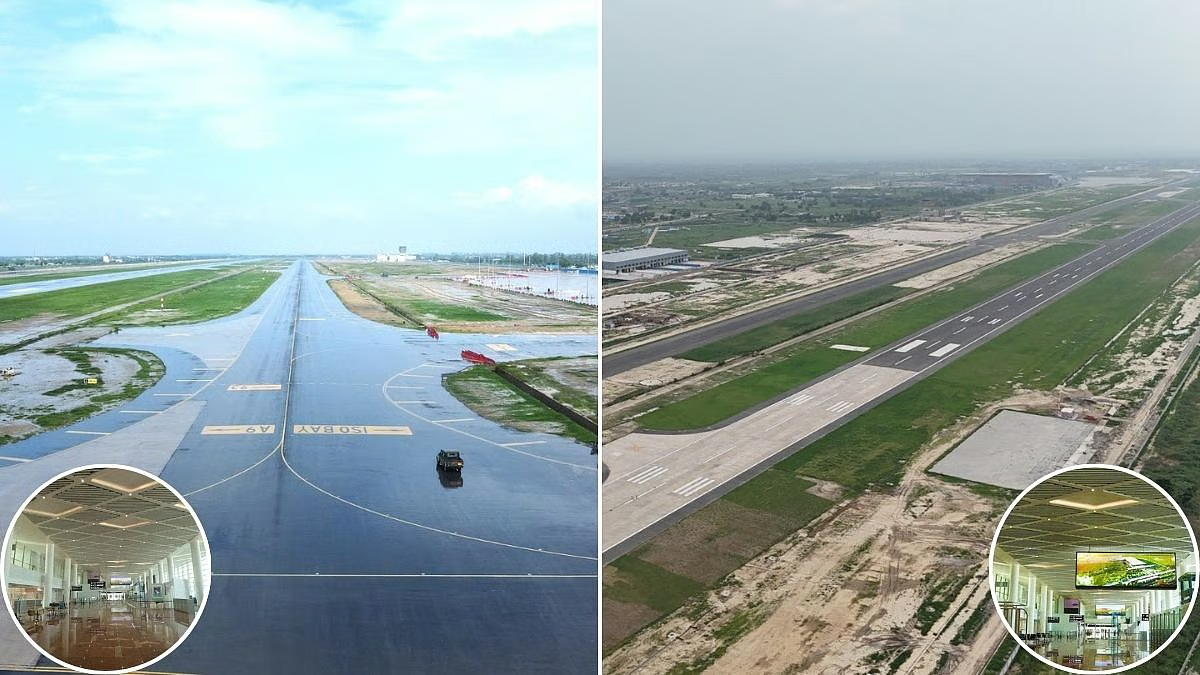
NEW DELHI, March 7, 2026 – In a landmark development for India’s aviation sector, the Directorate General of Civil Aviation (DGCA) has officially granted the aerodrome license to Noida International Airport (NIA) in Jewar. This final regulatory green light, issued on March 6, 2026, marks the end of a rigorous approval process and clears the path for commercial flight operations to begin this spring.
The license was awarded to Yamuna International Airport Private Limited (YIAPL), a subsidiary of Zurich Airport International AG, which is developing the project under a public-private partnership with the Uttar Pradesh and Union governments.
A Major Regulatory Milestone
The aerodrome license, issued under Rule 78 of the Aircraft Rules, 1937, is the ultimate “fitness certificate” for an airport. It confirms that the facility’s infrastructure—including runways, navigation aids, and emergency response systems—meets the stringent safety and operational standards required by the national regulator.
This approval follows closely on the heels of the Bureau of Civil Aviation Security (BCAS) granting security clearance just a day prior. With both safety and security certifications in hand, the airport is now legally permitted to handle public aircraft movements.
Technical Specifications and Capabilities
Noida International Airport, identified by its IATA code DXN, is designed to handle some of the world’s largest aircraft from day one. Key features of the Phase 1 development include:
- Runway: A 3,900-meter by 45-meter runway (Orientation 10/28) equipped with Category-I Instrument Landing System (ILS) and Aeronautical Ground Lighting (AGL) for all-weather, 24/7 operations.
- Capacity: The first phase features one terminal capable of handling 12 million passengers annually.
- Aircraft Handling: The parking apron includes stands for 24 Code C and 2 Code D/F aircraft.
- Emergency Services: Equipped with ARFF Category 9 facilities, the airport can safely manage wide-body aircraft like the Boeing 777-300ER.
Launch Timeline: What to Expect
While the infrastructure is ready, a final “Operational Readiness Activation and Transition” (ORAT) phase is currently underway. Sources within the Uttar Pradesh government suggest the following timeline:
- Inauguration: Officials are seeking dates from the Prime Minister’s Office (PMO), with a formal inauguration ceremony expected in the last week of March 2026.
- Commercial Flights: Domestic passenger services and cargo operations are slated to begin within 45 days, likely by the second week of April.
- Airlines: Major carriers including IndiGo, Akasa Air, and Air India Express have already confirmed their intent to operate from the hub, initially connecting Noida to metros like Mumbai, Bengaluru, and Hyderabad.
- International Operations: While domestic flights take off first, international services are expected to be phased in by September 2026.
Boosting the Regional Economy
Union Civil Aviation Minister Rammohan Naidu Kinjarapu congratulated the state government, describing the airport as a “catalyst for regional economic growth.” By serving as the secondary hub for the National Capital Region (NCR), the airport is expected to significantly reduce the congestion at Delhi’s Indira Gandhi International Airport.
Upon the completion of all four phases, Noida International Airport is projected to handle 70 million passengers per year, potentially making it one of the largest aviation hubs in Asia.