

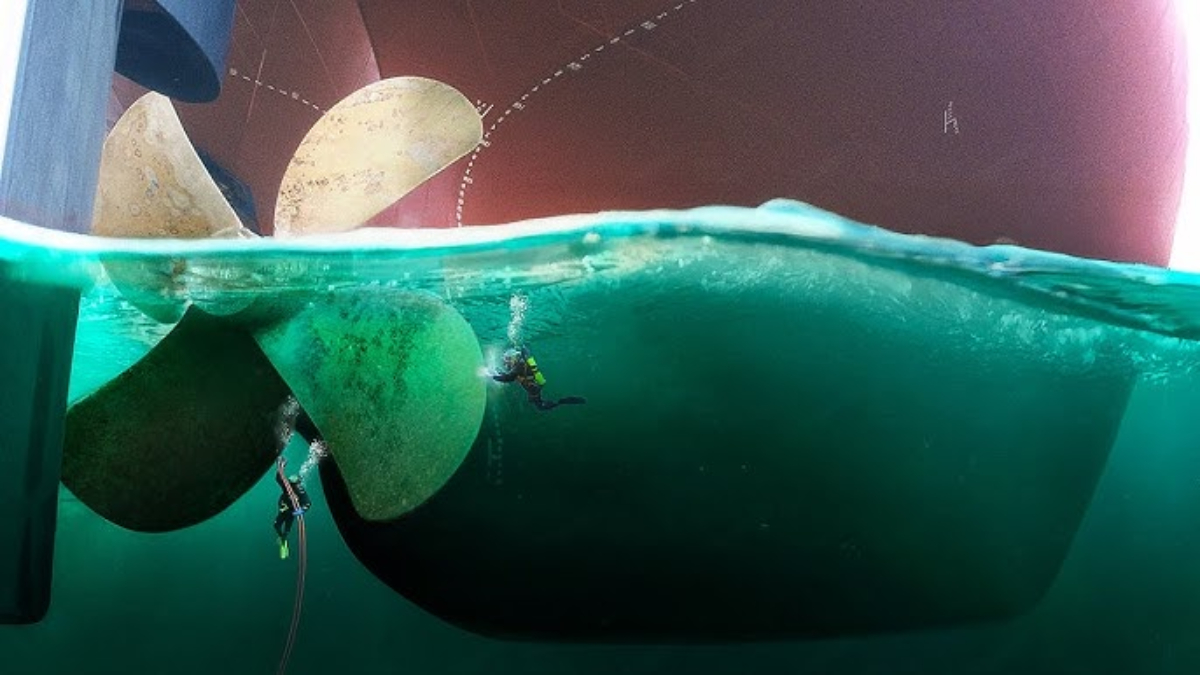
New Delhi, March 25, 2026: In the churning, sun-dappled waters of the Pacific or the icy depths of the North Atlantic, a specialized breed of Sailor operates where few others dare to go. US Navy Divers, the silent guardians of the fleet’s propulsion, are tasked with one of the most physically demanding and mentally taxing jobs in the maritime world: Underwater Ship Husbandry (UWSH).
When a multi-billion dollar aircraft carrier or a stealthy fast-attack submarine suffers a damaged propeller—whether from a stray log, “cavitation” erosion, or an unfortunate encounter with the seabed—the mission doesn’t stop. Instead of heading to a costly and time-consuming dry dock, the Navy calls in the divers to fix the problem “waterborne.”
The “Scary” Reality of the Deep
To the uninitiated, the sight of a diver dwarfed by a massive, five-bladed bronze propeller is awe-inspiring. To the diver, it is a high-risk workspace. Working underneath a vessel that weighs 100,000 tons creates an environment where “claustrophobia meets the abyss.”
- The Suction Hazard: Divers must operate in close proximity to the “running gear.” Even when the engines are locked and tagged out, underwater currents can cause a massive propeller to “windmill,” posing a lethal threat to anyone nearby.
- The “Dark Zone”: Often, these repairs happen in murky harbor waters with zero visibility. Divers must rely on “tactile sensing”—feeling for cracks or nicks with their hands while bulky gloves and pressurized suits fight against them.
- Pressure and Time: Whether using standard SCUBA or surface-supplied “hard hat” gear, divers face the constant threat of decompression sickness. Every minute spent grinding or welding at depth adds to their “nitrogen debt.”
Precision Under Pressure: The Repair Process
Modern underwater propeller maintenance is far more than just “scrubbing off barnacles.” It is a feat of engineering performed in a liquid medium.
1. The Visual & NDT Inspection
The process begins with a Propeller Visual Inspection (PVI). Divers use high-definition cameras and Non-Destructive Testing (NDT)—such as magnetic particle or dye penetrant testing—to find microscopic cracks that could lead to catastrophic failure at high speeds.
2. Underwater “Plastic Surgery” (Grinding and Polishing)
Even small nicks in a propeller blade can cause “cavitation”—the formation of vapor bubbles that “explode” against the metal, eating it away over time. Divers use hydraulic-powered grinders to smooth these edges to a Rupert Scale ‘A‘ finish, a standard of smoothness that reduces drag and saves the Navy millions in fuel costs.
3. The 80-Ton Heavy Lift
In extreme cases, an entire propeller must be replaced. This involves complex rigging where divers use hydraulic jacks and massive “Pilgrim nuts” to slide a propeller—which can weigh up to 80 tons—off the shaft and lower it to the seabed or a waiting barge, all while the ship remains afloat.
Why It Matters: Fleet Readiness
The ability to perform these “scary” inspections and repairs in-situ is a strategic advantage. By avoiding dry dock, the Navy keeps its ships on the front lines.
As we move through 2026, the integration of new technologies like Remotely Operated Vehicles (ROVs) and underwater laser scanning is helping divers map damage with sub-millimeter precision. However, the “human in the loop”—the diver with a wrench, a welding torch, and the nerves of steel—remains irreplaceable.