

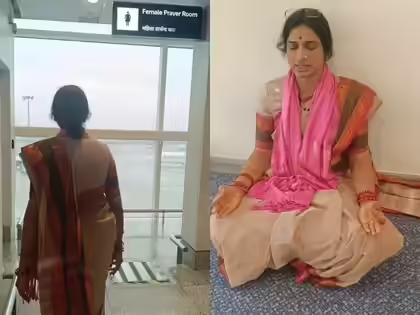
New Delhi, March 25, 2026: A significant wave of digital discussion and polarizing reactions has been triggered following a recent social media post by a prominent political figure. On March 23, 2026, BJP leader Kompella Madhavi Latha was observed participating in a spiritual practice at the Indira Gandhi International Airport in New Delhi. It is noted that a two-minute video, shared on her official handle, depicted her reciting the “Durga Suktam” within the airport’s designated prayer room. This startlingly public display of faith has been widely shared as a primary example of the increasing intersection between personal devotion and public spaces.
The Contentious Visuals of the Prayer Room
The specifics of the incident are being meticulously discussed by netizens who noticed the presence of other travelers in the background. It is observed in the viral footage that at least two burqa-clad women were standing near the entrance of the prayer room while the chanting occurred. It is reported by several digital observers that Madhavi Latha sat cross-legged in a corner and immersed herself in the verses, seemingly undisturbed by her surroundings. The visual of a high-profile politician being recorded while performing rituals in a multi-faith sanctuary has provided a grounding narrative for a broader debate on airport etiquette.
Also Read: Kia EV2 Global Launch: Brand’s Most Affordable Electric SUV Debuts with 448 km Range
Netizens Question the “Provocation” Claims
A massive conversation regarding “religious freedom” and “public decorum” has been ignited by the varying interpretations of the clip. It is noted that while some critics, including political coordinators from the Congress party, accused her of “breaking rules” and making others uncomfortable with audible prayers, her supporters have pushed back fiercely. Thousands of analytical comments have been left by social media users who asked, “How is reciting a prayer provocating?” It is frequently mentioned in support threads that prayer rooms are meant for all faiths, and a Hindu prayer should be viewed as an act of coexistence rather than a confrontation.
Official Guidelines and Privacy Concerns
The impact of this viral event has extended beyond religious sentiment to influence a discussion on the technical rules of airport sanctuaries. It is observed that some users tagged the Airports Authority of India (AAI), questioning whether filming and loud chanting are permitted in areas designated for “silent meditation.” A renewed sense of scrutiny is being observed toward the use of mobile cameras in private religious settings, with critics suggesting that the act was a “calculated performance” for digital engagement. It is believed that the viral nature of this specific “Airport Suktam” video will prompt a dialogue on the need for clearer signage regarding volume levels in shared spiritual spaces.
A Stark Reminder of India’s Diverse Fabric
As the footage continues to accumulate millions of views in late March 2026, it serves as a powerful and resilient reminder of the complexities of faith in a modern, mobile world. It is believed that the account of the “Delhi Airport Chanting” will remain a primary highlight of the month’s most discussed and socially polarizing news features. The legacy of this viral event is expected to be a heightened public awareness regarding the balance between personal religious assertion and the comfort of fellow citizens. Until an official clarification is issued by airport authorities, this video remains a stark testament to the fact that in Bharat, even a quiet prayer room can become a center of national conversation.