

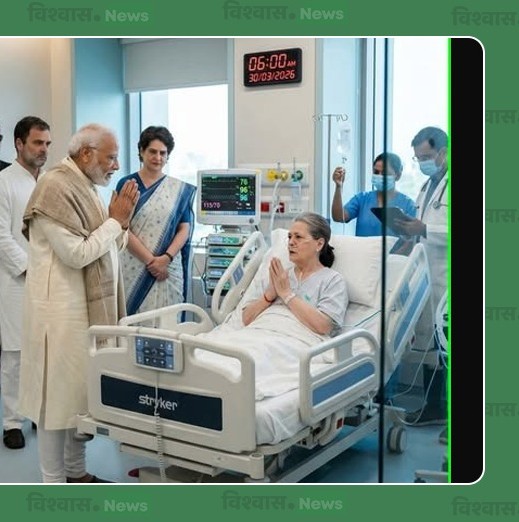
New Delhi, April 1, 2026: A hyper-realistic image appearing to show Prime Minister Narendra Modi visiting senior Congress leader Sonia Gandhi in a hospital room has been debunked as a sophisticated AI-generated fabrication. The visual, which began circulating across social media platforms on April 1, 2026, depicts the two political rivals in a rare moment of personal empathy, sparking a massive wave of emotional reactions from followers of both parties. However, a detailed “truth” check reveals that no such meeting has taken place, and the image is a product of generative artificial intelligence designed to mimic real-world photography.
The interaction was observed to have originated on messaging apps before being amplified by several high-traffic political fan pages. In the viral image, the Prime Minister is seen standing by a hospital bed where Mrs. Gandhi is resting, with medical equipment and lighting that appear strikingly authentic. It is reported by forensic digital analysts that while the textures and shadows are convincing, several “glitches” typical of AI—such as distorted finger shapes and inconsistent reflections on the glass monitors—confirm that the scene is entirely synthetic.
Anatomy of a Political Deepfake: Why the Image Gained Traction
The reaction from the digital community has been a mixture of initial awe followed by a stern warning against the “weaponization” of AI during sensitive political periods. It is argued by fact-checkers that the image was strategically timed to coincide with April Fools’ Day to exploit the blurred lines between satire and misinformation. On platforms like X and Facebook, the post was shared with captions suggesting a “new era of political unity,” leading to a surge in the hashtag #AIRealism.
The impact of the image has prompted a wider discussion regarding the ease with which public perception can be manipulated through “deepfake” technology. It is noted by media ethics experts that the high emotional stakes of the Indian political landscape make it a prime target for such experiments. The passive consumption of the image—without verifying official schedules or press releases from either the Prime Minister’s Office (PMO) or the AICC—highlights the growing challenge of “visual literacy” in the age of generative tools like Nano Banana 2.
Also Read: Man Selling Dharamshala’s “Fresh Air” in Delhi for ₹50
Safeguarding the Truth: The Role of Verified Media
Following the viral spread of the fake meeting, official spokespersons from both political camps have confirmed that the image is a total fabrication. It is reported that several independent fact-checking organizations have used reverse-image search tools to prove that the “hospital setting” was actually a composite of multiple unrelated stock photos. The passive role played by social media algorithms—which often promote high-engagement content regardless of its accuracy—has once again been identified as a major hurdle in curbing the spread of political misinformation.
As of the afternoon of April 1, 2026, the “Modi-Sonia AI Fact Check” remains a top trending topic in the technology and politics categories. While the image has been flagged as “Altered Media” on most major platforms, the incident serves as a stark reminder of the “post-truth” era we are entering. For now, the story stands as a digital lesson: in a world where an AI can “create” a meeting that never happened, the only reliable source of truth remains verified, professional journalism.