

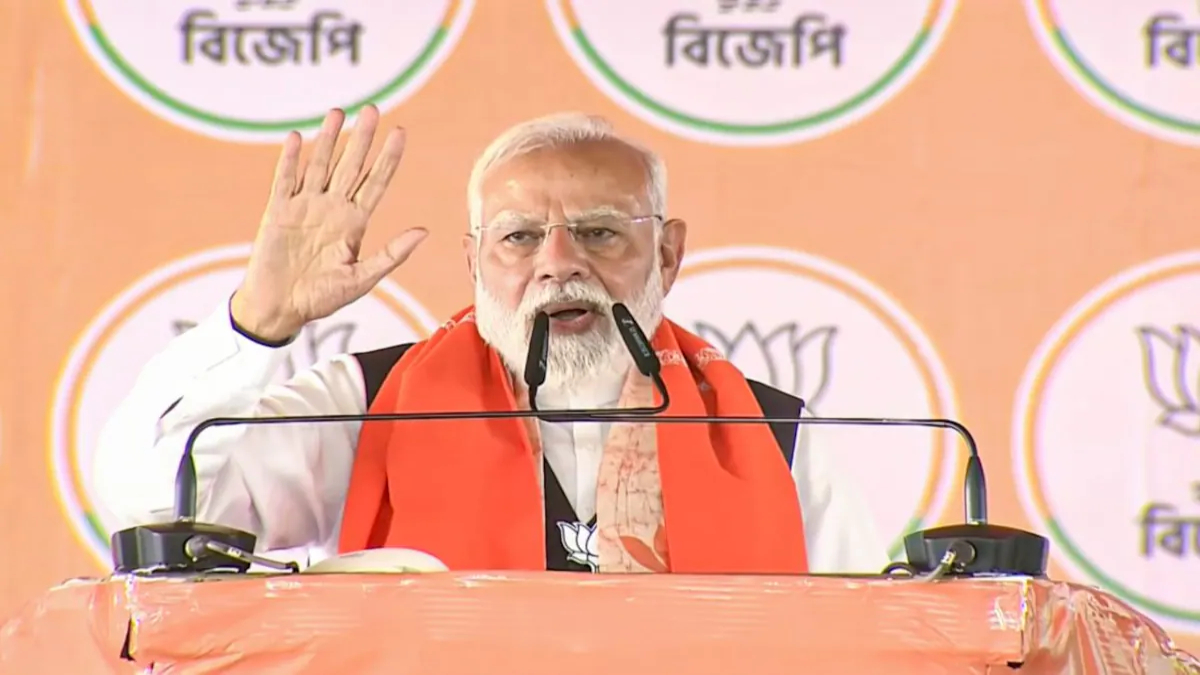
New Delhi, April 11, 2026: The humble fish has swum from the dinner plates of West Bengal into the turbulent waters of high-stakes electioneering. In a recent political firestorm ahead of the 2026 Assembly Elections, Prime Minister Narendra Modi sparked a massive debate by claiming that West Bengal, a state synonymous with its love for Maach-Bhaat (fish and rice), is struggling with self-sufficiency and relying on imports to feed its population.
While the rhetoric is sharp, the reality of Bengal’s fish economy is a complex mix of high production, even higher demand, and an intricate interstate trade network.
The Prime Minister’s Claim: What Was Said?
Addressing a massive rally in Haldia, PM Modi took a direct jab at the ruling Trinamool Congress (TMC). He alleged that despite Bengal’s vast water resources and coastline, the state has failed to become atmanirbhar (self-reliant) in fish production over the last 15 years.
Modi compared Bengal to states like Bihar and Assam, claiming they have doubled their production and moved toward self-sufficiency under double-engine governance, while Bengal remains dependent on “imports.” The subtext of the speech was clear: a jab at the state’s management of a sector that is vital to the Bengali cultural identity.
The Counter-Punch: “Don’t Teach Bengalis About Fish”
Chief Minister Mamata Banerjee was quick to respond, turning the data back on the Center. She dismissed the claims as a political gimmick, stating that West Bengal is now India’s second-largest fish producer, trailing only Andhra Pradesh.
Banerjee highlighted that the state has drastically reduced its reliance on outside supply, specifically mentioning that Bengal has largely stopped “importing” fish from Andhra Pradesh (often referred to as ‘Challani Maach’) as local production has surged to meet roughly 80–90% of the state’s massive demand.
Fact-Checking the “Uganda to Bengal” Reality
While “Uganda” was used as a rhetorical extreme to highlight the distance of imports, the actual trade data reveals a more nuanced picture:
1. Production vs. Consumption
West Bengal produces approximately 2.37 million tonnes of fish annually (as per 2024–25 provisional data). This accounts for nearly 12% of India’s total production. However, unlike most states, nearly 80% of Bengal’s 100 million-plus population consumes fish daily. This “hyper-demand” creates a gap that local production—though massive—occasionally struggles to fill during peak seasons.
2. The Interstate Gap
Bengal does indeed bring in fish from other states, primarily Andhra Pradesh, Odisha, and Bihar. This isn’t necessarily a sign of “failure” but rather a result of the state’s status as the largest market for fish in India. About 1.2 to 1.5 lakh tonnes are still sourced from other states to stabilize prices and ensure a variety of species are available in local markets.
3. The International Angle (Bangladesh and Beyond)
When it comes to actual international imports, the focus is almost exclusively on Bangladesh, particularly for the prized Padma Hilsa. Imports from African nations like Uganda are virtually non-existent in the retail markets of Bengal, though Uganda does export certain varieties of processed or canned fish (like Silver Cyprinid) globally. In the context of Bengal’s fresh-fish markets, the “Uganda” claim is more a metaphor for “faraway dependency” than a statistical reality.
The Political Stakes
For the BJP, the “fish dependency” narrative is an attempt to chip away at the TMC’s governance record by targeting a sector that affects every household. By claiming Bengal is “import-dependent,” the BJP seeks to project a lack of industrial and agricultural modernization under Mamata Banerjee.
For the TMC, the issue is about Regional Pride. By framing it as “outsiders” lecturing Bengalis on their staple food, Mamata Banerjee is tapping into a potent vein of sub-nationalism.
Conclusion
The reality lies somewhere in the middle. West Bengal has seen a significant rise in inland fisheries and aquaculture, becoming a national leader in seed production. However, the sheer scale of Bengali appetite means the state remains a magnet for fish from across the country.
Whether this makes the state “dependent” or simply the “seafood capital” of India is a matter of political interpretation. For the average voter in 2026, the question won’t be about the tonnage produced, but the price of the Rohu or Hilsa at their local bazaar.