

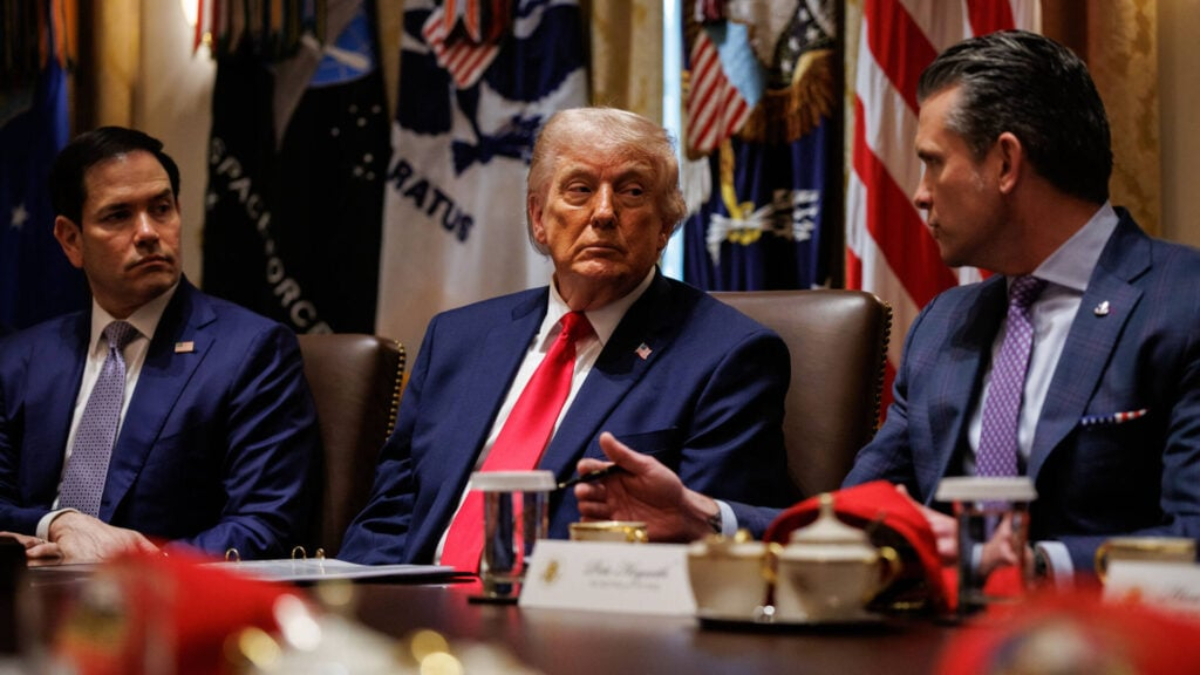
New Delhi, May 28, 2026 — In a dramatic escalation of rhetoric surrounding the ongoing Middle East maritime crisis, US President Donald Trump has declared the Strait of Hormuz to be strict “international waters.” Speaking directly to reporters during a White House Cabinet meeting, Trump issued a blunt, highly unconventional military warning to Oman, a long-standing American ally in the Gulf region. The President firmly rejected any diplomatic proposals that would grant regional nations regulatory control or the authority to collect transit tolls over the strategic choke point.
The controversy erupted following a volley of unconfirmed media reports out of Tehran, which suggested that a potential framework deal was being negotiated behind closed doors to end the month-long naval blockade of the region. Iranian state television had claimed that a draft memorandum of understanding (MoU) was on the table. Under this alleged proposal, the United States would lift its naval blockade on Iranian ports and withdraw forces from areas surrounding Iran. In exchange, Tehran would work alongside the Sultanate of Oman to jointly manage maritime traffic and restore commercial shipping to normal pre-conflict levels within 30 days. Part of this rumored setup reportedly involved the implementation of transit fees on shipping vessels passing through the narrow corridor.
The reaction from the White House was swift, aggressive, and uncompromising. When asked directly by reporters if he would accept a short-term arrangement permitting joint Iranian and Omani management of the waterway, President Trump did not mince words.
Trump then turned his focus to Muscat, delivering a harsh warning that shocked foreign policy analysts given Oman’s historical role as a trusted mediator between Washington and Tehran. “Oman will behave just like everybody else or we’ll have to blow ’em up,” Trump said during the televised portion of the meeting. “They understand that, they’ll be fine.”
While initial speculation pulsed through diplomatic circles that the 79-year-old president may have simply misspoken—perhaps intending to threaten Iran rather than America’s traditional partner—the US State Department intentionally published the official transcript and video clips of the remarks online without offering any corrections or clarifications, effectively cementing the hardline stance.
Understanding the Choke Point
The Strait of Hormuz is widely regarded as the most critical oil transit channel in the world. Its geography and economic significance explain why the situation has drawn such heavy global focus:
- The Geography: A narrow bend of water separating Iran to the north from Oman and the United Arab Emirates to the south. At its narrowest point, the shipping lanes are only about two miles wide in either direction.
- The Volume: Approximately one-fifth of the world’s total petroleum liquids—roughly 20 million barrels of oil per day—passes through this single passage from the Persian Gulf out to the Arabian Sea and global markets.
- The Economic Stakes: Because major economies in Asia, Europe, and the Americas rely heavily on this daily flow of energy, any disruption instantly sends global crude oil prices surging, threatening to trigger a broader international energy crisis.
A Complex and Tangled Diplomacy
The President’s sharp commentary underscores the immense friction plaguing current diplomatic efforts. While Trump acknowledged that negotiations are technically proceeding, he signaled intense dissatisfaction with the terms put forward by Iranian representatives. Accusing Iran of intentionally stalling the peace process to “outwait” him ahead of the upcoming US midterm elections, Trump warned that the US military is fully prepared to switch back to offensive operations if diplomatic channels fail to yield a favorable outcome. “They want very much to make a deal. So far they haven’t gotten there. We’re not satisfied with it… either that or we’ll have to just finish the job,” he added.
Supporting this dual-track strategy of aggressive posturing, US Secretary of State Marco Rubio noted that while a diplomatic path remains the President’s preferred option, Washington retains an array of non-diplomatic choices. Meanwhile, US Defense Secretary Pete Hegseth echoed the administration’s resolve, stating that the military is entirely equipped to deploy the full might of the armed forces to complete objectives against hostile actors if required.
To further complicate the narrative, the White House officially dismissed the Iranian state media’s version of the draft agreement as “a complete fabrication.” White House spokeswoman Olivia Wales emphasized that President Trump would never agree to a deal that includes premature financial concessions or structural changes to maritime law. Trump himself explicitly ruled out releasing frozen Iranian funds or easing existing economic sanctions as incentives to secure the waterway’s reopening. “No sanctions, no money, no nothing,” Trump declared, insisting that any return of assets would remain entirely non-contingent upon the baseline maritime safety talks.
Ongoing Military Realities on the Water
Despite the active diplomatic back-and-forth and a fragile, nominal ceasefire, conditions on the ground remain highly volatile. Only hours before the Cabinet meeting, the US military carried out fresh overnight defensive strikes against an inside military asset in Iran, which Washington officials claimed posed an immediate, physical threat to American personnel and merchant shipping. US defense forces also successfully intercepted a wave of explosive drones launched from Iranian territory.
Currently, the United States is maintaining its naval presence through “Project Freedom,” a high-stakes operational campaign designed to securely escort commercial tankers through the high-risk zones of the Gulf. The operation was launched following stringent shipping restrictions and an ongoing American naval blockade established earlier this spring.
While regional stakeholders and international markets look on anxiously, the path forward appears increasingly fraught. Oman, a country of 5.3 million that has spent decades successfully balancing relationships between Western powers and regional neighbors, now finds itself caught squarely in the crosshairs of a highly volatile rhetorical showdown. For now, the United States has drawn its red line clearly: the Strait of Hormuz must return to an unmonitored, toll-free international shipping lane, or the threat of expanded military intervention remains firmly on the table.