

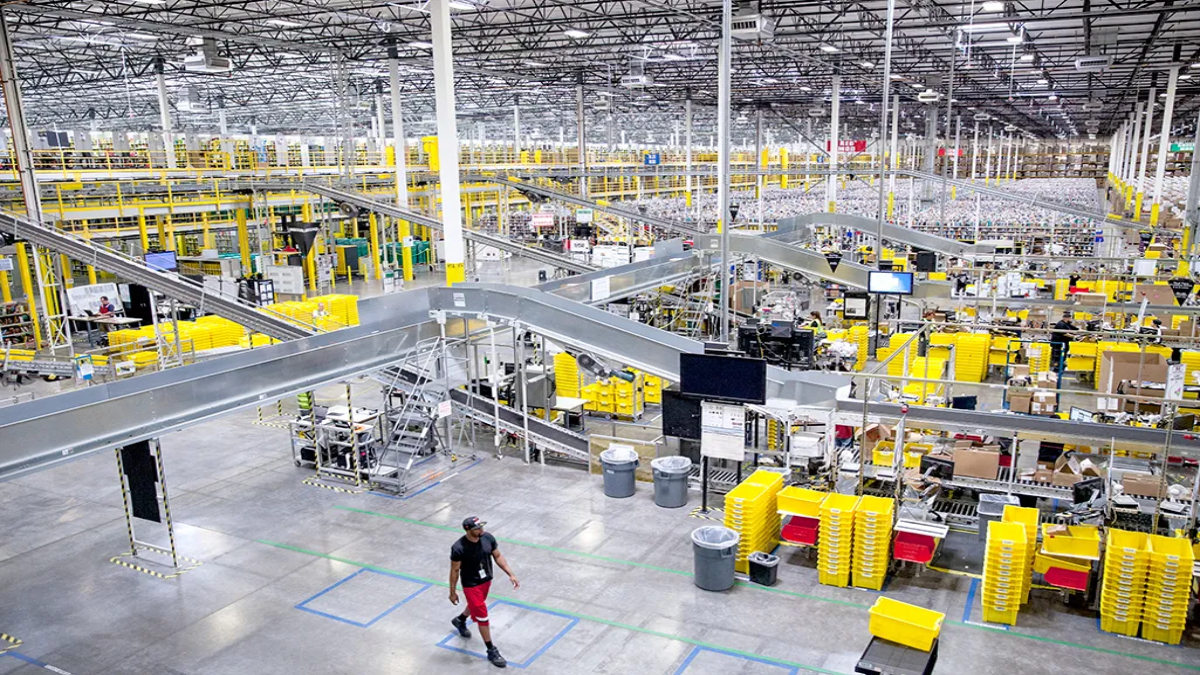
New Delhi, April 14, 2026: The glow of the fluorescent lights at the PDX9 Amazon fulfillment center in Troutdale, Oregon, didn’t flicker when a 46-year-old worker collapsed on the concrete floor on Monday, April 6, 2026. The mechanical hum of the conveyor belts didn’t stop, and the relentless “rate” that dictates the lives of thousands of employees continued to tick upward.
For more than an hour, according to harrowing eyewitness reports, the man lay unattended on the warehouse floor. As management reportedly instructed staff to “just turn around and not look” and “get back to work,” the facility became a grim tableau of modern industrial labor: a human life extinguished in the middle of an aisle, while the machinery of global commerce moved around it.
The Incident: “Don’t Look, Just Pick”
The details emerging from the PDX9 facility paint a chilling picture of corporate priorities. Reports suggest the worker, whose identity has been kept private out of respect for his family, collapsed during a shift characterized by unusual heat and humidity.
Internal accounts shared by colleagues on platforms like Reddit and through local labor advocates tell a story of systemic indifference:
- The Delay: The worker reportedly remained on the floor for over 60 minutes before emergency services were effectively integrated into the scene.
- The Instruction: Multiple employees allege that supervisors and “Top Managers” did not immediately halt operations. Instead, workers were told to continue fetching totes and picking items from shelves, literally walking past their fallen colleague.
- The Environment: In the weeks leading up to the tragedy, employees had filed complaints regarding broken fans and poor ventilation. The installation of “sound curtains” in certain departments reportedly trapped heat, creating a “stuffy and dizzying” atmosphere even in early April.
“I have a lot of anxiety over walking back into that building,” one anonymous employee told The Western Edge. “To see someone you know, someone you work with, treated like a literal obstacle on the floor… it changes how you see the company.”
A Pattern of “Natural Causes”
This 2026 tragedy is not an isolated event; it is the latest chapter in a long-standing controversy surrounding Amazon’s workplace safety culture. The company has faced similar backlash for years, often citing “natural causes” or “pre-existing conditions” to distance operational pressure from worker fatalities.
| Location | Year | Incident Summary |
| Carteret, NJ | 2022 | A worker died during Prime Day; Amazon claimed it was a cardiac event unrelated to work. |
| Swansea, UK | 2023 | Martin Vaughan, 52, collapsed mid-shift. Family members fought for two years for an inquest into ambulance delays. |
| Staten Island, NY | 2025 | A 34-year-old worker was killed by a reversing truck at the JFK8 loading dock. |
| Troutdale, OR | 2026 | A worker lay on the floor for over an hour while operations continued around him. |
In the 2023 case of Martin Vaughan, his family expressed outrage after learning it took 14 minutes for anyone to even find him after he collapsed. The recurring theme across these tragedies is a perceived gap between Amazon’s public safety “investments” and the reality of the warehouse floor.
Amazon’s Defense: Safety by the Numbers
Amazon has consistently pushed back against the narrative that it is a “hazardous” employer. In a statement released shortly after the PDX9 incident, spokesperson Sam Stephenson expressed deep sadness:
“Our thoughts and deepest sympathies are with their loved ones during this difficult time. We have provided on-site grief counselors and additional support for our employees at PDX9.”
In its 2025-2026 safety reports, Amazon claims to have reduced workplace injury rates by 43% since 2019. The company highlights its use of assistive robotics like Proteus and Cardinal to reduce physical strain, and a 24/7 team of meteorologists to monitor heat and weather risks.
However, labor advocates argue that these statistics are “sanitized.” While heavy lifting might be decreasing due to automation, the speed of work—the “rate”—has only increased, leading to what many call “exhaustion-induced” medical emergencies.
The “Sound Curtain” Controversy
One specific technical complaint at the PDX9 facility involves the use of industrial sound curtains. Designed to reduce the deafening noise of thousands of moving parts, workers claim these thick barriers act as insulators, preventing airflow in the “AFE” (Amazon Fulfillment Engine) zones.
“They turned the building into an oven,” one worker reported. “The fans aren’t working, the heat from the machines stays trapped, and then they wonder why people are fainting. They prioritize the decibel level over the body temperature of the workers.”
The Human Cost of “Prime”
The phrase “Let’s get back to work” has become a rallying cry for labor unions and activists who see it as the ultimate distillation of Amazon’s philosophy. To the algorithm that manages these warehouses, a human being is a “unit of labor.” When that unit fails, the system is designed to route around the failure to maintain the flow of packages.
The psychological toll on the survivors at PDX9 is significant. Seeing a coworker die is a trauma; being told to ignore the body and keep picking items for a $20 delivery is a moral injury.
Also Read: Noida Unrest: Pakistan Link Probed?
What Happens Next?
- OSHA Investigations: The Occupational Safety and Health Administration (OSHA) is expected to review the response time and the environmental conditions at the Oregon facility.
- Union Pressures: The Amazon Labor Union (ALU) and groups like Warehouse Life are using this incident to demand “Heat Stress Standards” and mandatory “Stop-Work” protocols in the event of medical emergencies.
- Transparency Demands: Families of the deceased are increasingly taking legal action to obtain internal CCTV footage and supervisor communication logs to see if help was intentionally delayed to meet shipping quotas.
Final Reflections
As we move further into 2026, the convenience of “Same-Day Delivery” is increasingly scrutinized through the lens of those who provide it. The death at PDX9 serves as a stark reminder: behind every brown box is a human being operating in a high-pressure environment where, in the eyes of management, the clock never stops—not even for death.
Until the “rate” is secondary to the pulse of the person working, tragedies like the one in Troutdale will likely continue to be dismissed as “natural causes” in a very unnatural environment.