

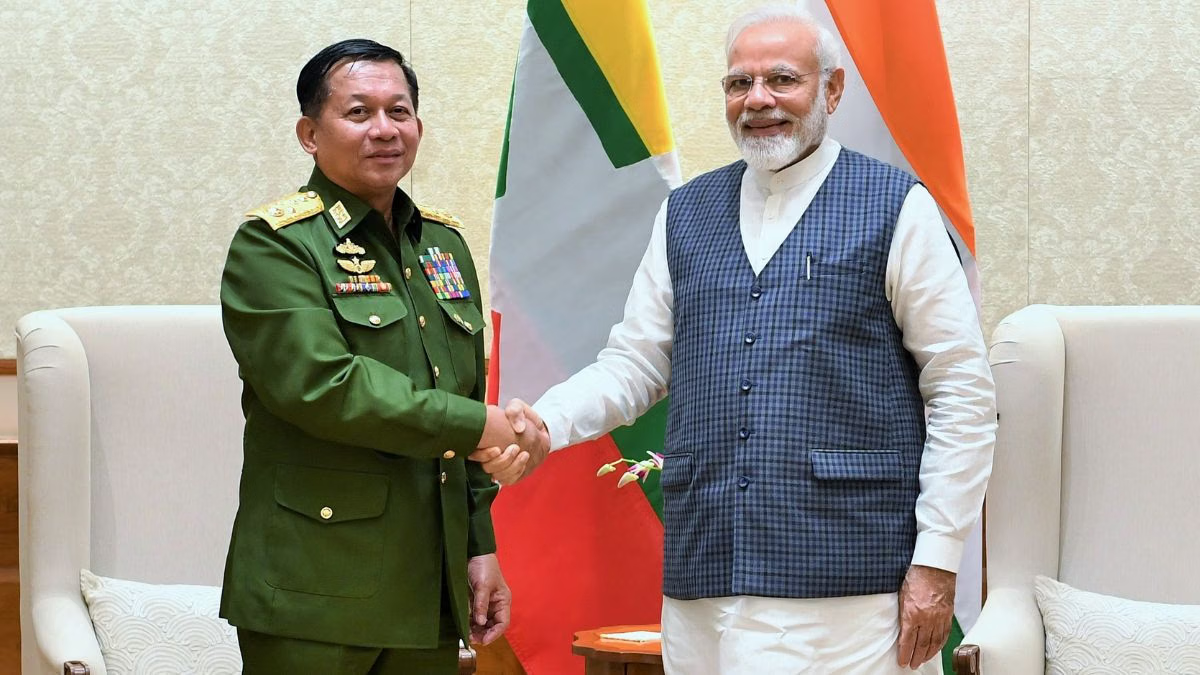
New Delhi, May 30, 2026 — In his first official overseas trip since transitioning from military junta chief to civilian president, Myanmar’s U Min Aung Hlaing arrived in India on Saturday, May 30, 2026. The high-profile, five-day state visit, undertaken at the personal invitation of Indian Prime Minister Narendra Modi, signals an aggressive push by Naypyidaw to reclaim regional legitimacy. However, beneath the standard diplomatic protocols lies a deeper, urgent geopolitical reality: Myanmar is looking to India as a critical counterweight to dilute China’s overwhelming influence over its sanction-choked economy.
For the international community, the visit marks a stunning shift from isolation to strategic re-engagement. Five years after Min Aung Hlaing led the February 2021 coup—ousting the democratically elected government of Aung San Suu Kyi and drawing widespread Western sanctions—the newly minted president is shedding his military uniform for civilian attire. Accompanied by a heavyweight delegation of cabinet ministers, senior bureaucrats, and prominent business leaders, his arrival on Indian soil underscores a pragmatic calculated risk by New Delhi to safeguard its own national interests, even if it means rolling out the red carpet for a deeply controversial leader.
The China Factor: Escaping Beijing’s Embrace
For Myanmar’s military-backed administration, over-dependence on Beijing has become an increasingly uncomfortable reality. While China remains Myanmar’s most powerful ally and a critical economic lifeline, Beijing’s deep pockets have come with immense strategic strings. China has aggressively pushed its Belt and Road Initiative (BRI) projects across Myanmar to secure a direct energy corridor to the Indian Ocean, bypassing the Malacca Strait.
Furthermore, Naypyidaw has grown increasingly uneasy over Beijing’s dual-track diplomacy. While China publicly supports the junta, it maintains close tactical ties with powerful ethnic armed organizations operating along the China-Myanmar border. By heading to New Delhi, Min Aung Hlaing is explicitly attempting to diversify Myanmar’s foreign policy portfolio. Establishing stronger bonds with India gives the Myanmar regime a valuable regional alternative, reducing its vulnerability to unilateral economic and political leverage from Beijing.
India’s Strategic Calculus: Borders, Security, and Rare Earths
From New Delhi’s perspective, hosting the Myanmar leader is less about endorsing his domestic political record and more about cold, hard realism. India shares a porous 1,643-kilometer land border and a critical maritime boundary in the Bay of Bengal with Myanmar. The ongoing armed conflict within Myanmar has repeatedly spilled over into India’s northeastern states, resulting in a complex humanitarian crisis and a massive influx of refugees into states like Mizoram and Manipur.
Security analysts emphasize that India cannot afford a chaotic, ungoverned vacuum on its eastern flank. Deeper cooperation with the Myanmar government is essential for India to crack down on insurgent groups that exploit the dense border jungles. Additionally, the economic stakes are incredibly high. India is determined to protect its flagship infrastructure projects, including the Kaladan Multi-Modal Transit Transport Project and the India-Myanmar-Thailand Trilateral Highway.
Furthermore, as the global race for technology supply chains intensifies, India is eyeing Myanmar’s massive, untapped deposits of heavy rare earth elements. These minerals are vital for semiconductors, electric vehicles, and defense technology—an industry currently dominated almost entirely by China. Secure access to these resources would give India a monumental economic boost.
A Packed Itinerary: From Sacred Sites to Corporate Boardrooms
The carefully structured visit blends spiritual diplomacy with high-level economic negotiation. President Min Aung Hlaing commenced his journey on Saturday by landing at Gaya International Airport in Bihar, proceeding directly to the UNESCO World Heritage site of Bodh Gaya. By visiting the sacred Mahabodhi Temple, the Myanmar leader is actively playing to his domestic image as a devout protector of Buddhism, leveraging the shared civilisational and religious ties that have bound India and Myanmar for centuries.
The political core of the visit will take place on Monday, June 1, in New Delhi, where Min Aung Hlaing will sit down with Prime Minister Narendra Modi and President Droupadi Murmu. According to India’s Ministry of External Affairs spokesperson, Randhir Jaiswal, the talks will comprehensively cover border management, enhanced connectivity, maritime security, and a revitalization of trade. Following the political consultations, the Myanmar delegation will participate in a business forum in the capital before flying to Mumbai on June 2 for extensive interactions with captains of Indian industry.
Backlash and Regional Reverberations
Unsurprisingly, the visit has drawn sharp condemnation from human rights organizations and Myanmar’s parallel civilian government, the National Unity Government (NUG). Activist groups like Justice For Myanmar have fiercely criticized New Delhi, arguing that hosting the former general grants unearned international legitimacy to an authoritarian regime. Protest groups and Myanmar diaspora networks in New Delhi are already organizing demonstrations to coincide with the bilateral meetings.
Yet, despite the fierce domestic and international pushback, New Delhi is sticking firmly to its neighborhood priorities. Myanmar sits perfectly at the intersection of India’s “Neighborhood First” and “Act East” policies. For India, keeping the channels of communication open with whoever holds power in Naypyidaw is an unavoidable necessity to check China’s naval expansion in the Bay of Bengal.
As President Min Aung Hlaing transitions his regime into a civilian-facing facade, this trip serves as a litmus test for his broader diplomatic survival strategy. By engaging with the world’s largest democracy, Myanmar’s leadership is signaling to Beijing that it has options, while India is making it clear that it will do whatever it takes to protect its eastern frontier.