

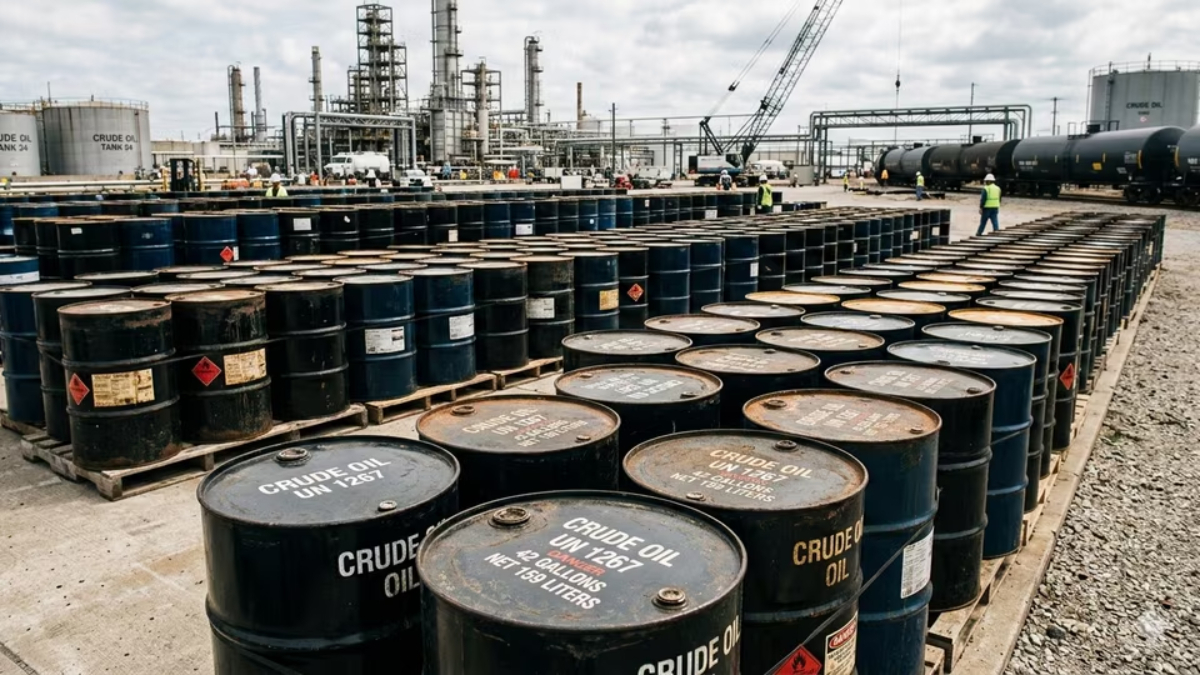
New Delhi, April 20, 2026 — Global energy markets were jolted into action early Monday morning as oil prices spiked, reacting sharply to a weekend of escalating military friction in the Strait of Hormuz. The sudden surge in crude prices follows President Donald Trump’s announcement on Sunday that the United States Navy had attacked and forcibly seized an Iranian-flagged cargo ship, the Touska, which allegedly attempted to bypass an ongoing U.S. naval blockade.
The market reaction was swift. Within an hour of trading resuming on the Chicago Mercantile Exchange, U.S. crude oil surged 6.4%, reaching $87.90 per barrel. Brent crude, the international benchmark, saw a similar climb, jumping 5.8% to $95.64 per barrel. This spike effectively reversed a brief downward trend from late last week, when markets had briefly reacted with optimism to reports of potential openings in the vital waterway.
A Flashpoint in the Strait
The seizure of the Touska marks the latest, and perhaps most volatile, development in a deepening US-Iran conflict that has now entered its eighth week. The Strait of Hormuz, a narrow but critical choke point for global energy transit, has become the primary theater of this confrontation.
According to official statements from the U.S. Central Command, the guided-missile destroyer USS Spruance intercepted the Touska in the Gulf of Oman after it ignored repeated warnings to stop. Following a six-hour standoff, the Spruance fired several rounds from its 5-inch Mark 45 gun into the vessel’s engine room, disabling its propulsion system. US Marines subsequently boarded and took control of the ship, which is now in American custody.
President Trump confirmed the incident via social media, framing it as a necessary enforcement of the U.S. blockade on Iranian ports—a blockade that remains a core element of the current administration’s strategy in the ongoing conflict. Tehran’s joint military command has vowed a “swift response” to what it labels an illegal act of aggression, further casting doubt on the stability of the region’s maritime corridors.
Market Volatility and the “Choke Point” Fear
The financial impact of this incident highlights the extreme sensitivity of global energy markets to geopolitical instability in the Middle East. Before the current crisis erupted in late February, the Strait of Hormuz was the conduit for approximately 20% of the world’s seaborne oil and liquefied natural gas (LNG).
The blockade, combined with the ongoing hostilities, has forced major disruptions in energy distribution. Industry analysts warn that as long as the waterway remains contested or closed, the physical supply chain—rather than abstract market benchmarks—will drive pricing.
“As long as Hormuz flows remain constrained, the physical market will drive pricing,” said Robert Rennie, head of commodity and carbon research at Westpac Banking Corp. “We are seeing real-economy fuel costs likely to remain under sustained upward pressure.”For consumers, this translates to continued pain at the pump. While gasoline prices in the U.S. saw a marginal decline of about 8 cents last week, sitting at an average of $4.05 per gallon according to AAA, this latest rally is expected to stall or reverse those modest gains. Energy Secretary Chris Wright, appearing on CNN’s State of the Union on Sunday, acknowledged the difficulty, noting that while officials believe prices have peaked, a return to pre-war averages—below $3.00 per gallon—may not be realistic until next year.
Also Read: 2009 Brazilian Telenovela’s Rendition of ‘Kajra Re’ Becomes a Digital Sensation
Economic Ripple Effects
The escalation comes at a precarious time for the global economy, which is already grappling with inflationary pressures exacerbated by the energy crisis. The Touska incident has reignited fears of stagflation—a combination of stagnant economic growth and high inflation—particularly in energy-dependent economies in Europe and Asia.
In March, the conflict’s intensity had already pushed Brent crude above $100 per barrel for the first time in several years, triggering a broad sell-off in global equity markets. Investors, who had begun to rotate capital into non-US equities earlier in the year, found themselves retreating in the face of a renewed “safe-haven” scramble, though gold, often a beneficiary of such instability, saw mixed performance as inflation concerns dominated trading desks
Furthermore, the physical damage to infrastructure during the wider conflict, including attacks on energy facilities in the region, continues to hamper production volumes. Even in a scenario where a lasting ceasefire is achieved, experts warn that the resumption of normal shipping and production levels could take months, if not longer. Tanker traffic remains severely backed up, and shipowners, wary of sudden escalations and unpredictable blockades, are increasingly hesitant to transit the region.
The Diplomatic Impasse
The timing of this incident is particularly sensitive as a fragile two-week ceasefire between the United States and Iran is set to expire this Wednesday. Hopes for a diplomatic breakthrough had been buoyed last week by reports that Iran might fully reopen the Strait of Hormuz to commercial traffic. However, those hopes were dashed on Saturday when Tehran reversed that decision, citing the U.S. blockade as a violation of the ceasefire terms.
The seizure of the Touska further complicates the diplomatic landscape. With the U.S. maintaining that the vessel was in breach of the blockade and Iran vowing retaliation, the path toward a renewed negotiation process looks increasingly narrow.
As energy traders watch the headlines from the Gulf of Oman, the consensus among analysts is that the market will remain in a state of “headline sensitivity.” Every statement from either Washington or Tehran is being parsed for clues on whether the blockade will tighten or if further naval engagements are imminent. For now, the energy sector remains on high alert, with prices likely to continue their turbulent path as the global community waits to see if the conflict will de-escalate or spiral further into a wider regional crisis.