

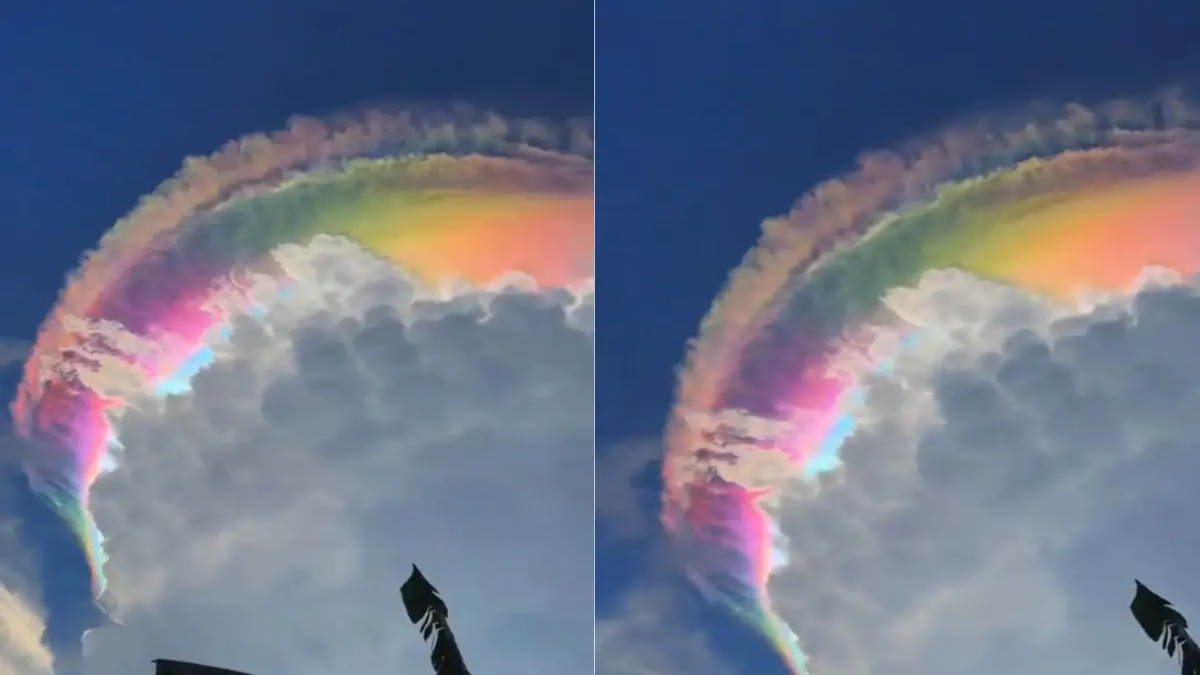
New Delhi, May 8, 2026 — In an era where artificial intelligence can generate hyper-realistic landscapes with a few keystrokes, the world has become a skeptical audience. So, when videos began circulating this week of a sky drenched in shimmering neon pastels over West Java, the collective internet response was a mix of awe and disbelief.
“Is this real life, or is this just AI?” one TikTok user commented on a video that has now surpassed 46 million views.
The footage, captured primarily in the regions of Bogor and Bekasi, shows massive, billowing clouds crowned with a “cap” of iridescent colors—vibrant pinks, electric greens, and deep violets that look more like a Mario Kart track than a typical sunset. But according to atmospheric scientists and Indonesia’s meteorological agency, this isn’t a digital fabrication. It is a rare, breathtaking natural phenomenon known as Cloud Iridescence, often accompanied by a Pileus cloud.
The Moment the Sky Stopped Traffic
On May 1, 2026, the quiet streets of Jonggol, West Java, came to a standstill. Motorists pulled over to the side of the road, and residents spilled out of their homes, mobile phones aimed upward.
One witness, 21-year-old Ahmad Baehaqy Pratama, was traveling along Jalan Jeprah when he saw the sky begin to “bleed” color. “It hadn’t rained yet, but on the right side, it looked like there was a rainbow inside the cloud,” he told local reporters.
As the videos hit platforms like TikTok, X (formerly Twitter), and Instagram, they quickly spiraled into a global sensation. The most popular clips show a towering cumulus cloud—the kind that usually signals a thunderstorm—topped with a thin, gauzy veil that shimmers with the intensity of an oil slick on water.
“Too Perfect to be Real”: The AI Skepticism
The viral nature of the Indonesia rainbow cloud highlights a growing modern dilemma: our increasing inability to trust our eyes. Because the colors were so saturated and the shapes so geometric, thousands of commenters claimed the footage was “obviously CGI.”
“We’ve reached a point where nature has to prove it’s not a filter,” says digital media analyst Sarah Chen. “Because we see so much fake content, when the Earth actually does something spectacular, our first instinct is to look for the glitch.”
However, meteorologists from Indonesia’s Meteorology, Climatology, and Geophysics Agency (BMKG) were quick to verify the event. Ida Pramuwardani, Acting Director of Public Meteorology at BMKG, confirmed that the phenomenon is a natural occurrence related to atmospheric optics.
The Science: How Nature Creates a “Rainbow Cap”
So, how does a cloud turn into a prism? The answer lies in a specific combination of physics and timing.
1. The Pileus Cloud (The “Haircut”)
The phenomenon often involves what scientists call a pileus cloud (Latin for “cap”). This is a smooth, thin cloud that forms on top of a rapidly growing cumulus cloud. As the moist air from the lower cloud is pushed upward by a strong current, it cools and condenses into a cap. Because these clouds form so quickly, they are made of tiny, uniform water droplets—the perfect canvas for light.
2. Diffraction vs. Refraction
While a standard rainbow is caused by refraction (light bending as it enters a raindrop), cloud iridescence is caused by diffraction. When sunlight hits these tiny, uniform water droplets or ice crystals at just the right angle (usually within 10 to 40 degrees of the sun), the light waves are scattered and spread out.
Because the droplets in a pileus cloud are all roughly the same size, they scatter the light in a consistent way, creating the vivid, organized bands of color seen in the Indonesian videos.
3. The “Thinness” Factor
For the colors to be this bright, the cloud must be very thin. If the cloud were thicker, the light would be scattered too many times, and the colors would wash out into white. The Indonesian sighting was a “perfect storm” of conditions: a rapidly rising cloud, a thin moisture cap, and the sun positioned at the exact angle to ignite the colors.
A Sign of a Storm?
While the clouds looked “otherworldly,” BMKG officials assured the public that they were not a sign of a natural disaster. Instead, they indicate high humidity and strong upward air currents.
“This phenomenon is not a direct sign of an impending storm,” Pramuwardani explained. “It simply indicates the growth of convective clouds. It might rain locally, but it’s a standard atmospheric process, even if the result looks like a miracle.”
Nature’s Viral Marketing
This isn’t the first time rainbow clouds have gone viral—similar sightings have been reported in China, Thailand, and South America—but the Indonesian event has struck a chord because of its sheer vibrance.
For many, the “rainbow road” in the sky provided a moment of collective wonder. In a world often dominated by heavy news, the sight of a neon-colored sky served as a reminder of the Earth’s capacity to surprise us.
As one social media user put it: “If this is what the world looks like without filters, maybe we should look up more often.”