

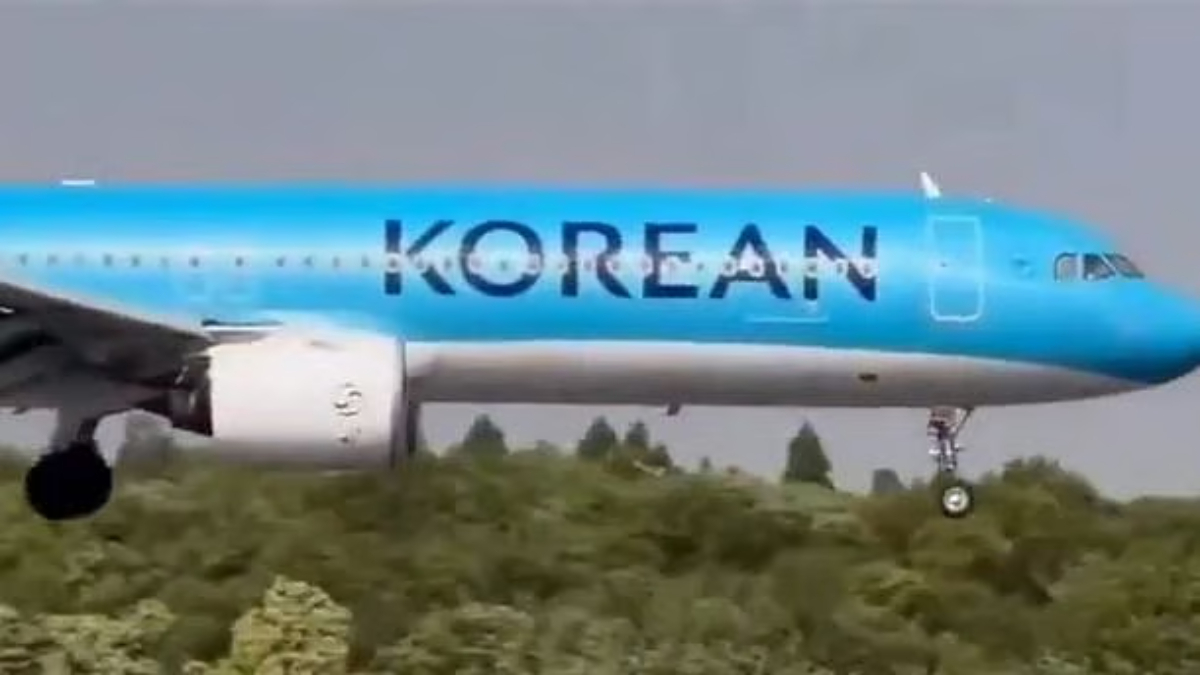
New Delhi, May 12, 2026 – Passengers aboard a Korean Air flight experienced a heart-stopping moment this week as their aircraft was filmed swaying violently and “wobbling” just meters above the runway at Tokyo’s Narita International Airport. The dramatic scene, captured by aviation enthusiasts and now a viral sensation on social media, shows the immense power of nature and the split-second decision-making required by modern pilots.
The incident occurred during a period of severe weather in the Kanto region of Japan, where powerful crosswinds and “wind shear” have made operations at one of the world’s busiest airports exceptionally challenging.
A Near-Miss Captured on Camera
The footage, which has garnered millions of views across platforms like X (formerly Twitter) and YouTube, begins with the Korean Air aircraft—identified as a Boeing 777—on its final approach. As it descends toward the tarmac, the plane is visibly buffeted by invisible gusts.
Spectators watching from the airport’s perimeter can be heard gasping as the massive jet begins to tilt sharply from side to side. At one point, the left wing dips precariously low, and the aircraft appears to “crab” or drift sideways, misaligned with the runway’s centerline. Just as the wheels appear ready to touch the ground, the engines roar to life. The pilot, recognizing that a safe landing is no longer guaranteed, executes a “go-around,” pulling the nose up and climbing steeply back into the safety of the clouds.
Understanding the “Go-Around”
While the video may look like a near-disaster to the untrained eye, aviation experts are praising the flight crew for their professionalism.
“What you are seeing in that video is a perfectly executed go-around,” said Captain Sarah Miller, a retired commercial pilot and flight safety consultant. “A go-around is not an emergency; it is a standard safety maneuver. When a pilot feels the approach is ‘unstable’—meaning the speed, drift, or altitude isn’t exactly right—they abort and try again. It’s the safest thing they can do.”
In this instance, the “wobble” was caused by crosswinds—winds blowing perpendicular to the runway. When these gusts are strong enough, they can push a plane off-course or cause the wings to rock. The pilots must use the rudder and ailerons to keep the plane straight, a technique known as “sideslipping” or “crabbing.” However, if the wind becomes too unpredictable or exceeds the aircraft’s safety limits, the landing must be aborted.
Impact on Passengers
For the passengers inside the cabin, the experience was undoubtedly more harrowing than it appeared from the ground. Reports from social media suggest that the turbulence during the descent was “extreme,” with many travelers gripped by fear as the plane tilted.
“It felt like a roller coaster,” one passenger reportedly shared on a travel forum. “We could see the ground getting very close, and then suddenly we were pushed sideways. Then the engines got very loud, and we were heading back up into the sky. There was a lot of silence in the cabin until the pilot explained what happened.”
After climbing back to a safe altitude, the aircraft entered a holding pattern for approximately 20 minutes. This allowed the crew to reassess the weather conditions and wait for a “window” of calmer air. The flight eventually landed safely on its second attempt, much to the relief of everyone on board.
Weather Woes at Narita
Narita International Airport is notorious among pilots for its difficult wind conditions, particularly during the spring and autumn months. The airport’s geographical location makes it a funnel for strong winds coming off the Pacific Ocean.
On the day of the Korean Air incident, several other flights were reportedly forced to perform go-arounds or divert to other airports like Haneda or Nagoya. Japanese meteorological authorities had issued warnings for wind shear—a sudden change in wind speed or direction—which can be particularly dangerous during takeoff and landing.
The Viral Ripple Effect
The video has sparked a wider conversation online about flight safety. Many commenters expressed awe at the skill of the pilots. “I would have been terrified, but watching how they controlled that beast of a plane is incredible,” one user wrote. Others noted the importance of trusting the crew’s training.
Korean Air has a long history of rigorous pilot training, and this incident serves as a testament to those standards. In a brief statement, the airline confirmed that the flight encountered “unstable weather conditions” and that the crew followed all standard operating procedures to ensure the safety of the passengers and aircraft.
Safety First in the Skies
While dramatic videos of “wobbling” planes often go viral, they serve as a reminder of the sophisticated safety systems in place in modern aviation. Between advanced weather radar, ground-based wind shear detection systems, and thousands of hours of pilot training in high-tech simulators, flying remains the safest form of long-distance travel.
As for the passengers on that Korean Air flight, they walked away with a story they will likely be telling for years—and perhaps a newfound respect for the men and women in the cockpit who navigate the invisible currents of the sky.