

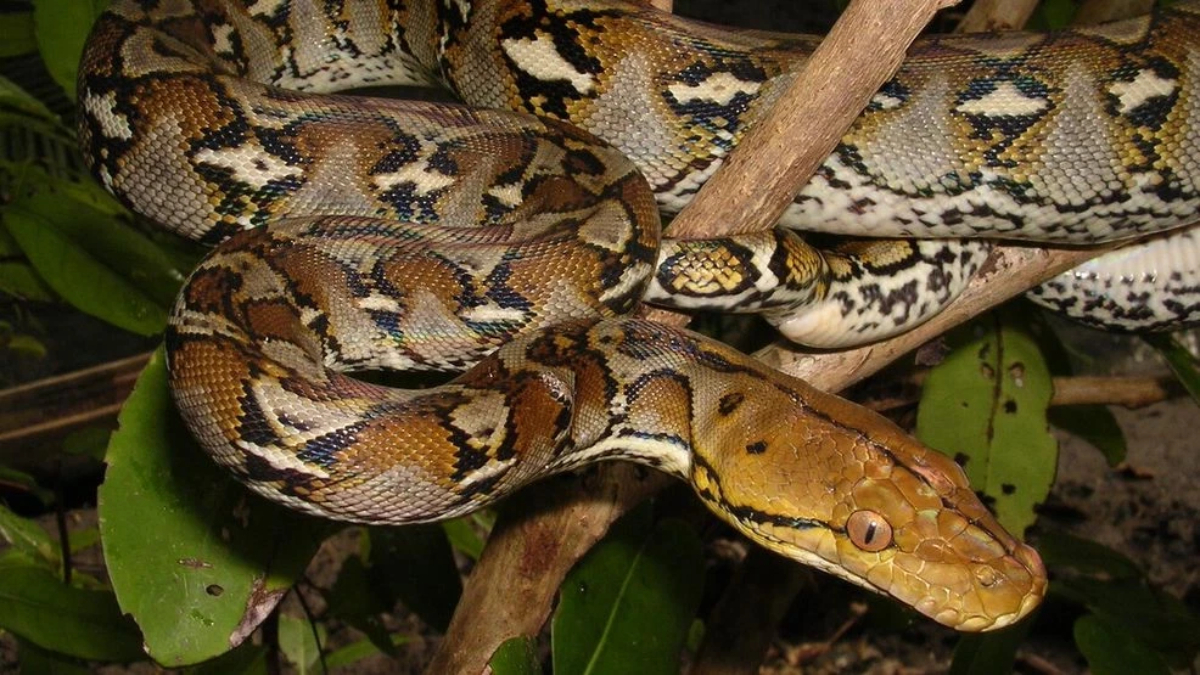
New Delhi, May 12, 2026: In the dense, limestone-rich forests of South Sulawesi, Indonesia, a living legend has emerged from the shadows. Known to locals as “Ibu Baron”—translated as The Baroness—this female reticulated python has officially been crowned the world’s longest wild snake ever verifiably measured.
At a staggering 23 feet and 8 inches (7.22 meters), her discovery in late 2025 and subsequent verification in early 2026 has sent shockwaves through the scientific community. More than just a record-breaker, the Baroness has become a powerful symbol of the delicate balance between Southeast Asia’s extraordinary biodiversity and the encroaching footprint of human civilization.
The Measurement: A Giant in the Flesh
Measuring a snake of this magnitude is no simple feat. In January 2026, a team led by wildlife photographer Radu Frentiu, rescuer Diaz Nugraha, and local conservationist Budi Purwanto set out to document the giant.
Unlike snakes in captivity, which are often sedated for medical checks, the Baroness was measured while fully awake and alert. To ensure accuracy for Guinness World Records, the team used a non-stretch surveyor’s tape, carefully following the natural curves of her spine from the tip of her snout to the end of her tail.
Key Statistics of the Baroness:
- Length: 23 feet 8 inches (7.22 meters).
- Weight: 213 pounds (96.5 kg)—roughly the weight of a mature giant panda.
- Status: Measured on an empty stomach; experts believe she could weigh significantly more after a meal.
- Potential: Scientists note that if she were sedated—allowing her muscles to fully relax—she could potentially measure 10% to 15% longer, possibly reaching over 26 feet.
“I had never seen a snake this big,” Frentiu remarked after the weigh-in. “This is a creature that could easily swallow a calf, or even an adult cow. Every coil is a powerhouse of pure muscle.”
Why She Matters: A Rare Survivor
The discovery of the Baroness is extraordinary because giant snakes rarely survive long enough to be measured by scientists. In Indonesia, reticulated pythons (Malayopython reticulatus) are often killed on sight due to the perceived threat they pose to livestock and villagers. Additionally, they are frequently targeted by the illegal wildlife trade or hunted for their skin and meat.
The Baroness’s survival into adulthood—and to such a gargantuan size—is a testament to the remote, rugged terrain of the Maros region where she was found. However, her discovery has also highlighted a grim reality: the wild spaces where these “megafauna” live are shrinking rapidly.
The Conservation Crisis: Habitat vs. Hunger
While the world marvels at her size, scientists are deeply concerned about what her appearance says about the environment. The primary reason giant snakes like the Baroness are being “discovered” more frequently is habitat loss.
- Deforestation: As forests are cleared for palm oil plantations and housing, the natural corridors pythons use are destroyed.
- Prey Depletion: Wild pigs and deer—the primary food sources for large pythons—are declining due to overhunting and habitat fragmentation.
- Human Conflict: When natural prey disappears, pythons are drawn toward human settlements in search of easy meals, like goats, dogs, or cattle. This “commuter” lifestyle inevitably leads to fatal encounters for the snakes.
“A python this big will naturally be drawn toward a village if the forest can no longer feed her,” explains Frentiu. “And once she is spotted near a home, the outcome is almost always tragic for the snake.”
A New Home: Protection Over Profit
When news of the Baroness first broke, there were immediate fears she would be sold into the exotic pet trade or killed for her skin. Recognizing the bird-of-prey rarity of such a specimen, local conservationist Budi Purwanto stepped in.
Purwanto purchased the snake from the locals who found her and relocated her to a private, secure shelter on his property. While the ideal scenario would be a “catch and release” back into the wild, experts remain cautious. Releasing a 23-foot predator near expanding human settlements is a recipe for disaster.
For now, the Baroness lives in a controlled environment alongside other rescued pythons. This move has sparked a debate among conservationists: Is a life in a shelter better than a life of high-risk freedom?
For Purwanto, the answer is clear. “By keeping her safe and visible, we can educate the public. We want people to see her not as a monster or ‘vermin,’ but as a national treasure—a symbol of the incredible wildness that still exists in Indonesia.”
The Future of the Giant
The Baroness has shattered a record that stood since 1999, when a 22-foot 10-inch python was measured in Borneo. Her existence proves that the “giants” of the jungle are not just myths from the past; they are still out there, hidden in the remaining pockets of Southeast Asian rainforest.
However, her legacy will likely be defined by more than just her length. She is a “living benchmark” for researchers studying how large reptiles adapt to a changing world. Her story serves as a cooling reminder that if we want to live in a world where such wonders exist, we must preserve the wild spaces they call home.
As the Baroness settles into her role as an ambassador for her species, she remains a stunning reminder of nature’s power—and its vulnerability. In the words of the team that found her: “There are still wonders out there. This is one of them—and we must ensure it isn’t the last.”