

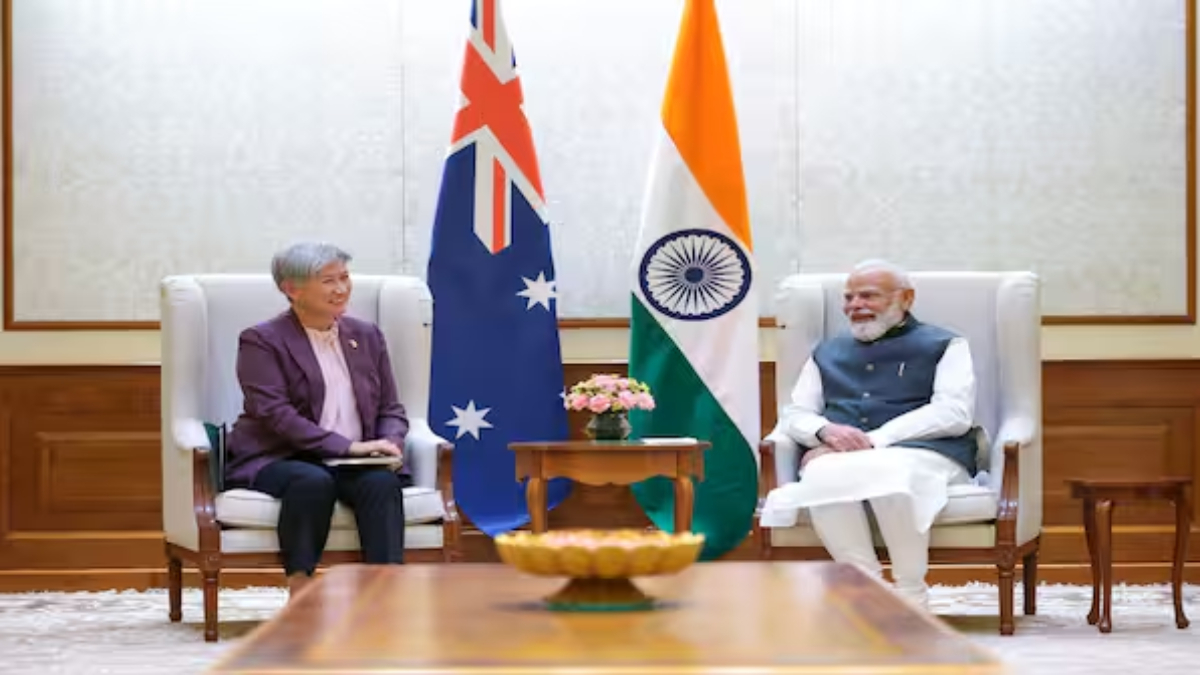
New Delhi, May 27, 2026 — In a major diplomatic move aimed at strengthening regional security and economic cooperation, the Prime Minister of India, Narendra Modi, met with the Minister for Foreign Affairs of Japan, Toshimitsu Motegi. The high-level meeting took place at the Seva Teerth in New Delhi, serving as a cornerstone for bilateral diplomacy during a heavily packed week of international summits in the capital.
The meeting comes at a time of shifting geopolitical dynamics across Asia and West Asia. Both leaders used the opportunity to reaffirm the “vital role” of the India-Japan Special Strategic and Global Partnership. Following the half-hour courtesy call, PM Modi emphasized that the relationship between the two democratic powerhouses remains central to ensuring peace, stability, and prosperity across the Indo-Pacific region and beyond.
Expanding the Vision for a Free and Open Indo-Pacific
A primary focus of the discussions was a comprehensive review of the “Japan-India Joint Vision for the Next 10 Years.” This blueprint, which was originally laid out during PM Modi’s official visit to Japan last year, serves as a road map for deep collaboration across multiple critical sectors. Security, the digital economy, infrastructure investment, and technological innovation topped the agenda.
Central to this vision is the shared commitment to a Free and Open Indo-Pacific (FOIP). As maritime trade routes face increasing pressure from shifting political alignments and regional posturing, India and Japan have increasingly found common ground. Both nations view their partnership not just as a standard bilateral agreement, but as a stabilizing force for the entire Asian continent.
During the dialogue, PM Modi and Minister Motegi agreed to accelerate efforts to achieve concrete outcomes under this 10-year framework. This includes working closely to reinforce economic security—ensuring that supply chains for vital goods remain resilient against global disruptions.
The Broader Context: The New Delhi Quad Summit
Minister Motegi’s visit to India was part of a larger diplomatic gathering, as New Delhi hosted the latest Quad Foreign Ministers’ Meeting. The Quadrilateral Security Dialogue—comprising India, Japan, Australia, and the United States—convened to build directly on agreements established during their previous meeting in Washington, D.C.
The broader Quad discussions wrapped up with substantial progress on several key initiatives, which naturally flowed into the bilateral talks between Japan and India:
- Maritime Surveillance: The ministers welcomed the operationalization of India’s Indian Ocean Region program under the Quad Indo-Pacific Partnership for Maritime Domain Awareness (IPMDA). Operating out of the Information Fusion Centre in Gurugram, this program helps countries across the region track shipping data to prevent illegal fishing and improve maritime security.
- Critical Minerals & Energy: The four nations unveiled new frameworks to secure stable supplies of critical minerals and energy, reducing dependency on single-source supply chains. The Hindu
- Global Commerce Protection: Amid ongoing tensions in West Asia, the ministers issued a joint statement pushing for strict adherence to international law, specifically the United Nations Convention on the Law of the Sea (UNCLOS), to protect trade moving through crucial choke points like the Strait of Hormuz and the Red Sea. The Hindu
Strengthening Defense and People-to-People Ties
Beyond the Prime Minister’s meeting, Minister Motegi held extensive, specialized talks with India’s External Affairs Minister, Dr. S. Jaishankar. A key takeaway from those discussions was the decision to significantly advance bilateral defense and security cooperation. This will be guided by a newly revised bilateral security declaration designed to address modern security challenges, including cybersecurity and next-generation communications standards.
The year 2027 will mark the milestone 75th anniversary of diplomatic relations between India and Japan. Recognizing this historic upcoming event, both governments committed to launching a series of cultural, educational, and professional exchange programs. The goal is to build strong “people-to-people” ties to match the robust political and military agreements currently being signed at the executive level.
By making it easier for students, researchers, and skilled workers to move between the two nations, India and Japan hope to spark deeper collaboration in knowledge-sharing and digital identity technology.
A Shared Path Forward
The meeting between Minister Motegi and PM Modi underlines a growing reality in modern global politics: the relationship between New Delhi and Tokyo has evolved from traditional economic assistance into a deep, proactive strategic alliance.
As India continues its rapid economic expansion and Japan adapts its security posture to a changing world, their aligned interests offer a predictable anchor in an unpredictable global landscape. With clear commitments made toward clean energy, technological standard-setting, and open sea lanes, the India-Japan partnership looks set to play a defining role in shaping the geopolitical architecture of the Indo-Pacific for decades to come.