

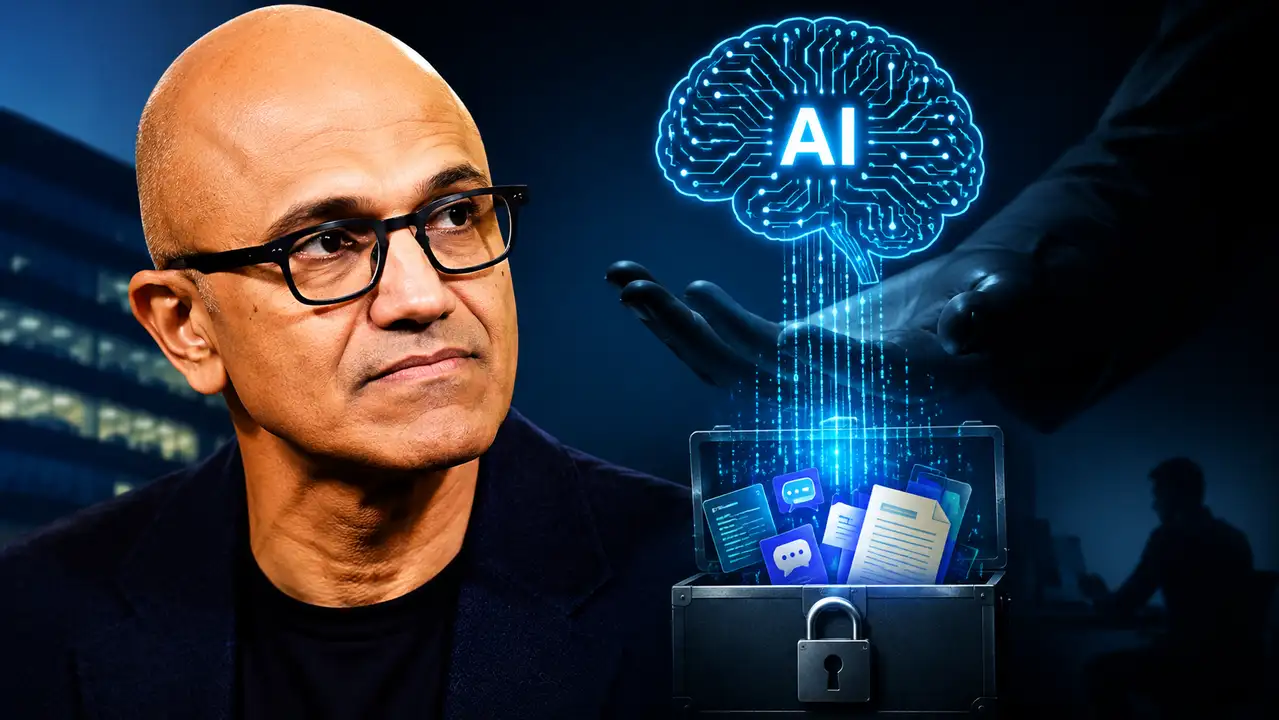
New Delhi, July 13, 2026: In a major shift in how tech leaders view artificial intelligence, Microsoft Chairman and CEO Satya Nadella has issued a sweeping warning about the hidden economic risks facing modern businesses. In an essay titled “The Reverse Information Paradox” published on X, Nadella argued that the rapid adoption of artificial intelligence has flipped a decades-old economic theory entirely on its head, forcing corporate buyers into a dangerous dilemma where they risk unknowingly trading away their most valuable intellectual assets.
According to Nadella, businesses adopting AI are caught in a transactional imbalance. Companies are essentially forced to pay for intelligence twice—once with financial capital to license the models, and a second time with something far more irreplaceable: the proprietary, institutional knowledge required to make those AI models useful in the first place.
Flipping a Nobel Prize-Winning Economic Theory
To explain this phenomenon, Nadella drew directly from the work of Nobel Prize-winning economist Kenneth Arrow. In 1962, Arrow coined the Information Paradox, which detailed a classic hurdle for anyone trying to sell information or proprietary data. Arrow pointed out that a seller risks giving away their knowledge for free just to prove its worth to a prospective buyer, because a buyer cannot truly know the value of information until they have already seen it.
Nadella argues that the AI era has completely reversed this dynamic. Today, the risk has shifted entirely from the seller to the buyer.
When an enterprise purchases access to a raw artificial intelligence model, that model is essentially a blank slate regarding the specific inner workings of that business. To make it perform effectively—whether that means drafting legal contracts, optimizing a supply chain, or managing customer service—the human employees must feed the system deeply specific prompts, historical context, and ongoing feedback. In doing so, the corporate buyer inadvertently transfers its specialized operational wisdom directly back to the infrastructure provider.
The Rise of ‘Intelligence Exhaust’
The core threat to businesses isn’t a traditional, malicious data breach. Instead, Nadella focused on a quieter, more continuous leakage of competitive advantage that he labels “intelligence exhaust.“
When employees interact with an AI application, they do not just consume data; they generate a digital trail of intellectual workflows. Every highly specific prompt, every subtle evaluation of an AI’s output, every manual correction made to a flawed draft, and every trace of a digital autonomous agent’s activity represents accumulated, specialized know-how. This institutional memory is the exact kind of “secret sauce” that a competitor could never buy on the open market.
Over months and years of constant interaction, the information asymmetry between the AI vendor and the business buyer becomes heavily lopsided. The AI provider’s core models learn continuously from how the buyer works, absorbing the buyer’s unique industry expertise trace by trace. Meanwhile, the enterprise buyer learns almost nothing about what the underlying model is extracting in return. If this one-way flow of learning continues unchecked, Nadella warned, corporate economic value will steadily drain away from individual knowledge-creating businesses and converge almost entirely toward the elite few who own the global AI infrastructure.
Moving Beyond Simple Data Protection
This reality means businesses have to fundamentally change what they mean by “security.” During the dawn of cloud computing, corporate security teams focused strictly on protecting data privacy and preventing unauthorized access to raw files.
In the AI era, however, safeguarding static data is no longer enough. The primary corporate asset requiring protection is learning. Companies must learn to isolate and protect the collective memory, feedback loops, adapted model weights, and behavioral patterns that emerge organically as their workforce co-evolves alongside AI tools.
To bridge this security gap, Nadella emphasized that enterprises must establish a firm, unyielding “trust boundary.” No prompt, interaction trace, or piece of institutional knowledge should ever cross outside of an organization’s private digital walls without explicit, controlled consent. Furthermore, he noted that businesses should aggressively defend their right to use their own AI-generated outputs to train and fine-tune their own local, proprietary systems, keeping the intellectual compounding interest entirely inside the company.
The 5-Point Playbook for Enterprise AI Control
To help businesses navigate the reverse information paradox, Nadella outlined five architectural principles that modern enterprises must prioritize when building out their corporate AI strategy.
A New Era of Technical Independence
Nadella’s public warning marks an interesting philosophical moment for the tech sector. While Microsoft remains one of the largest financial backers of closed-model pioneers like OpenAI, Nadella’s commentary directly echoes a sentiment growing rapidly across the corporate tech landscape. He even pointedly cited Palantir CEO Alex Karp, noting that highly technical enterprise customers increasingly demand absolute, uncompromised control over their compute, data stacks, model weights, and competitive “alpha.”
Ultimately, the competitive landscape of the AI age will not just be won by the organizations that deploy artificial intelligence the fastest. Instead, it will be dominated by the companies that figure out how to successfully supercharge their productivity using advanced models, without accidentally giving away the unique institutional knowledge that makes them valuable in the first place. As open-weight and highly capable localized models become increasingly available to modern enterprises, the push toward closed-loop, completely sovereign AI ecosystems is transforming from a minor security preference into an absolute business necessity.