

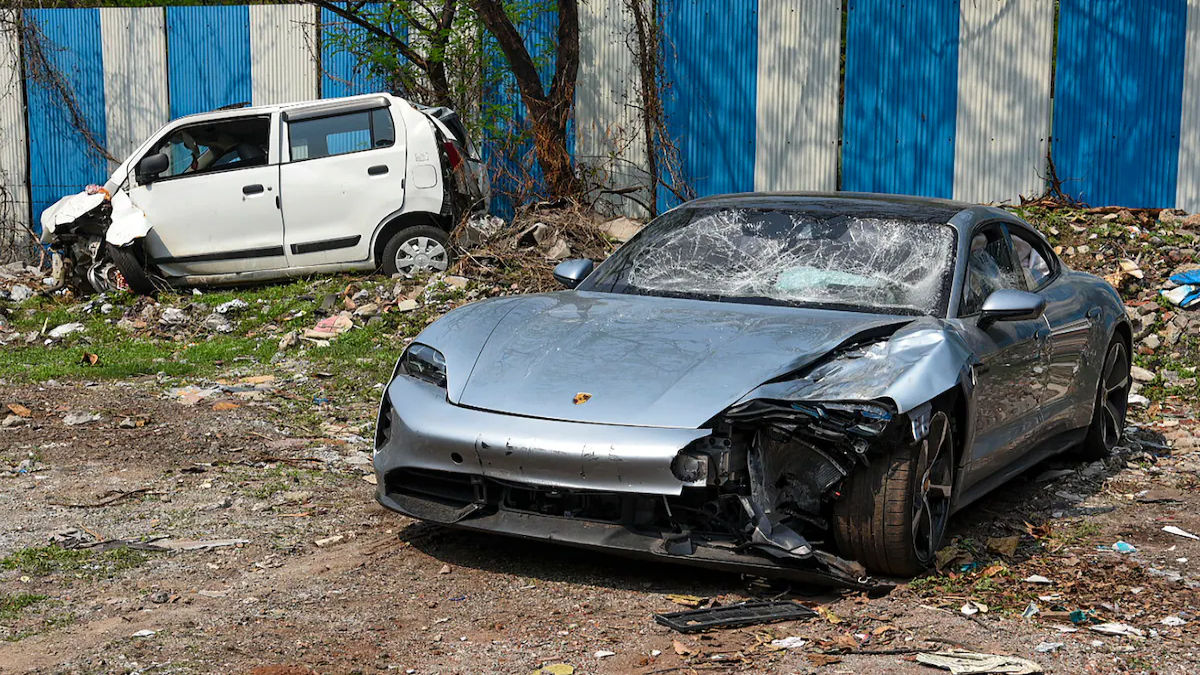
New Delhi, May 27, 2026 — A wave of public anger has erupted once again across India regarding the infamous 2024 Pune Porsche car crash case. The fresh outrage follows a controversial video that has surfaced on social media, showing prominent real estate developer Vishal Agarwal—the father of the minor accused—aggressively celebrating his release on bail with a lavish party surrounded by his family.
The viral video, which began circulating heavily on May 27, 2026, features Agarwal and his wife dancing to the upbeat rhythms of the classic Bollywood track “Mumbai Se Aaya Mera Dost.” Strikingly, both are seen wearing massive, heavy garlands crafted entirely from high-denomination currency notes. At one point in the video, his son is also seen lifting him up into the air in celebration as live music plays in the background at what appears to be a local restaurant. Netizens have fiercely criticized the footage, labeling it an insensitive and arrogant display of wealth that mocks the memory of the victims.
The Legal Subversion That Shocked a Nation
To understand the intense backlash surrounding this celebration, one must look back at the horrifying events of May 19, 2024. In the early hours of that Sunday morning, Agarwal’s 17-year-old son was driving a luxury, unregistered electric Porsche Taycan Turbo S at a blistering speed through Pune’s upscale Kalyani Nagar area. The teenager, who was heavily under the influence of alcohol after partying at local clubs, rammed the vehicle into a motorcycle. The violent impact instantly killed two young IT professionals: Anish Awadhiya and Ashwini Costa.
The case immediately sparked nationwide anger when the Juvenile Justice Board (JJB) granted the teenager bail within hours of the crash under highly lenient conditions—including a directive to write a 300-word essay on road safety.
However, the real scandal emerged in the days that followed. Investigations revealed a massive, multi-layered conspiracy orchestrated by the teen’s family to subvert the justice system. Vishal Agarwal and his wife were accused of colluding with medical staff at a local hospital to swap their underage son’s blood samples with the mother’s to ensure a “Nil Alcohol” report. Furthermore, the police alleged that the family had kidnapped and pressured their household driver, trying to coerce him into taking the blame for the fatal crash.
A 22-Month Battle Leading to the Supreme Court Bail
Following the exposure of the cover-up, public pressure forced a severe crackdown. The minor was moved to an observation home, and his parents, along with several co-accused—including doctors who allegedly accepted bribes to alter medical evidence—were arrested and lodged in jail.
After their bail pleas were repeatedly rejected by the Bombay High Court, the legal battle eventually reached the apex court. On March 10, 2026, a Supreme Court bench comprising Justices B. V. Nagarathna and Ujjal Bhuyan finally granted bail to Vishal Agarwal.
The Supreme Court noted that while the allegations of swapping blood samples reflected a deeply troubling mindset in Indian society where people attempt to “get the better of the law,” it could not be used as a ground to curtail personal liberty indefinitely before a trial conclusion. Pointing out that Agarwal had already spent nearly 22 months in custody, the court granted him relief under strict terms, explicitly warning him not to make any direct or indirect attempt to contact witnesses.
“They Are Mocking Common Citizens”: Victims’ Families Express Anguish
While the Supreme Court ruled that bail could not be denied merely to “send a message to society,” the sudden emergence of the celebration video has reopened unhealed wounds for the grieving families of the victims.
Reacting to the viral footage of the currency-garlanded party, Suresh Koshta, the heartbroken father of Ashwini Costa, spoke out with deep anguish and fury. He alleged that the lavish display proves there is a complete lack of accountability and fear of the law among the wealthy elite.
Koshta strongly criticized the judicial system for letting the accused out on bail, warning that such outcomes only encourage future crimes. He urged the Supreme Court to take a firmer stance to restore public faith in the judiciary, demanding that the bail be revoked immediately and that the parents be sent back to prison.
Social Media Backlash and the Demand for Justice
The timing of the video has created a public relations nightmare for the Agarwal family, reigniting conversations surrounding systemic corruption, the misuse of financial muscle, and VIP culture in India. On platforms like X (formerly Twitter) and Instagram, users have voiced deep disgust, pointing out that while two promising young lives were abruptly cut short, the perpetrators are treating their release from jail as a triumph.
The Pune Porsche case continues to serve as a litmus test for the Indian judicial system. As public outrage intensifies over the viral video, citizens and the families of Anish and Ashwini are holding onto hope that the fast-tracked trial will ultimately bring structural accountability—proving that wealth and influence cannot entirely shield individuals from the consequences of a tragedy.