

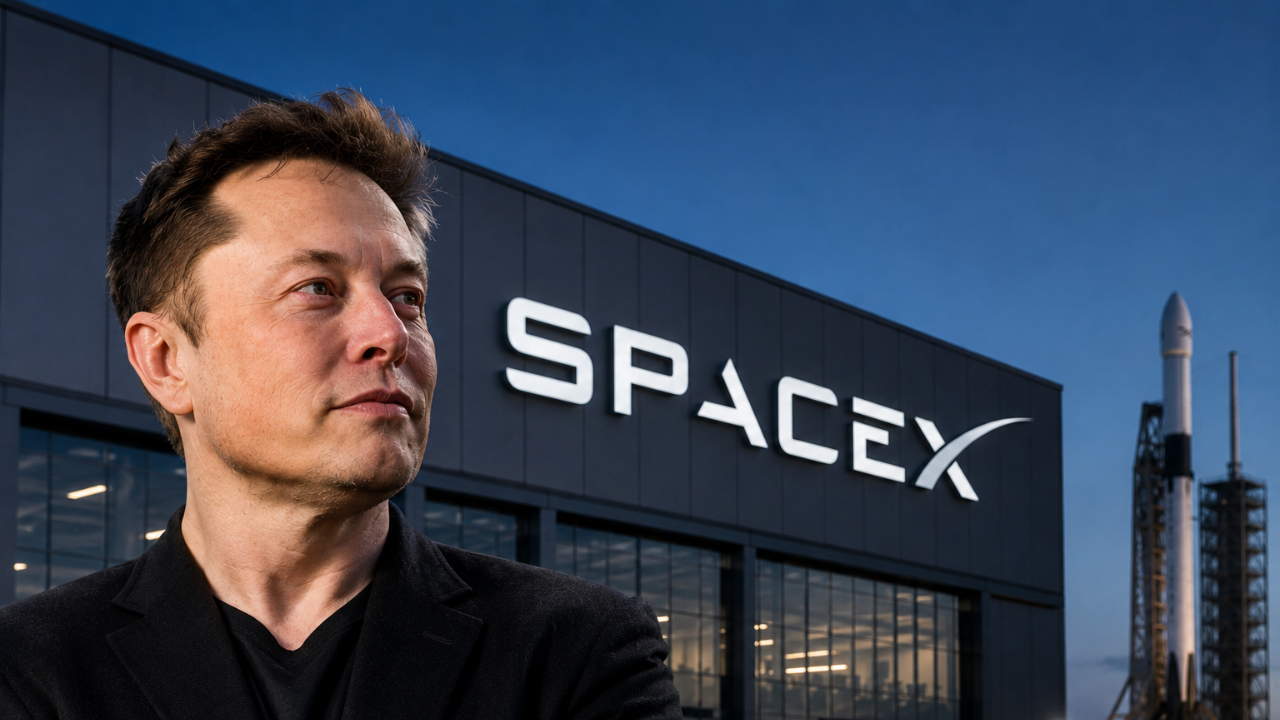
New Delhi, June 12, 2026: The global financial landscape changed forever on Friday, June 12, 2026, as Elon Musk officially became the world’s first trillionaire. This unprecedented milestone was triggered by the highly anticipated, record-shattering initial public offering (IPO) of his aerospace giant, SpaceX. As trading opened on the Nasdaq exchange, investor frenzy pushed the rocket, satellite, and artificial intelligence company to a breathtaking valuation of $1.77 trillion. This single event instantly catapulted Musk’s personal fortune beyond the thirteen-digit mark, crossing an estimated $1.1 trillion and rewriting the history of modern wealth.
The Record-Breaking Flotation
The SpaceX IPO has completely redrawn the Wall Street playbook, easily becoming the largest stock market debut in history. The company raised a staggering $75 billion by offering 555.56 million shares priced at $135 each. To put that into perspective, the previous global IPO record was held by Saudi Aramco, which raised $25.6 billion when it floated in 2019. Demand for a piece of Musk’s space empire was overwhelming, with the offering being oversubscribed by three to four times, pulling in more than $250 billion in total bids from eager investors.
With its new valuation, SpaceX has debuted as the seventh-largest publicly traded company in the United States. Remarkably, it has bypassed established corporate giants like JPMorgan Chase, Meta Platforms, and even Musk’s own electric vehicle pioneer, Tesla.
Rewriting the Wall Street Rules
True to form, Elon Musk did not follow traditional financial conventions to take his company public. In a highly unusual move that caught the market off guard, SpaceX announced its official IPO price while U.S. markets were still actively trading on Thursday, rather than waiting for the closing bell. Furthermore, the final price was locked in before the traditional investment “roadshow”—the standard corporate tour where executives negotiate demand and pricing with big institutional investors.
Perhaps the most significant departure from Wall Street norms was Musk’s focus on everyday traders. SpaceX reserved an exceptionally large 30% of its total offering specifically for retail investors, allowing individual buyers, wealth family offices, and sovereign wealth funds to claim a massive slice of the pie. Despite the decentralized distribution, Musk remains firmly in the cockpit. Thanks to a dual-class share structure featuring super-voting shares, Musk retains a commanding 82% of SpaceX’s total voting power, ensuring he has absolute control over the company’s future direction.
A Fortune Beyond National Economies
Musk’s jump into trillionaire status places him in a financial league entirely of his own. Before the IPO, he was already leading the global wealth charts with roughly $971 billion. With his 50% stake in SpaceX now valued at over $752 billion on its own, his combined holdings across SpaceX, Tesla, xAI, Neuralink, and X (formerly Twitter) have comfortably pushed his net worth past $1.1 trillion.
To understand the sheer scale of this wealth, consider how it stacks up against the rest of the world:
- The Billionaire Gap: Musk is now more than three times richer than his closest wealth rival, Alphabet co-founder Larry Page, whose net worth hovers around $304 billion.
- The GDP Comparison: Musk’s personal net worth is now larger than the entire annual Gross Domestic Product (GDP) of Taiwan, a global powerhouse for semiconductor and AI chip manufacturing, which sits at $976.7 billion.
- The Spending Paradox: According to an analysis by humanitarian group Oxfam America, if Musk were to spend $1 million every single day, it would take him approximately 2,740 years to exhaust a $1 trillion fortune.
The “Elon Premium” vs. The Fundamental Disconnect
While the market’s enthusiasm is undeniable, the eye-watering valuation has sparked intense debate among financial analysts. The core of the skepticism lies in SpaceX’s current financial fundamentals. The company is not yet consistently profitable, having recorded a net loss of $4.9 billion in 2025 and an additional $4.28 billion loss in the first quarter of 2026.
Skeptics argue that pricing the stock at $135 per share values the company at a staggering 92 times its trailing sales. Financial research firm Morningstar issued a warning to investors, calculating the underlying fair value of the business at just $63 per share. Analysts at the firm warned of a “major disconnect” between market hype and real fundamentals, calling the valuation highly speculative given the unproven nature of space-based AI applications and deep-space infrastructure.
However, institutional buyers are aggressively paying what Wall Street calls the “Elon Premium.” This is the widely held investor belief that Musk’s unmatched track record of disrupting industries—from payments with PayPal to automotive with Tesla—justifies ignoring traditional valuation metrics. Investors are not buying SpaceX for its current balance sheet; they are wagering on a future where the company dominates orbital data centers, controls global satellite internet via its Starlink constellation, and builds the foundational logistics for lunar bases and Mars colonization.
High Stakes and Rising Criticism
As the celebrations settle on Wall Street, the reality of a single individual holding one trillion dollars has ignited heavy political and social pushback. Activists and political figures have raised alarm bells over the extreme concentration of wealth and power. Critics argue that a trillion-dollar fortune is incompatible with a healthy democracy, especially given Musk’s close ties and recent influential advisory roles within the U.S. government.
Humanitarian groups have pointed out that while Musk’s wealth grew at an average rate of over $1 million per minute over the last year, systemic global inequality has widened. Oxfam noted that a simple 10% tax on Musk’s historic fortune could generate enough revenue to eradicate extreme global poverty for an entire year, lifting over 800 million people above the poverty line.
There are also operational risks facing shareholders. Much of the capital raised in this IPO is earmarked for highly experimental, capital-intensive programs. If SpaceX chooses to divert its future revenues away from investor dividends and instead pours hundreds of billions into high-risk projects like building cities on Mars, everyday shareholders may find the company less “shareholder-friendly” than they initially hoped.
Also Read: Shahid Kapoor Changes Script Strategy After Box Office Setbacks
Looking to the Cosmic Horizon
Despite the warnings of overvaluation and the escalating political crossfire, the successful SpaceX float marks a defining moment for the 21st-century global economy. It serves as a massive financial validation for the private space industry and sets the stage for upcoming tech giants, such as OpenAI and Anthropic, who are also eyeing public listings approaching the trillion-dollar mark.
For Elon Musk, the trillionaire label is simply fuel for a much larger fire. With billions of fresh capital secured from the public markets, SpaceX is now fully weaponized to accelerate its Starship development, expand its global Starlink network, and push deeper into the cosmos. Whether this historic IPO represents a dangerous financial bubble or the dawn of a multi-planetary economy, one thing is certain: the era of the trillionaire has arrived.